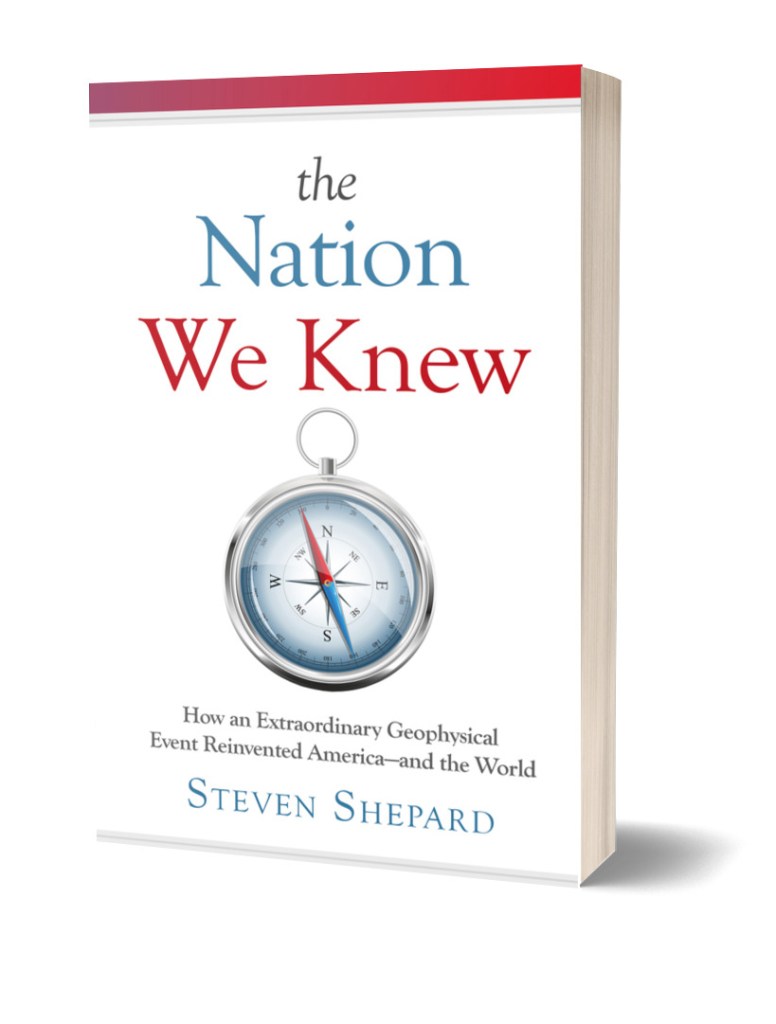
Visit The Nation We Knew on Amazon
Click here to listen to an interview about why I wrote The Nation We Knew
Click here to listen to my audio essay, “The Nation We Knew, One Year Later”
About The Nation We Knew
What would the United States look like—what would it represent—if leadership suddenly put country before party, possibility before dogma, and created a vision of a better future and then executed against that vision? In this thought-provoking book, a new president takes the country to task—and reinvents government, healthcare, job creation, foreign relations, transportation infrastructure, and education, and with the help of her unlikely cabinet, shows the nation—and the world—what could be, rather than what is. That’ the premise of this book, which became an international bestseller when it was released, rising to the top of the global charts in political thrillers on Amazon, where it stayed in the number one position for almost two weeks.
It took thousands of hours of research and more than 40 complete edits to get the book ready to publish, but it was worth the effort. Not only has the book won critical acclaim, but it has attracted the attention of politicians, business leaders, and media people all over the world as an interesting take on leadership and what the world might look like if Washington’s elite were to actually do their jobs the way those jobs were envisioned.
Why I Wrote The Nation We Knew
There’s a well-known Winston Churchill quote that goes like this:
Many forms of Government have been tried, and will be tried, in this world of sin and woe. No one pretends that democracy is perfect, or all-wise. Indeed, it has been said that democracy is the worst form of Government—except for all those other forms that have been tried from time to time.
I was born in the American southwest—Amarillo, Texas, if you care—and I lived all over that part of the country until I was 13, although we did spend some time in southern California and Calgary, Alberta, as well. My Dad was a petroleum geologist; His job, and by extension, my Mom’s, was to follow the oil. So, we moved around constantly. We lived all over the Permian Basin, as well as in Oklahoma and New Mexico. We actually lived in the same house in Midland, Texas, three different times. Those moves were made easier by the fact that the nail holes in the walls for pictures were exactly where my parents had left them the LAST time they lived in that house.
In 1968, when I was 13, we were transferred to Madrid, Spain. For me, that was the 11th move in 13 years. But this time, we weren’t moving to another dry, nameless little town in west Texas, places like Midland, where the two competing high schools were Robert E. Lee and Ulysses S. Grant, or the next town over, Odessa, where the TV show Friday Night Lights took place. Nope: We were moving to Spain, a country I knew nothing about, but whose leader was Generalísimo Francisco Franco and whose government was a dictatorship—a BENEVOLENT dictatorship, to be sure, as long as you didn’t get crosswise with the government. But make no mistake—it was a dictatorship. We learned quickly what NOT to talk about, and to look around to see who was nearby before discussing anything that was government oriented. When my parents held parties, as they did at New Years, for example, where more than ten guests were going to attend, they were required to notify the Civil Guard—Spain’s answer to a domestic militia—and the evening of the party, two of them would show up, in uniform, carrying their machine guns, and just sort of …hang out. I don’t recall that it put a damper on the party, but they were there. My point is, moving from Midland, Texas to Franco’s Spain in the 1960s was different than moving from Midland to Houston. I learned, I became multicultural, and I developed a moral and professional compass that ultimately led me to be a writer, and a speaker, and a teacher.
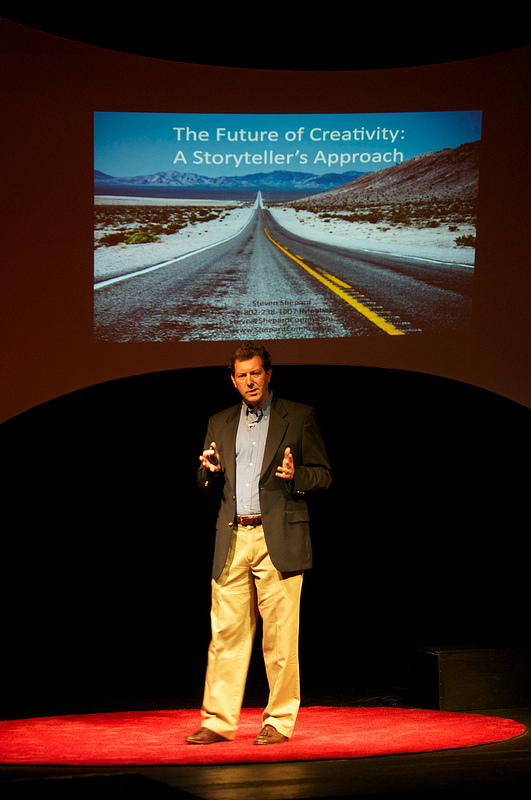
But the international bug had bitten me, and while my career started in the United States, I longed to get back overseas. It wasn’t a dream; it was part of who I was. So, when the time came, in 2000, I left my corporate job, went independent as a consulting analyst (A fancy way of saying that I was a writer, speaker, and teacher), and began to travel. I wrote books; I gave keynotes; I went to so many places that are hard to find on maps of the developing world that my kids were convinced I was a CIA asset (and it didn’t hurt that my mobile number ends in 007).
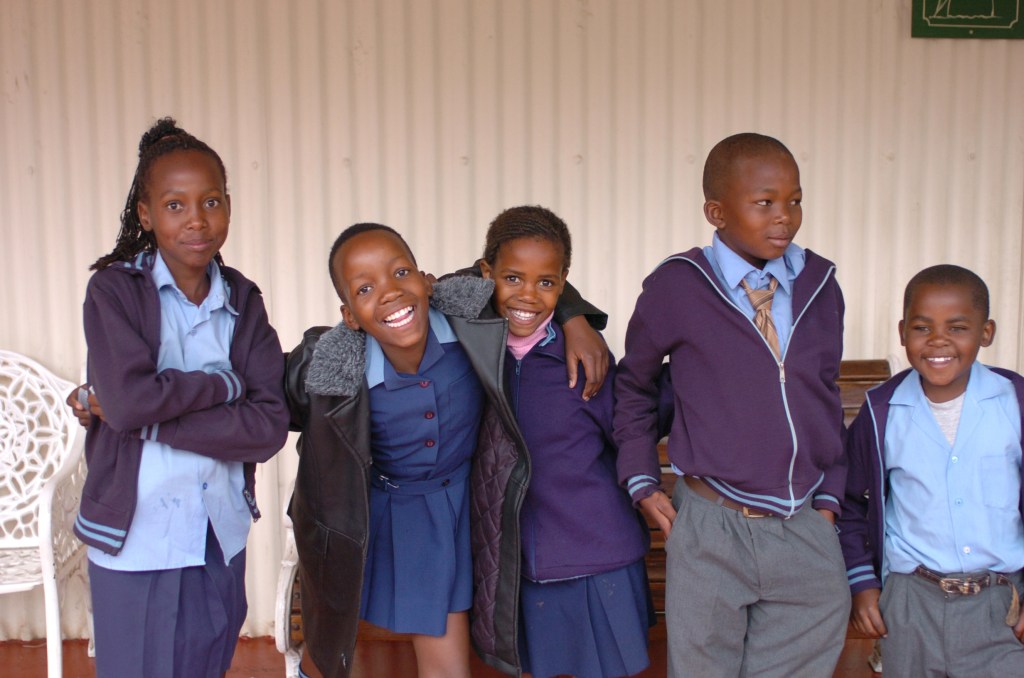
Every place I visited made me a better person. They made me appreciate what I have; they taught me about integrity, and honor, and the kindness of strangers. They taught me that some of the richest people I know have nothing, and that some of the poorest I know have everything. They taught me respect, and gratitude, and patience, and what life is supposed to be about.
The other thing I learned, and this is perhaps the origin of the idea that became The Nation We Knew, was the unbelievable sense of admiration and awe that people in so many countries have for the United States—for the symbol that America is in their lives. I remember a friend telling me that he was stopped by an old man in Australia one day, an elderly, obviously poor, First Australian man, who asked him if he knew who the most powerful woman in the world was. My friend began to mentally compile a list of names, but before he could answer, the old man smiled at him and said, ‘The Statue of Liberty, man—God bless you.’ You want to be humbled? Have THAT conversation. Walk into a small village in the developing world and have people want to touch you, to hold your hand, just because you’re from America. You want to be put in your place? Go through that a few times. In fact, I strongly recommend it.
In 2013, ten years ago, while I was flying all over the world—I worked in 29 countries that year—things back in the States were becoming increasingly tense and unpleasant as ideological partisanship began to rear its head like never before. A lot happened that year: John Boehner was re-elected as Speaker of the House; Obama was sworn in for his second term; Edward Snowden’s intelligence leaks became public; Trayvon Martin’s killer was found not guilty; and the Federal Government shut down for 16 days because of intransigence on both sides of the political aisle. Suddenly, instead of looking like the shining city on the hill that people outside the country wanted to see, NEEDED to see, were HUNGRY to see, we began to look like a bunch of self-important teenage bullies whose motto went from E Pluribus Unum (from the many, one), to ‘I’m more important than we.’
And, we began to assign labels. But what’s worse, we began to assign VALUE to the labels: Not to the person to whom the labels were attached, but to the labels themselves. Liberal? You’re a whining snowflake who wants a world full of extremely expensive unicorns and rainbows. Conservative? You’re an old-school, out-of-touch, uneducated, ignorant bigot. Democrat? Raise taxes at all costs. Republican? Destroy the middle class by eliminating taxes on the rich. Hispanic? You’re a lazy waste of resources, except when you develop high energy to be a criminal. Black? You’re an entitled, white-hating militant. These were the labels that American society began to assign to people. We got lazy: it was so much easier to read the label and instantaneously (and wrongly) categorize than it was to actually take the time to get to know the person—to have a civil conversation in search of common beliefs and values, instead of working so hard to drive distance between each other because of convenient differences.
And then came social media.
Over the last few years, we’ve faced some serious challenges, not just in the US, but across the world: A global pandemic; the rise of global nationalism; economic uncertainty; fear of unbridled technology; climate change; and the realization that we haven’t exactly been the best neighbors on this planet, and that the landlord is starting to notice.
But rather than coming together as members of a thoughtful, intelligent, civil society, intent to face off against these challenges and actively do something about them, we chose instead to point fingers at each other and use blame as a way to justify doing nothing. This works when you’re three years old. It doesn’t work when you’re a responsible adult—or at least, when you’re supposed to be.
Meanwhile, social media sucked us in and, while it gave us access to family photos and people we hadn’t seen in years, and helped us create communities of interest so that we could find people who shared our interests, it also isolated us in those communities, creating an artificial tribal effect that turned us against one another by ABSOLUTELY WRONGLY pointing out that we are far more different than we are alike, and that ‘different’ is something to fear rather than a quality we should find intriguing and attractive.

As a result, some of us have begun to realize that social media is actually antisocial media. It provides an effective platform for the expansion of confirmation bias and serves as an influence conduit for bad actors to have their way with us, including Russia, China, QAnon, Antifa, and others. It serves as a megaphone and echo chamber, amplifying outlandish, apocryphal, and often dangerous ideas and points-of-view that are nowhere near as widespread as their relative loudness would indicate. But because they appear bigger than they actually are, they create fear, further dividing us as a cohesive society. It was on social media, so it must be true.
Let me be clear: I’m not stupid or naïve. Rest assured, all of these voices existed long before the arrival of social media. Whether we’re talking about anti-government conspiracy theorists, flat-earthers, white supremacists, anti-vaxxers, the Christian right, or the ultra-socialist left, all had their followers, and all had a voice. But in keeping with the bell curve that defines any statistically large group, including countries, these voices are fringe elements that have always existed at the periphery of civilized society, a place where they are free to rant as loudly as they like, without causing harm to the vast numbers of people under the bulk of the bell who don’t adhere to their beliefs.
Today, though, those fringe voices enjoy an advantage that only comes through the influence of social media’s unlimited geography. They can be at a safe distance from the controversial, fear-mongering conversation that they spawn, which is the ultimate hallmark of cowardice (as I point out in the book, it’s akin to tossing a firecracker into a crowd from the top of a building), while at the same time enjoying the artificial, echoing loudness that social media and the Internet make possible, turning low-volume noise into hurtful rhetoric that creates fear and erodes trust. They’re like the Mighty Oz: A loud, commanding voice on the surface, but when we pull back the curtain, we find a timid little bully with a megaphone—and no real message to share. Things are not always as they seem.
I wrote my book, The Nation We Knew, because of the fatigue that has settled on the country today—not COVID-related fatigue, although that’s part of it, but fatigue associated with the loud drone of meaningless noise emanating from many of our elected officials, noise that divides rather than unites—at a time when we need the power of national unity more than we have at any time in the recent past. In the United States, anyone who has made it through second grade knows two phrases well: ‘We, the People,’ and ‘e Pluribus Unum.’ From the many, one. When did the one become many, so polarized that coming together is like trying to get the south poles of two strong magnets to touch?
So, as I wrap up this explanation, let me take you back to my observation about people in the world, whom I’ve had the honor to know, and who struggle every day to survive. Do you know what they worry about? They worry about whether they can feed their kids tonight. They worry about whether some government goon is going to bash the door down and take them away because they made some off-handed comment in the public market. They wonder if they’ll be able to get the medication that they need but that has been almost impossible to find because it gets stolen by the government to resell for profit at the expense of the people they supposedly govern and care for. They worry about whether their meager savings will still be in the bank tomorrow. A lot of them worry about whether there will BE a tomorrow. I know this, because I know them. I’ve been in their homes.
But way off in the distance, when they squint their eyes and crank up their imagination just a bit, they see this glow on the horizon. It comes from a distant city, a city on a hill, a city that represents hope and promise and a warm welcome for worthy individuals who want a better life. It represents a vision of what could be, not what is. It shows them that there’s always something better, something worth striving for.
And THAT’s why I wrote The Nation We Knew. Because you know what? We’re better than this. I want people to read the story and then sit down and think about how we create some of the change that I wrote about in the book. And let me be very, very clear: The book is non-partisan—it takes no side, other than the side of people who want a better life and a government willing to help them get it.
Let me also say that I knew I had something good when I realized that every single time I have a conversation with someone that edges toward politics and the issues that we face, it hits me right in the face that—wow—that’s in the book. It’s in the book!
I hope this helped, and I hope you enjoy the book. It’s on Amazon, in both physical and digital formats. Thanks for reading.
The Nation We Knew on Amazon
My Liberal, Snowflake, Unrealistic, Best-selling Novel
There’s an expression that I think comes out of Hollywood: “The only thing worse than people talking about you is nobody talking about you.”
When I published The Nation We Knew, I quickly came to grips with the reality of that statement. Some of it was good; some of it wasn’t. And I find that curious.
Let me be clear: The Nation We Knew is a novel. It’s fiction. It’s not a treatise on political strategy, nor is it a political science textbook. It’s a fantasy. But based on the positive feedback I’ve gotten from the thousands of people who have read it, maybe it should be a political guidebook of some kind. And, based on the negative feedback the book garnered from the political fringes on both sides of the supposed ideological aisle, well, second that last comment. More than a few people have said to me, “This book should be required reading for anyone who runs for the position of dogcatcher all the way to those who have aspirations for the White House.’ Okay, I won’t go that far. Or maybe I will. Politicians have reached out with the same observation.
One of the ways she (yes, you heard me correctly, she) does that is by appointing a functional cabinet in which every member has deep expertise in the responsibility of their position. So: the person heading up defense has spent considerable time in the military. The person responsible for intelligence has been both a field operative and an administrator in one of the alphabet agencies. The person who owns education has actually served as a professional educator. And the person who owns infrastructure? They have hands-on experience in actually creating it and pulling together the kinds of people required to do so. And infrastructure? I’m not just talking about roads and bridges; I’m also talking about port facilities. Cybersecurity. Sustainable energy. Smart cities. Intelligent roadways. And, much more.
The novel is a thinly veiled exercise in leadership, the way I define leadership to be and as I’ve defined it for the last 30 years of successfully advising leadership teams on their approaches to being effective, courageous, passionate leaders. It’s about doing the right thing. And it’s about painting a picture for people of what could be, rather than a picture of what is. It’s about turning our backs on the status quo, about not accepting the phrase, ‘If it ain’t broke, don’t fix it,’ about saying no to the idea that good enough is good enough. You know why? Because the moment we do that, we start moving backward, not forward.
When the book came out, it quickly rose to be the number one bestselling book in the world on Amazon in political fiction, and it stayed in that position for about two weeks. It still sells very well. But it also kicked off a firestorm of criticism: unrealistic, liberal, snowflake, and naïve were some of the words tossed at the book. But do you know what I found most interesting? More than half of the negative reviews—more than half—started out with a version of the following phrase:
Well, I haven’t read it yet, but…
Seriously? And you’re therefore qualified to review the book because…?
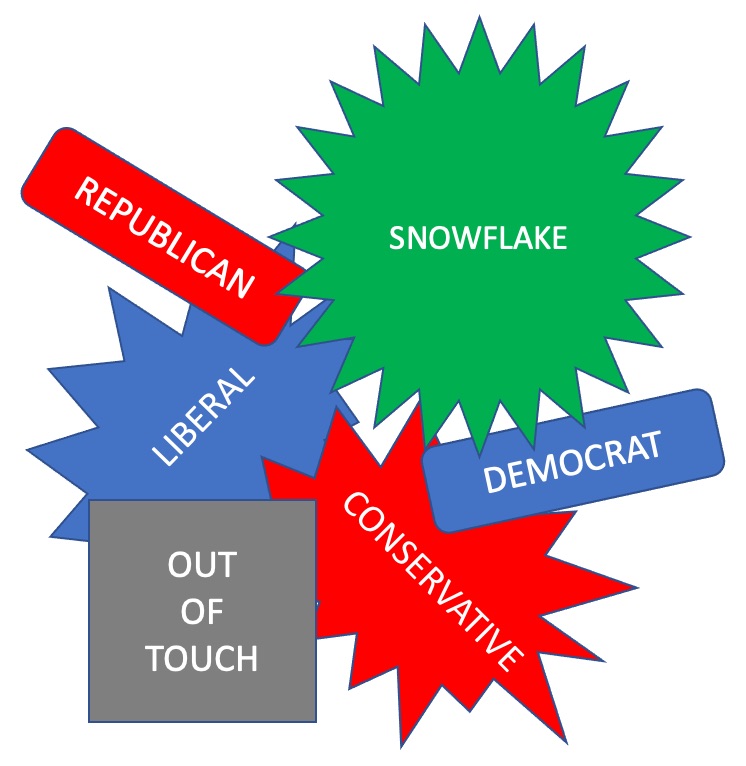
Click here to listen to my audio essay about the destructive power of labels
Politically, I consider myself to be a centrist. I believe that we have two parties (I’m talking about the true Republican and Democratic parties, not the clown college that’s currently making noise in Washington) for a reason: They want the same things for the American people, and they approach those things differently. Fair enough. But I found it interesting that both I and the book were branded with the mark of the Liberal beast.
I have a problem with labels, because labels are designed to oversimplify, to make it easy to categorize a person or idea or political stance without effort. So, I decided to go look up the definition of the label that had been affixed to my forehead. From the dictionary, I pulled this definition:
Liberal: “Willing to respect or accept behavior or opinions different from one’s own; open to new ideas.”
If that’s what ‘Liberal’ means, then I accept the label. What I don’t accept is the idea that different thinking means wrong thinking. Why? Because that kind of thought is what fossilizes us into the status quo, which is a deadly place to be.
The Nation We Knew is built around a very simple, but profoundly important, question:
What if.
There’s so much power in that. If only we gave ourselves permission to dream, and then acted on those dreams, it’s amazing what we could accomplish.
The Nation We Knew on Amazon
Why I Cast Mike Rowe in The Nation We Knew
A lot of people ask me why I cast Mike Rowe, of Dirty Jobs fame, as the nation’s Chief Infrastructure Officer in my novel, The Nation We Knew. It’s a good question.
To summarize, The Nation We Knew is the story of national change that’s brought about by a singularly remarkable event. What would happen, the book asks, if the self-serving denizens of Washington (both sides, by the way) could set aside their ideological differences and put country ahead of party. What if, the new president asks, we could leave the donkeys and elephants outside to tear up the grass, and come together as responsible adults, intent on moving the country forward in every possible way in a bipartisan, common-sense fashion?
So, I got to thinking: what kind of expertise do we need to do that job? Well, clearly, we need people with degrees in electrical engineering, mechanical engineering, architecture, and civil engineering. But we also need surveyors. Electricians. Designers. Heavy equipment operators. IT technicians. In other words, we need a combination of people with university degrees in complex fields, and we need people from the skilled trades. We can’t get the job done without both.
So, after a lot of thinking, it hit me like a brick in the head: Who better to be the nation’s Chief Infrastructure Officer than Mike Rowe? So, I asked his permission, and he graciously gave it.
There’s another reason I placed him in that role. The United States is long overdue for a renaissance in the way we think about the skilled trades. Far too many people look at the trades as ‘the job you do if you can’t get a REAL job.’ Really? Without those skills and the people who know how to wield them, we wouldn’t enjoy the level of comfort that modern society affords us. Without electricians, plumbers, telecom technicians, heavy equipment operators, carpenters, framers, roofers, lots of medical and dental professionals, and myriad others, we wouldn’t have smart cities—in fact, we wouldn’t have cities. And by the way, have you ever had to call a plumber on a Sunday night because your pipes were frozen or your toilet wouldn’t work? Assuming you can even find one who has time to come out, you’re going to have to take out a second mortgage to pay the bill. And it’s not because they’re gouging the public—it’s because they’re making the salary that they’re worth, and it’s probably more than yours and mine combined.
There’s a lot more to the story in the book, so have a read and see for yourself. As it happens, even though he doesn’t think so, Mike Rowe is the perfect paradigm for a presidential cabinet member. We need more people like him in those jobs—you know, people who actually know something about whatever they’re responsible for.
I leave you with Putt’s Law: Technology is made up of two kinds of people: Those who manage that which they do not understand, and those who understand that which they do not manage.
Think about it.
The Nation We Knew on Amazon
 Steven Shepard