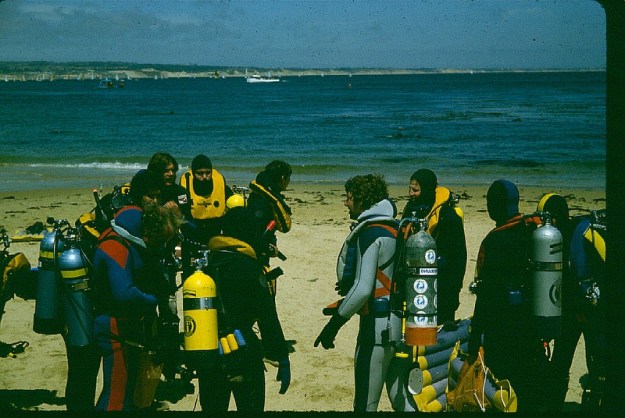
ack in my diving days, my fellow instructors and I used to take groups of divers down to Monterey for their checkout dive. This is the first dive they do in the ocean with full SCUBA gear, during which they have to demonstrate all the skills they’ve learned in class before we certify them as divers. Typically, I’d send the assistant instructors down to the bottom with the students, and they’d run them through all the drills and skill demonstrations to make sure they knew their stuff. I’d stay on the surface, sitting on an inflatable surf mat and nibbling on kelp, ready to deal with any students that came to the surface and needed assistance.
One day, while sitting there watching a pod of sea lions circle the mat (something they did all the time), I spotted something bobbing on the surface a few yards away. I couldn’t tell what it was, so I paddled over and grabbed it. It turned out to be a bottle, sealed with wax, and yes, it had a note inside. I pulled it out, and it was a message from a college student at Cal Poly, who had dropped it into the water nine months before as an experiment to see how far the bottle might go. It included a telephone number (this was before email was common (hell, we barely had electricity), so I called him. He was very grateful and told me that he had dropped it in the water in Morro Bay near San Luis Obispo, which meant that it had traveled almost 150 miles to get to Monterey. I agreed to seal it back up and drop it in the water again so that it could continue its journey, which I did. I never heard back from him, but I assume it continued northward.

Years later, after I had left my professional diving days behind and become a telecom analyst, I was teaching a program in Dallas, where I met an old cowboy who worked part-time in one of the hotels as a greeter. His name was Bud. We chatted every day, sometimes for hours when it was quiet at the hotel, and one day he confided to me that he had a very strange hobby. Not one to ignore that kind of comment, I asked him what it was. He smiled, and, looking around to make sure no one was within earshot, he told me that he drives out into the desert and ties notes to tumbleweeds. He then releases the tumbleweeds, to let ‘em continue rolling across the plains. The notes have the location, date and time that he released them, along with a brief message asking whoever finds the note call him and tell him where and when they found the tumbleweed and the note. He told me that he had released more than 600 tumbleweeds (technically, Russian thistles) and had heard back from over 150 people. He said that he figured that most of them ended up stuck on fence lines or run over by road traffic. One of them, he told me, he released just south of Waco, and it was found in Lampasas. That’s about 90 miles away. He also said that that particular tumbleweed was huge—almost five feet across. Those things really get around.
Everybody thinks of tumbleweeds as having an iconic presence in old westerns. Unless there’s one or two blowing through the streets of that old western town, it just isn’t realistic—although I have to say that I worked on a movie set once where we had a tumbleweed wrangler who used a leaf blower to move them down the street, since the wind wasn’t cooperating.
Anyway, as I mentioned earlier, tumbleweeds are officially known as Russian thistle, and they originated in Ukraine. Most likely, the seeds got mixed into a shipment of flax seeds that came over from Europe back in the 1800s, took root, and never left. Now, they’re pretty much everywhere, especially in the southwest. And they can be a real problem. Back in 2018, a windstorm came up that was howling at about 60 MPH. For some bizarre reason, the wind funneled hundreds of thousands of tumbleweeds into the California town of Victorville. There were so many that they piled up in huge mounds, in some cases actually burying houses. Go look it up—the pictures are amazing.
But here’s what else is amazing. A typical tumbleweed has 250,000 seeds nestled down inside its dried, thorny leaves. In the summer, the plant, which starts out as a green bushy ball, dries out. A layer of specialized cells right at the base of the plant, called the abscission layer, snaps off, and the wind blows the plant across the prairie, scattering seeds everywhere it goes. It’s a hardy plant, so wherever the seeds fall, they typically, eventually sprout, which is why they’re considered such a nuisance. Not only do they infest crop fields, they also collect along fences, sometimes knocking them down due to their sheer weight. They also have a nasty tendency to blow across roads at the most inopportune times. I’ve had it happen: there’s something pretty unnerving about a six-foot diameter ball suddenly rolling in front of your car from out of nowhere on the highway. They also carry insect pests that hitch a ride and can be widely dispersed across an agricultural area. Not a good thing.
It turns out that plants are a lot smarter than we give them credit for. In fact, they’ve developed a handful of techniques for spreading themselves far and wide. One is by harnessing the wind, which is what tumbleweeds do, as well as maple trees, dandelions, and lots of others. They swim; the reason that coconut trees are on almost every island in the south Pacific is because coconuts fell into the ocean and floated thousands of miles until they landed somewhere. Some explode; there are plants with seed pods that explode with such seed-scattering force that the seeds fly over 300 feet (we’re talking about the length of a football field!) at 160 MPH.
Next, we have the seeds that have to be eaten to be scattered. In fact, some of them actually MUST be eaten to germinate, because the hard shell that protects the embryo inside has to be abraded away by the grinding action of a bird’s gizzard before they’ll sprout.
Then we have those seeds that count on a rodent of some kind collecting them and burying them in the ground, where at least some of them sprout, and seed becomes tree. And then we have the cling-on approach—and no, I’m not making a Star Trek joke. Seed pods from the burdock plant, what we call a cocklebur, are covered with natural Velcro (in fact, it’s what gave the inventor the idea in the first place). When an animal brushes against them, they get tangled in the animal’s fur, and hitch a ride to wherever the animal’s going.
I know this is a pretty geeky topic, but hey, consider the source. I find it remarkable how different species adapt to whatever they’re given to work with. I’ll tell you what—I bet you look at tumbleweeds a little differently from now on.
By the way, one more thing before I go. Sabine and I watched a pretty good movie a few years ago called “Conagher.’ It’s an adaptation of a Louis L’Amour novel, and it stars Sam Elliott alongside his wife, Katherine Ross. It’s a love story, set in the old west, and it has a great theme. Sam Elliott is this grizzled, lonely cowboy who keeps finding poems tied to tumbleweeds on the prairie. He doesn’t know who’s writing them, but he wants to. I’ll bet you can figure out what happens.
 Steven Shepard