Tag Archives: science

The Wonderful, Terrible Gift of Science

*A note before you begin to read: This is a long post; if you’d rather listen to it, you can find it at the Natural Curiosity Project Podcast.

Part I

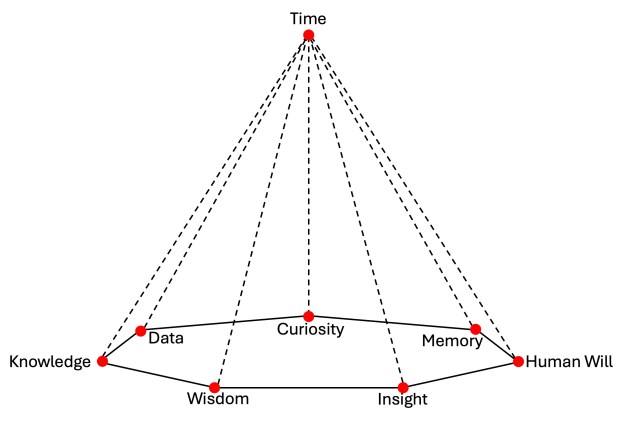
LIFE IS VISUAL, so I have an annoying tendency to illustrate everything—either literally, with a contrived graphic or photo, or through words. So: try to imagine a seven-sided polygon, the corners of which are labeled curiosity, knowledge, wisdom, insight, data, memory, and human will. Hovering over it, serving as a sort of conical apex, is time. 

Why these eight words? A lifetime of living with them, I suppose. I’m a sucker for curiosity; it drives me, gives my life purpose, and gives me a decent framework for learning and applying what I learn. Knowledge, wisdom, insight, and data are ingredients that arise from curiosity and that create learning. Are they a continuum? Is one required before the next? I think so, but that could just be because of how I define the words. Data, to me, is raw ore, a dimensionless precursor. When analyzed, which means when I consider it from multiple perspectives and differing contexts, it can yield insight—it lets me see beyond the obvious. Insight, then, can become knowledge when applied to real-world challenges, and knowledge, when well cared for and spread across the continuum of a life of learning, becomes wisdom. And all of that yields learning. And memory? Well, keep listening.

Here’s how my model came together and why I wrestle with it. 

Imagine an existence where our awareness of ‘the past’ does not exist, because our memory of any action disappears the instant that action takes place. In that world, a reality based on volatile memory, is ‘learning,’ perhaps defined as knowledge retention, possible? If every experience, every gathered bit of knowledge, disappears instantly, how do we create experience that leads to effective, wisdom-driven progress, to better responses the next time the same thing happens? Can there even be a next time in that odd scenario, or is everything that happens to us essentially happening for the first time, every time it happens?

Now, with that in mind, how do we define the act of learning? It’s more than just retention of critical data, the signals delivered via our five senses. If I burn myself by touching a hot stove, I learn not to do it again because I form and retain a cause-effect relationship between the hot stove, the act of touching it, and the pain the action creates. So, is ‘learning’ the process of applying retained memory that has been qualified in some way? After all, not all stoves are hot.

Sometime around 500 BC, the Greek playwright Aeschylus observed that “Memory is the mother of all wisdom.” If that’s the case, who are we if we have no memory? And I’m not just talking about ‘we’ as individuals. How about the retained memory of a group, a community, a society?

Is it our senses that give us the ability to create memory? If I have no senses, then I am not sentient. And if I am not sentient, then I can create no relationship with my environment, and therefore have no way to respond to that environment when it changes around me. And if that happens, am I actually alive? Is this what awareness is, comprehending a relationship between my sense-equipped self and the environment in which I exist? The biologist in me notes that even the simplest creatures on Earth, the single-celled Protozoa and Archaea, learn to respond predictably to differing stimuli.

But I will also observe that while single-celled organisms routinely ‘learn,’ many complex multi-celled organisms choose not to, even though they have the wherewithal to do so. Many of them currently live in Washington, DC. A lifetime of deliberate ignorance is a dangerous thing. Why, beyond the obvious? Because learning is a form of adaptation to a changing environment—call it a software update if you’re more comfortable with that. Would you sleep well at night, knowing that the antivirus software running on your computer is a version from 1988? I didn’t think so. So, why would you deliberately choose not to update your personal operating system, the one that runs in your head? This is a good time to heed the words of Charles Darwin: It is not the strongest that survive, nor the most intelligent, but those that are most adaptable to change. Homo sapiens, consider yourselves placed on-notice.

Part II

RELATED TO THIS CONUNDRUM IS EPISTEMOLOGY—the philosophy that wrestles with the limits of knowledge. Those limits don’t come about because we’re lazy; they come about because of physics. 

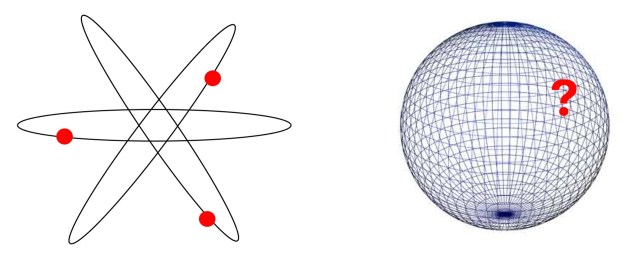
From the chemistry and physics I studied in college, I learned that the convenient, simple diagram of an atom that began to appear in the 1950s is a myth. Electrons don’t orbit the nucleus of the atom in precise paths, like the moon orbiting the Earth or the Earth orbiting the Sun. They orbit according to how much energy they have, based on their distance from the powerfully attractive nucleus. The closer they are, the stronger they’re held by the electromagnetic force that holds the universe together. But as atoms get bigger, as they add positively-charged protons and charge-less neutrons in the densely-packed nucleus, and layer upon layer of negatively charged orbiting electrons to balance the nuclear charge, an interesting thing happens. As layers of electrons are added,  the strength with which the outermost electrons are held by the nucleus decreases with distance, making them less ‘sticky,’ and the element becomes less stable. 

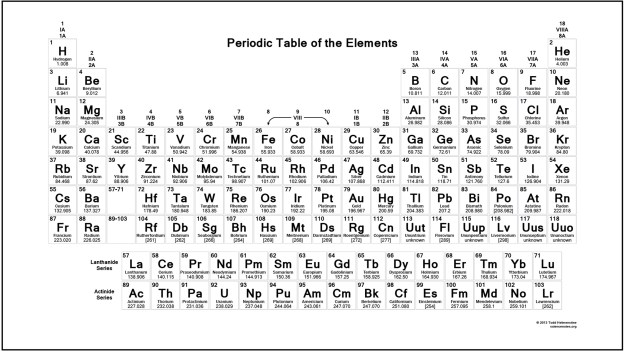
This might be a good time to make a visit to the Periodic Table of the Elements. Go pull up a copy and follow along.

Look over there in the bottom right corner. See all those elements with the strange names and big atomic numbers—Americium, Berkelium, Einsteinium, Lawrencium? Those are the so-called transuranium elements, and they’re not known for their stability. If a distant electron is attracted away for whatever reason, that leaves an element with an imbalance—a net positive charge. That’s an unstable ion with a positive charge that wants to get back to a stable state, a tendency defined by the Second Law of Thermodynamics and a process called entropy, which we’ll discuss shortly. It’s also the heart of the strange and wonderful field known as Quantum Mechanics.

This is not a lesson in chemistry or nuclear physics, but it’s important to know that those orbiting electrons are held within what physicists call orbitals, which are statistically-defined energy constructs. We know, from the work done by scientists like Werner Heisenberg, who was a physicist long before he became a drug dealer, that an electron, based on how far it is from the nucleus and therefore how much energy it has, lies somewhere within an orbital. The orbitals, which can take on a variety of three-dimensional shapes that range from a single sphere to  multiple pear-shaped spaces to a cluster of balloons, define atomic energy levels and are stacked and interleaved so that they surround the nucleus. So, the orbital that’s closest to the nucleus is called the 1s orbital, and it’s shaped like a sphere. In the case of Hydrogen, element number one in the Periodic Table, somewhere within that orbital is a single lonely electron. We don’t know precisely where it is within the 1s orbital at any particular moment; we just know that it’s somewhere within that mathematically-defined sphere. This is what the Heisenberg Uncertainty Principle is all about: we have no way of knowing what the state of any given electron is at any point in time. And, we never will. We just know that statistically, it’s somewhere inside that spherical space.

Which brings us back to epistemology, the field of science (or is it philosophy?) that tells us that we can never know all that there is to know, that there are defined limits to human knowledge. Here’s an example. We know beyond a shadow of a doubt that the very act of observing the path of an electron changes the trajectory of that electron, which means that we can never know what its original trajectory was before we started observing it. This relationship is described in a complex mathematical formula called Schrödinger’s Equation.

Look it up, study it, there will be a test. The formula, which won its creator,  Erwin Schrödinger, the Nobel Prize in 1933, details the statistical behavior of a particle within a defined space, like an energy-bound atomic orbital. It’s considered the fundamental principle of quantum mechanics, the family of physics that Albert Einstein made famous. In essence, we don’t know, we can’t know, what the state of a particle is at any given moment, which implies that the particle can exist, at least according to Schrödinger, in two different states, simultaneously. This truth lies at the heart of the new technology called quantum computing. In traditional computing, a bit (Binary Digit) can have one or the other of two states: zero or one. But in quantum computing, we leave bits behind and transact things using Qubits (quantum bits), which can be zero, one, or both zero and one at the same time.  Smoke ‘em if you got ‘em.

The world isn’t neat and tidy where it matters: it’s sloppy and ill-defined and statistical. As much as the work of Sir Isaac Newton described a physical world defined by clear laws of gravity, and velocity, and acceleration, and processes that follow clearly-defined, predictably linear outcomes, Schrödinger’s, Heisenberg’s, and Einstein’s works say, not so fast. At the atomic level, the world doesn’t work that way. 

I know—you’re lighting up those doobies as you read this. But this is the uncertainty, the necessary inviolable unknown that defines science. Let me say that again, because it’s important. Uncertainty Defines Science. It’s the way of the universe. Every scientific field of study that we put energy into, whether it’s chemistry, pharmacology, medicine, geology, engineering, genetics, or a host of others, is defined by the immutable Laws of Physics, which are governed by the necessary epistemological uncertainties laid down by people like Werner Heisenberg and Erwin Schrödinger, and codified by Albert Einstein.

Part III

ONE OF MY FAVORITE T-SHIRTS SAYS,

I READ.

I KNOW SHIT.

I’m no physicist, Not by a long shot. But I do read, I did take Physics and Chemistry, and I was lucky enough to have gone to Berkeley, where a lot of this Weird Science was pioneered. I took organic chemistry from a guy who was awarded a Nobel Prize and had more than a few elements named after him (Glenn Seaborg) and botany from the guy who discovered how photosynthesis works and also had a Nobel Prize (Melvin Calvin). I know shit.

But the most important thing I learned and continue to learn, thanks to those grand masters of knowledge, is that uncertainty governs everything. So today, when I hear people criticizing scientists and science for not being perfect, for sometimes being wrong, for not getting everything right all the time, for not having all the answers, my blood boils, because they’re right, but for the wrong reasons. Science is always wrong—and right. Schrödinger would be pleased with this duality. It’s governed by the same principles that govern everything else in the universe. Science, which includes chemistry, pharmacology, medicine, geology, engineering, genetics, and all the other fields that the wackadoodle pseudo-evangelists so viciously criticized during the pandemic, and now continue to attack, can’t possibly be right all the time because the laws of the universe fundamentally prevent us from knowing everything we need to know to make that happen. Physics doesn’t come to us in a bento box wrapped in a ribbon. Never in the history of science has it ever once claimed to be right. It has only maintained that tomorrow it will be more right than it is today, and even more right the day after that. That’s why scientists live and die by the scientific method, a process that aggressively and deliberately pokes and prods at every result, looking for weaknesses and discrepancies. Is it comfortable for the scientist whose work is being roughed up? Of course not. But it’s part of being a responsible scientist. The goal is not for the scientist to be right; the goal is for the science to be right. There’s a difference, and it matters.

This is science. The professionals who practice it, study it, probe it, spend their careers trying to understand the rules that govern it, don’t work in a world of absolutes that allow them to design buildings that won’t fail and drugs that will work one hundred percent of the time and to offer medical diagnoses that are always right and to predict violent weather with absolute certainty. No: they live and work in a fog of uncertainty, a fuzzy world that comes with no owner’s manual, yet with that truth before them, and accepting the fact that they can never know enough, they do miraculous things. They have taken us to the stars, created extraordinary energy sources, developed mind-numbingly complex genetic treatments and vaccines, and cured disease. They have created vast, seamless, globe-spanning communications systems, the first glimmer of artificial intelligence, and demonstrated beyond doubt that humans play a major role in the fact that our planet is getting warmer. They have identified the things that make us sick, and the things that keep us well. They have helped us define ourselves as a sentient species.

And, they are pilloried by large swaths of the population because they’re not one hundred percent right all the time, an unfair expectation placed on their shoulders by people who have no idea what the rules are under which they work on behalf of all of us. 

Here’s the thing, for all of you naysayers and armchair critics and nonbelievers out there: Just because you haven’t taken the time to do a little reading to learn about the science behind the things that you so vociferously criticize and deny, just because you choose deliberate ignorance over an updated mind, doesn’t make the science wrong. It does, however, make you lazy and stupid. I know shit because I read. You don’t know shit because you don’t. Take a lesson from that.

Part IV

THIS ALSO TIES INTO WHAT I BELIEVE to be the most important statement ever uttered by a sentient creature, and it begins at the liminal edges of epistemological thought: I am—the breathtaking moment of self-awareness. Does that happen the instant a switch flips and our senses are activated? If epistemology defines the inviolable limits of human knowledge, then what lies beyond those limits? Is human knowledge impeded at some point by a hard-stop electric fence that prevents us from pushing past the limits? Is there a ‘there be dragons here’ sign on the other side of the fence, prohibiting us from going farther? I don’t think so. For some, that limit is the place where religion and faith take over the human psyche when the only thing that lies beyond our current knowledge is darkness. For others, it stands as a challenge: one more step moves us closer to…what, exactly?

A thinking person will experience a moment of elegance here, as they realize that there is no fundamental conflict between religious faith and hardcore science. The two can easily coexist without conflict. Why? Because uncertainty is alive and well in both. Arthur C. Clarke: Any sufficiently advanced technology is indistinguishable from magic.

Part V

THIS BRINGS ME TO TIME, and why it sits at the apex of my seven-sided cone. Does time as we know it only exist because of recallable human memory? Does our ability to conceive of the future only exist because, thanks to accessible memory and a perception of the difference between a beginning state and an end state,  of where we are vs. where we were, we perceive the difference between past and present, and a recognition that the present is the past’s future, but also the future’s past?

Part VI

SPANISH-AMERICAN WRITER AND PHILOSOPHER George Santayana is famous for having observed that ‘those who fail to heed the lessons of history are doomed to repeat them.’ It’s a failing that humans are spectacularly good at, as evidenced by another of Santayana’s aphorisms—that ‘only the dead have seen the end of war.’ I would observe that in the case of the first quote, ‘heed’ means ‘to learn from,’ not simply ‘to notice.’ But history, by definition, means learning from things that took place in the past, which means that if there is no awareness of the past, then learning is not possible. So, history, memory, and learning are, to steal from Douglas Adams, the author of The Hitchhiker’s Guide to the Galaxy, “inextricably intertwingled” (more on that phrase later). And if learning can’t happen, does that then mean that time, as we define it, stops? Does it become dimensionless? Is a timeless system the ultimate form of entropy, the tendency of systems to seek the maximum possible state of disorder, including static knowledge? Time, it seems, implies order, a logical sequence of events that cannot be changed. So, does entropy seek timelessness? Professor Einstein, white courtesy telephone, please.

The Greek word chronos defines time as a physical constant, as in, I only have so much time to get this done. Time is money. Only so much time in a day. 60 seconds per minute, 60 minutes per hour, 24 hours per day. But the Greeks have a second word, kairós, which refers to the quality of time, of making the most of the time you have, of savoring time, of using it to great effect. Chronos, it seems, is a linear and quantitative view of time; kairós is a qualitative version. 

When I was a young teenager, I read a lot of science fiction. One story I read, a four-book series by novelist James Blish (who, with his wife, wrote the first Star Trek stories for television), is the tale of Earth and its inhabitants in the far distant future. The planet’s natural resources have been depleted by human rapaciousness, so, entire cities lift off from Earth using a form of anti-gravity technology called a Gravity Polaritron Generator, or spindizzy for short, and become independent competing entities floating in space. 

In addition to the spindizzy technology, the floating cities have something called a stasis field, within which time does not exist. If someone is in imminent danger, they activate a stasis field that surrounds them, and since time doesn’t exist within the field, whatever or whoever is in it cannot be hurt or changed in any way by forces outside the field. It’s an interesting concept, which brings me to a related topic. 

One of my favorite animals, right up there with turtles and frogs, is the water bear, also called a  tardigrade (and, charmingly by some, a moss piglet). They live in the microscopically tiny pools of water that collect on the dimpled surfaces of moss leaves, and when viewed under a microscope look for all the world like tiny living gummy bears. 

Tardigrades can undergo what is known as cryptobiosis, a physiological process by which the animal can protect itself from extreme conditions that would quickly kill any other organism. Basically, they allow all the water in their tiny bodies to completely evaporate, in the process turning themselves into dry, lifeless little husks. They become cryptospores. Water bears have been exposed to the extreme heat of volcanos, the extreme cold of Antarctica, and intense nuclear radiation inside power plants; they have been placed outside on the front stoop of the International Space Station for days on end, then brought inside, with no apparent ill effects. Despite the research into their ability to survive such lethal environments, we still don’t really know how they do it. Uncertainty.

But maybe I do know. Perhaps they have their own little stasis field that they can turn on and off at will, in the process removing time as a factor in their lives. Time stops, and if life can’t exist without time, then they can’t be dead, can they? They become like Qubits, simultaneously zero and one, or like Schrödinger’s famous cat, simultaneously dead and alive.

Part VII

IN THE HITCHHIKER’S GUIDE TO THE GALAXY, Douglas Adams uses the phrase I mentioned earlier and that I long ago adopted as one of my teaching tropes. It’s a lovely phrase that just rolls off the tongue: “inextricably intertwingled.” It sounds like a wind chime when you say it out loud, and it makes audiences laugh when you use it to describe the interrelatedness of things. 

The phrase has been on my mind the last few days, because its meaning keeps peeking out from behind the words of the various things I’ve been reading. Over the last seven days I’ve read a bunch of books from widely different genres—fiction, biography, science fiction, history, philosophy, nature essays, and a few others that are hard to put into definitive buckets.

There are common threads that run through all of the books I read, and not because I choose them as some kind of a confirmationally-biased reading list (how could Loren Eiseley’s Immense Journey, Arthur C. Clarke’s Songs of a Distant Earth, E. O. Wilson’s Tales from the Ant World, Malcolm Gladwell’s Revenge of the Tipping Point, Richard Feynman’s Surely You’re Joking, Mister Feynman, and Studs Terkel’s And They All Sang possibly be related, other than the fact that they’re books?). Nevertheless, I’m fascinated by how weirdly connected they are, despite being so very, very different. Clarke, for example, writes a whole essay in Songs of a Distant Earth about teleology, a term I’ve known forever but have never bothered to look up. It means looking at the cause of a phenomenon rather than its perceived purpose to discern its reason for occurring. For example, in the wilderness, lightning strikes routinely spark forest fires, which burn uncontrolled, in the process cleaning out undergrowth, reducing the large-scale fire hazard, but doing very little harm to the living trees, which are protected by their thick bark—unless they’re unhealthy, in which case they burn and fall, opening a hole in the canopy that allows sunlight to filter to the forest floor, feeding the seedlings that fight for their right to survive, leading to a healthier forest. So it would be easy to conclude that lightning exists to burn forests. But that’s a teleological conclusion that focuses on purpose rather than cause. Purpose implies intelligent design, which violates the scientific method because it’s subjective and speculative. Remember—there’s no owners manual.

The initial cause of lightning is wind. The vertical movement of wind that precedes a thunderstorm causes negatively charged particles to gather near the base of the cloud cover, and positively charged particles to gather near the top, creating an incalculably high energy differential between the two. But nature, as they say, abhors a vacuum, and one of the vacuums it detests is the accumulation of potential energy. Natural systems always seek a state of entropy—the lowest possible energy state, the highest state of disorder. I mentioned this earlier; it’s a physics thing, the Second Law of Thermodynamics. As the opposing charges in the cloud grow (and they are massive—anywhere from 10 to 300 million volts and up to 30,000 amps), their opposite states are inexorably drawn together, like opposing poles of a gigantic magnet (or the positively charged nuclei and negatively charged electrons of an atom), and two things can happen. The energy stored between the “poles” of this gigantic aerial magnet—or, if you prefer, battery—discharges within the cloud, causing what we sometimes call heat lightning, a ripple of intense energy that flashes across the sky. Or, the massive negative charge in the base of the cloud can be attracted to positive charges on the surface of the Earth—tall buildings, antenna towers, trees, the occasional unfortunate person—and lightning happens. 

It’s a full-circle entropic event. When a tree is struck and a fire starts, the architectural order that has been painstakingly put into place in the forest by nature is rent asunder. Weaker trees fall, tearing open windows in the canopy that allow sunlight to strike the forest floor. Beetles and fungi and slugs and mosses and bacteria and nematodes and rotifers consume the fallen trees, rendering them to essential elements that return to the soil and feed the healthy mature trees and the seedlings that now sprout in the beams of sunlight that strike them. The seedlings grow toward the sunlight; older trees become unhealthy and fall; order returns. Nature is satisfied. Causation, not purpose. Physics, not intelligent design. Unless, of course, physics is intelligent design. But we don’t know. Uncertainty.

E. O. Wilson spends time in more than one of his books talking about the fact that individuals will typically act selfishly in a social construct, but that groups of individuals in a community will almost always act selflessly, doing what’s right for the group. That, by the way, is the difference between modern, unregulated capitalism and what botany professor Robin Wall Kimmerer calls “the gift economy” in her wonderful little book, The Serviceberry. This is not some left-leaning, unicorn and rainbows fantasy: it’s a system in which wealth is not hoarded by individuals, but rather invested in and shared with others in a quid pro quo fashion, strengthening the network of relationships that societies must have to survive and flourish. Kimmerer cites the story of an anthropologist working with a group of indigenous people who enjoy a particularly successful hunt, but is puzzled by the fact that they now have a great deal of meat but nowhere to keep it cold so that it won’t spoil. “Where will you store it to keep it fresh for later?” The anthropologist asks. “I store it in my friends’ bellies,” the man replies, equally puzzled by the question. This society is based on trust, on knowing that the shared meat will be repaid in kind. It is a social structure based on strong bonds—kind of like atoms. Bonds create stability; individual particles do the opposite, because they’re less stable. 

In fact, that’s reflected in many of the science fiction titles I read: that society’s advances come about because of the application of the common abundance of human knowledge and will. Individuals acting alone rarely get ahead to any significant degree, and if they do, it’s because of an invisible army working behind them. But the society moves ahead as a collective whole, with each member contributing. Will there be those who don’t contribute? Of course. It’s a function of uncertainty and the fact that we can never know with one hundred percent assurance how an individual within a group will behave. There will always be outliers, but their selfish influence is always neutralized by the selfless focus of the group. The behavior of the outlier does not define the behavior of the group. ‘One for one and none for all’ has never been a rallying call.

Part VIII

THIS ESSAY APPEARS TO WANDER, because (1) it wanders and (2) it connects things that don’t seem to be connected at all, but that clearly want to be. Learning doesn’t happen when we focus on the things; it happens when we focus on the connections between the things. The things are data; the connections create insight, which leads to knowledge, wisdom, action, a vector for change. Vector—another physics term. It refers to a quantity that has both direction and magnitude. The most powerful vector of all? Curiosity.

Science is the only tool we have. It’s an imperfect tool, but it gets better every time we use it. Like it or not, we live in a world, in a universe, that is defined by uncertainty. Science is the tool that helps us bound that uncertainty, define its hazy distant edges, make the unclear more clear, every day. Science is the crucible in which human knowledge of all things is forged. It’s only when we embrace that uncertainty, when we accept it as the rule of all things, when we revel in it and allow ourselves to be awed by it—and by the science-based system that allows us to constantly push back the darkness—that we begin to understand. Understand what, you say? Well, that’s the ultimate question, isn’t it?

The Power of Connections

Years ago, while still living in California, I began my writing career by submitting feature articles to local magazines in the San Francisco Bay Area. For some reason, I always gravitated toward offbeat subject matter, which apparently made my stories interesting – and desirable.  

One day, at the request of my editor, I sat down to write a feature story about one of the local towns in our area. But as I started writing, it occurred to me that I really didn’t know what a feature story was, even though I’d been writing them for several years. Wikipedia, by the way, defines a feature story as a “human interest” story that is not typically tied to a recent news event. They usually discuss concepts or ideas that are specific to a particular market, and are often pretty detailed. 

Anyway, I grabbed the dictionary off the shelf (this was years before the Web, and digital dictionaries were still a dream), and searched the Fs for ‘feature.’ I read the entry and satisfied my need to know and as I started to close the book, that’s when I saw it. Directly across the gutter (that’s what they call the middle of the open book where two pages come together) was the word ‘feces.’ 

Now I’m a pretty curious guy, so I wasn’t going to let this go. Needless to say, I know what feces is, but what was really interesting were the words at the bottom of the definition. The first one said, ‘See scat.’ So I turned to the Ss and looked up scat, and it turned out to be the word that wildlife biologists use for animal droppings. But wait, as they say, there’s more. THAT definition told me to see also, Scatologist. (You’ve got to be kidding me). But I did. You guessed it—someone who studies, well, scat. 

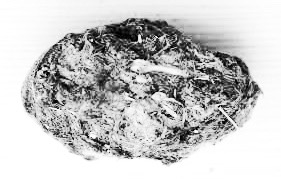
An owl pellet (scat) from a friend’s collection.

So I called the biology department at my undergraduate alma mater, the University of California at Berkeley. When somebody answered the phone, I asked, ‘Do you have a … scatologist on staff?’ Of course, she replied, let me connect you to Dan. The next thing I knew I was talking with Dan, a very interesting guy, so interesting, in fact, that the next weekend I was with him in the hills, collecting owl pellets  and the droppings of other animals to determine such things as what they eat, what parasites they might have, how predation of certain species affects populations of others, and so on. It was FASCINATING. 

Remember that what got me started down this rabbit hole was the search for feature, which led me to feces. Well right underneath the suggestion that I also see scatologist, it said, see also, coprolyte. This was a new word for me, so off to the Cs I went, in search of it. 

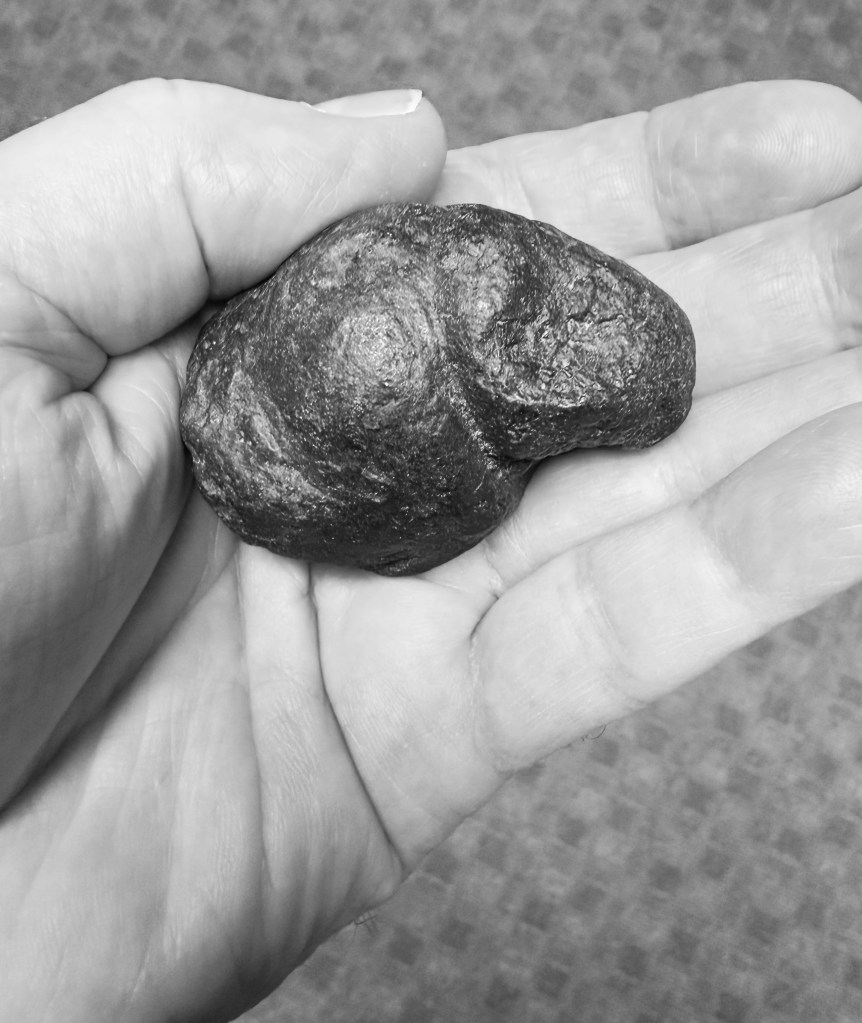
My very own coprolite.

A coprolite is, and I’m not making this up, a fossilized dinosaur dropping. A paleo-scat, as it were. I have one on my desk. OF COURSE I have one on my desk. Anyway, once again, I got on the phone, and this time I called the paleontology department at Berkeley, and soon found myself talking to a coprologist – yes, there is such a person. How do you explain THAT at a dinner party? Anyway, he agreed to meet with me, and once again I had one of those rare and wonderful days, learning just how fascinating the stuff is that came out of the north end of a south-bound dinosaur. He showed me how they slice the things on a very fine diamond saw and then examine them under a high-power microscope to identify the contents, just as the scatologist did with owl pellets and coyote scat. 

Think about this for a moment. If I hadn’t allowed myself to fall prey to serendipity (Wikipedia defines it as “A “happy accident” or “a pleasant surprise”), I never would have met those remarkable people, and never would have written what turned out to be one of most popular articles I’ve ever written.

 Another time, my wife and I were out walking the dogs in a field near our house. At one point, I turned around to check on the dogs and saw one of them rolling around on his back the way all dogs do when they find something disgustingly smelly. Sure enough, he had found the carcass of some recently dead animal, too far gone to identify but not so far gone that it didn’t smell disgusting. I dragged him home with my wife following about 30 feet behind and gave him the bath of baths to eliminate the smell. Anyway, once he smelled more or less like a dog again I felt that old curiosity coming on, so I went downstairs to my office and began to search Google for the source of that horrible smell that’s always present in dead things. And I found it. 

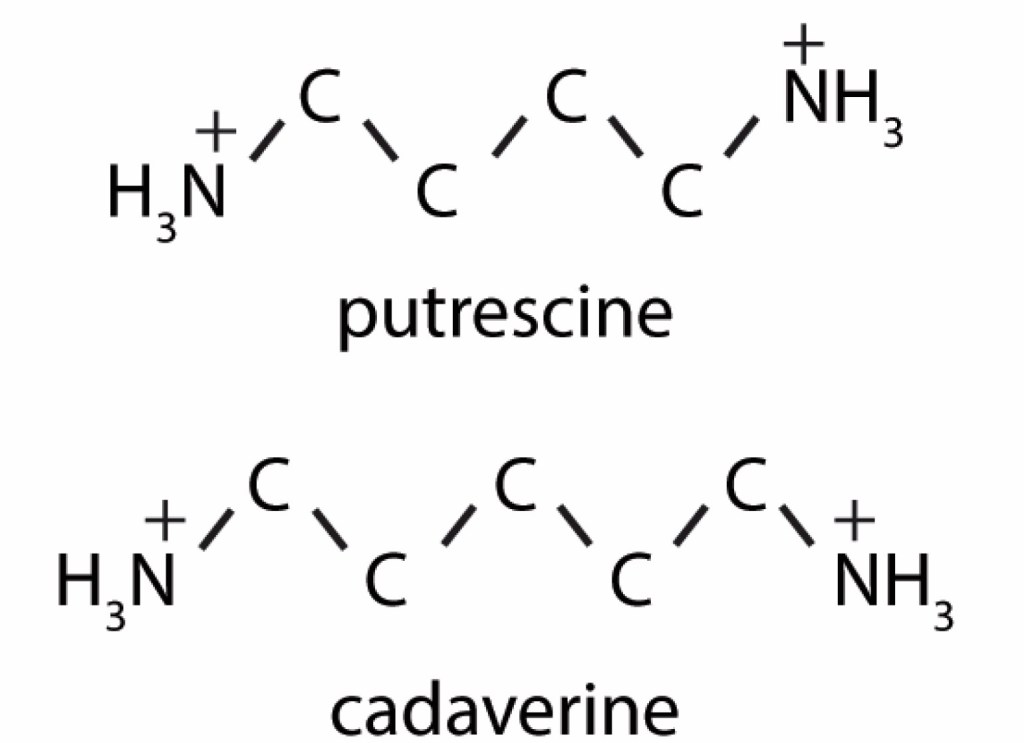
In case you care.

The smell actually comes from two chemicals, both of which are so perfectly named that whoever named them clearly had a good time doing so. The first of them is called cadaverine; the second, putrescine. Can you think of better names for this stuff? Interestingly, putrescine is used industrially to make a form of nylon.

So what’s the point of this wandering tale? Storytellers are always looking for sources, and the question I get more often than any other is about the source of my stories. The answer, of course, has lots of answers, but in many cases I find stories because I go looking for them but leave my mind open to the power of serendipity. For this reason, I personally believe that the best thing about Wikipedia is the button on the left side of the home page that says, “Random Article.” I use it all the time, just to see where it takes me. 

Curiosity is everything. I just wish there was more of it in the world.

The Wisdom of Loren Eiseley

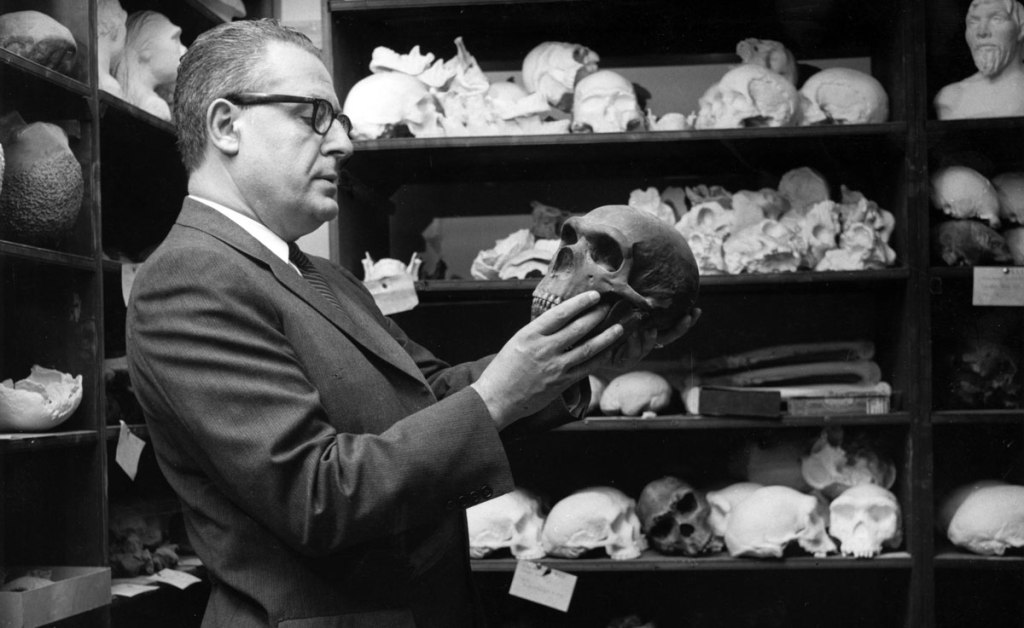
One of my favorite writers is an obscure guy that most people have never heard of. His name is Loren Eiseley, and he was a physical anthropologist and paleontologist at the University of Pennsylvania for over 30 years. As a young man, during the Great Depression, he was a ‘professional hobo,’ riding freight trains all over the United States, looking for work and the occasional adventure; his academic career came later. I’ve met few people who have read his books, yet few writers have affected me as much as he has.  

Loren Eiseley in his office at the University of Pennsylvania Museum, May 12, 1960. Photo by Bernie Cleff, courtesy of the University of Pennsylvania Archives and Records Center.

I discovered Loren Eiseley when I was at Berkeley; a friend loaned me his book, All the Strange Hours: The Excavation of a Life. It’s mostly an autobiography, but it’s powerfully insightful about the world at large. He draws on his early experiences as a vagabond as much as he does as an academic, both of which yield a remarkable way of looking at the ancient and modern worlds.

I have all of his books, in both physical and ebook formats, and they’re among the few I never delete. I keep a list of quotes from Loren’s works in my phone, and I pull them up and read them every once in a while. Here are a few of my favorites. Remember, this guy is a hardcore scientist, although you’d never know it from what you’re about to read.

If there is magic on this planet, it is contained in water.

One does not meet oneself until one catches their reflection from an eye that is other than human.

The journey is difficult, immense. We will travel as far as we can, but we cannot in one lifetime see all that we would like to see or to learn all that we hunger to know.

If it should turn out that we have mishandled our own lives as several civilizations before us have done, it seems a pity that we should involve the violet and the tree frog in our departure.

When man becomes greater than nature, nature, which gave us birth, will respond. This last one strikes me as particularly prescient.

Ray Bradbury, another of my all-time favorite writers, said that ‘Eiseley is every writer’s writer, and every human’s human. He’s one of us, yet most uncommon.’

More than anything else, Loren Eiseley was a gifted observer and storyteller. In All the Strange Hours, he writes about a chance encounter on a train. I’d like to share a bit of it with you.

“In the fall of 1936 I belatedly entered a crowded coach in New York. The train was an early-morning express to Philadelphia and what I had been doing in New York the previous day I no longer remember. The crowded car I do remember because there was only one seat left, and it was clearly evident why everyone who had boarded before me had chosen to sit elsewhere.The vacant seat was beside a huge and powerful man who seemed slumped in a drunken stupor. I was tired, I had once lived amongst rough company, and I had no intention of standing timidly in the aisle. The man did not look quarrelsome, just asleep. I sat down and minded my own business. 

Eventually the conductor made his way down the length of the coach to our seats. I proceeded to yield up my ticket. Just as I was expecting the giant on my right to be nudged awake, he straightened up, whipped out his ticket and took on a sharp alertness, so sharp in fact, that I immediately developed the uncanny feeling that he been holding that particular seat with a show of false drunkenness until the right party had taken it. When the conductor was gone, the big man turned to me with the glimmer of amusement in his eyes. “Stranger,” he appealed before I could return to my book, “tell me a story.” In all the years since, I have never once been addressed by that westernism “stranger” on a New York train. And never again upon the Pennsylvania Railroad has anyone asked me, like a pleading child, for a story. The man’s eyes were a deep fathomless blue with the serenity that only enormous physical power can give. People on trains out of New York tend to hide in their own thoughts. With this man it was impossible. I smiled back at him. ‘You look at me,’ I said, running an eye over his powerful frame, ‘as if you were the one to be telling me a story. I’m just an ordinary guy, but you, you look as if you have been places. Where did you get that double thumb?’

With the eye of a physical anthropologist, I had been drawn to some other characters than just his amazing body. He held up a great fist, looking upon it contemplatively as though for the first time.”

That’s just GREAT writing. Powerfully insightful, visual, and entertaining. And, it demonstrates Eiseley’s skill as a naturally curious storyteller, and the use of storytelling as an engagement technique. His willingness to talk with the odd guy in the next seat over, to ask questions, to give the guy the opportunity to talk, demonstrates one of the most important powers of storytelling.

For most people, storytelling is a way to convey information to another person, or to a group. And while that’s certainly true, that’s not the most important gift of storytelling. The best reason to tell stories is to compel the other person to tell a story BACK. Think about the last time you were sitting with a group of friends, maybe sharing a glass of wine. People relax and get comfortable, and the stories begin. One person tells a story, while everyone else listens. When they finish, someone else responds: ‘Wow. That reminds me of the time that…’ and so it goes, around the group, with everyone sharing. 

When this happens, when the other person starts talking, this is your opportunity to STOP talking and listen—to really listen to the person. They’re sharing something personal with you, something that’s important and meaningful to them—which means that it should be important and meaningful to you, if you want to have any kind of relationship with that person. It’s a gift, so treat it accordingly. 

In west Texas, there’s an old expression that says, ‘Never miss a good chance to shut up.’ This is one of those times. By letting his seat mate talk, Loren Eiseley discovered amazing insights about him, but not just about him. He also learned about his views of society and the world. The conversation goes on for many pages beyond what I quoted earlier, and it’s powerful stuff. So never underestimate the power of the story as an insight gathering mechanism, as much as it is an opportunity to share what YOU have to say.

Here’s one last thing I want to mention. In the tenth episode of my Podcast, The Natural Curiosity Project, I talked about a book I had recently read called ‘The Age of Wonder.’  It’s the story of the scientists of the Romantic Age (1798-1837) who made some of the most important discoveries of the time—people like Charles Babbage, William Herschel, Humphrey Davy, Michael Faraday, and Mungo Park, scientists who had one thing in common: their best friends, partners, and spouses were, without exception, artists—poets and novelists, for the most part. 

These were serious, mainstream, well-respected scientists. For example, Charles Babbage was a mathematician who was the father of modern computing (he invented the Difference Engine, a mechanical calculator that had more than 25,000 brass gears). He was married to Ada Lovelace, the daughter of the poet Lord Byron, and a writer and mathematician herself. William Hershel built the world’s first very large telescopes in England, and his best friend was George Gordon, better known as Lord Byron, the romantic poet. Humphrey Davy was a chemist and anatomist who discovered the medicinal properties of nitrous oxide. His closest friend was the poet and essayist Samuel Taylor Coleridge, who wrote Kubla Khan and The Rime of the Ancient Mariner.

In Xanadu did Kubla Khan, 

A stately pleasure-dome decree: 

Where Alph, the sacred river, ran, 

Through caverns measureless to man, 

Down to a sunless sea.

John Keats, a poet and the author of Ode on a Grecian Urn, was also a medical student whose scientific pursuits shaped his poetry. Mary Shelley is well known as the author of Frankenstein; her last name is Shelley because she was married to Percy Bysshe Shelley, another romantic poet and essayist:

I met a traveller from an antique land, 

Who said—“Two vast and trunkless legs of stone 

Stand in the desert. . . . Near them, on the sand, 

Half sunk a shattered visage lies, whose frown, 

And wrinkled lip, and sneer of cold command, 

Tell that its sculptor well those passions read 

Which yet survive, stamped on these lifeless things, 

The hand that mocked them, and the heart that fed; 

And on the pedestal, these words appear: 

My name is Ozymandias, King of Kings; 

Look on my Works, ye Mighty, and despair!

Shelley’s work was filled with and flavored by the wonders of science. 

So, you may be wondering if there’s a ‘so what’ coming any time soon. The answer is yes: Don’t you find it interesting that these scientists were all supported by and influenced by their artistic friends, and vice-versa? What does that tell us about the importance of the linkage between science and the arts? Well, there’s a huge focus right now in schools on STEM—Science, Technology, Engineering, and Math. Now look: I’ll be the first to tell you that those are all important, but there’s are two letters missing: it should be STREAM. The ‘R’ is for ‘Reading,’ a necessary and critical skill, and the ‘A’ for ‘Arts’ needs to be in there as well, with as much emphasis and priority as the others. Anyone who doubts that should look to the lessons of earlier history.

And Loren Eiseley—remember him? Where does he fit into this? Well, think about it. What made him such a gifted scientist was the fact that he was, in addition to being a respected scientist, a gifted essayist and poet. During his life he wrote nine books, hundreds of essays, and several collections of poetry, all centered on the wonders of the natural world. His philosophy, his approach to his profession, embodied the learnings from the Age of Wonder. 

In one of his essays, ‘How Flowers Changed the World’ (which you’ll find in his book, ‘The Immense Journey’), Loren Eiseley had this to say:

If our whole lives had not been spent in the midst of it, the natural world would astound us. The old, stiff, sky-reaching wooden world (he’s talking about trees here) changed into something that glowed here and there with strange colors, put out queer, unheard of fruits and little intricately carved seed cases, and, most important of all, produced concentrated foods in a way that the land had never seen before, or dreamed of back in the fish-eating, leaf-crunching days of the dinosaurs.” 

Imagining the first human being who pondered the possibility of planting seeds, he writes: “In that moment, the golden towers of man, his swarming millions, his turning wheels, the vast learning of his packed libraries, would glimmer dimly there in the ancestor of wheat, a few seeds held in a muddy hand. Without the gift of flowers and the infinite diversity of their fruits, man and bird, if they had continued to exist at all, would be today unrecognizable. 

Archaeopteryx, the lizard-bird, might still be snapping at beetles on a sequoia limb; man might still be a nocturnal insectivore gnawing a roach in the dark. The weight of a petal has changed the face of the world and made it ours.” 

The poetic power of Loren’s science writing infuses the facts with human wonder. Here he is, writing about the stupefyingly boring topic of angiosperms, seeds that are enclosed in some kind of protective capsule, yet, we’re mesmerized by the imagery his words create.

What a world. And it’s ours.

The Nine-Million Club

If we can believe the work of the UN Environment Programme—and I do—we are in the middle of the next great extinction on Earth. According to their global research, 200 species go extinct on this planet every 24 hours. But anyone who has studied biology knows that species naturally die out if they can’t stand the heat in the genetic kitchen—that’s what Darwin was talking about when he wrote that ‘it is not the strongest of the species that survives, nor the most intelligent that survives. It is the one that is the most adaptable to change.’ 

So, yeah—species die out—it’s part of the natural selection process. But here’s what bothers me. 200 species every 24 hours is about a thousand times the rate at which species naturally disappear from the planet because they get kicked off of gene pool island. The biologists who study this phenomenon say that this disappearance rate is faster than anything we’ve seen since the dinosaurs disappeared, 65 million years ago. And we, humans, are playing a big role in their loss.

According to the latest estimates, there are around 8.7 million species on Earth. And even though 70% of the planet is covered by water, the majority of species live on land—about three-quarters of them. In fact, 86% of the plants and 91% of the animals on Earth haven’t even been named yet—which is ironic, since it appears that many will disappear before we even get to know them.

So, let’s face it. We’ve all grown weary of the dire reports about some kind of biological Armageddon headed our way. Every day, it seems, it’s something else. Global warming that leads to melting icecaps, which will raise sea levels enough to drown coastal cities. The loss of the planet’s “lungs” as farmers cut down the equatorial rainforest to make room for more palm oil plantations, resulting in more carbon dioxide buildup in the atmosphere, stronger greenhouse gas effects, and even warmer climate. The imminent extinction of alpha species like rhinos, elephants, orangutans, and codfish, because of human ignorance and greed. The potential loss of natural medicines as the planet’s herbal base dies off. The point is, the list goes on and on, and it distresses me. But I have to keep reminding myself to not let the warning fade into the background, just another droning non-message. 

In my heart of hearts, I am, and always will be, a biologist and a naturalist. I share this planet with a boatload of other creatures, and while we humans may occupy the apex position on the Earth’s pyramid of life, the top of that pyramid doesn’t have much room—that tip is pretty narrow, which means it wouldn’t take much to shrug us off. E.O. Wilson, the famous biologist and one of my personal heroes, once remarked that if all the insects on earth were to disappear, all life on the planet would end within 50 years. On the other hand, if all the humans disappeared, within fifty years, all life would flourish, and we wouldn’t even be a footnote in the grand scheme of things. 

There’s nothing special about us. Four billion years ago, the universe did a little experiment. It combined a few elements—nitrogen, sulfur, phosphorus, carbon, hydrogen—and then zapped them with lightning. Those elements shook it off, joined forces with their neighbors, and by pure random accident, grouped themselves into complex molecules that ultimately became what we now know as amino acids. Those amino acids went on to meet new neighbors, and somewhere along the way they found themselves in a complex biochemical dance that yielded even more interesting things, like nucleic acids, the basis of biological life. From that primordial soup came tiny microbial creatures, and over time, those little creatures metamorphosed and evolved in billions of different directions, some of which led down a long and winding road of biological diversity, while others dead-ended—game over, dude. We humans are among the lucky few.

So, there’s nothing special about us, or kangaroo rats, or elephant shrews, or freshwater jellyfish, or that paramecium that enchanted you the first time you saw it moving around in a drop of pond water under a microscope. But what IS special is the Nine Million Club, an organization that has the most stringent, unyielding membership requirements in the known universe.

Let me explain. Every creature that’s alive today ran the evolutionary gauntlet, accepted the biological challenge, agreed to run the great genetic race—and, unlike billions of others, made it to the finish line. Each one is the result of that great experiment that the universe ran four billion years ago, an experiment that yielded some really interesting results. Consider this: The organisms living on Earth today have one thing in common: they are all, without exception, the best problem-solvers that have ever existed. Faced with the greatest test imaginable, their very survival, they accepted the challenge, and they beat it. For that, they were allowed to live, like Katniss in the Hunger Games. Five billion applied to the club; nine million were granted membership.

Every time a species goes dark, we lose hundreds of thousands, if not millions, of years of experimentation and problem-solving. I think that should count for something, and I think we should do everything in our power to keep the lights on for the other species that made it this far. The interspecies dependencies on this planet are extraordinary, and we humans are one of not quite nine million card-carrying members of the Club. I can accept the fact that species occasionally get booted off the planet because they just can’t hack it anymore. I’d just rather not be one of them. A few simple acts on our part, driven by curiosity and education and awareness, might allow us to keep calling the planet home. It is, after all, a pretty cool club to belong to. But keep this in mind: membership is revocable at any time.

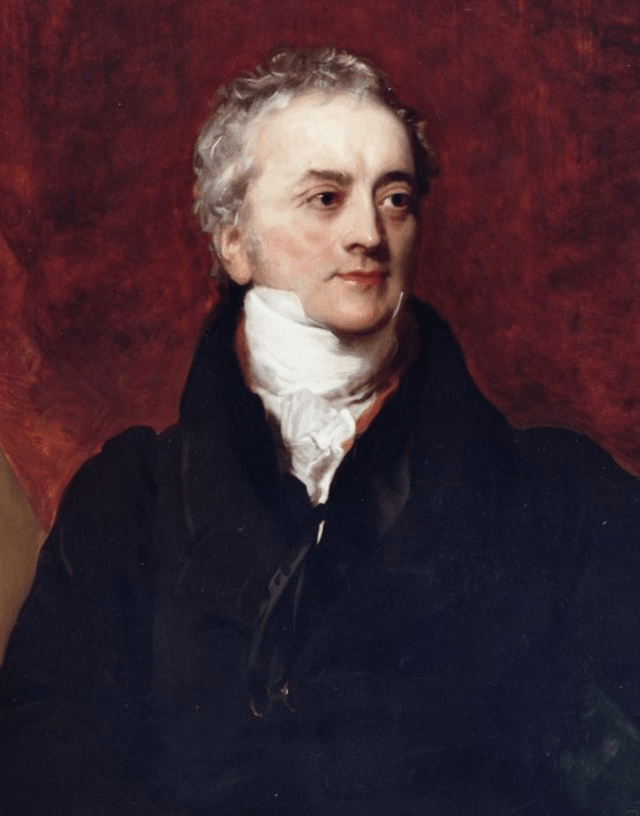
Thomas Young, The Last Man Who Knew Everything

Thomas Young was born in 1773 and lived until 1829. And while living to the ripe old age of 56 may have counted as being in his dotage in the 18th century, he certainly used his time well. The things that Young accomplished are beyond words.

Young was a medical doctor and for a while, a college professor. But he also made huge (as in, change-what-the-world-knows huge) discoveries in physics, energy, optics, vision, physiology, language, music, and Egyptology. He was referenced admiringly by such people as William Herschel, who built the world’s first large telescopes; Hermann von Helmholtz, who was a pioneer in fields as diverse as physiology, psychology, physics, and philosophy; James Clerk Maxwell, who figured out how electromagnetism works; and Albert Einstein, who figured out everything else. 

Here’s Young’s story. He studied medicine in London, and later went to Göttingen, Germany, where he received the degree of Doctor of Medicine in 1796. In 1797 he inherited a huge estate that belonged to his grand-uncle, Richard Brocklesby. That inheritance made him financially independent, which is probably why he was able to become a true polymath.

In 1801, Young was appointed professor of natural philosophy (what we’d call physics today) at the Royal Institution. Over the course of two years, he delivered 91 lectures on a staggering plethora of topics.

In 1811, he became a physician at St George’s Hospital, and in 1814 was elected to a committee that was created to study the dangers of installing natural gas lighting throughout London.  Five years later, he was elected secretary of a commission charged with determining the exact length of a pendulum whose period is exactly 2 seconds. This was extremely important for time-keeping, but it was also crucial for maritime navigation. No surprise, in 1818, he became secretary to the Board of Longitude, which was convened to come up with an answer to the vexing problem of calculating longitudinal position, which unlike latitude, can’t rely on star and planet positions relative to the horizon to do that. 

That’s a pretty healthy academic resume. But why is he called “The Last Man Who Knew Everything?” The answer is, well, he apparently was the last man to know just about everything—at least, for his time. 

My brain hurts just reading the list of this guy’s accomplishments. Young believed that his most important contribution to the world’s store of knowledge was his creation of the wave theory of light. This is important on many levels, not the least of which is that it put him at odds with Sir Isaac Newton, who was a science rock star, but believed that light was a particle (today, of course, we know that it behaves like both). He demonstrated his wave theory by crafting what came to be known as the double slit experiment, considered to be one of the most important contributions to physics ever made.

But he didn’t stop there. He went on to publish Young’s Modulus, a mathematical principle that related the pressure on a body to the amount of strain that the body is experiencing, regardless of the shape of the object—all that mattered, he concluded, is the nature of the material itself. This became fundamentally important for engineering problems, like bridge and building construction.

The next thing on Young’s to-do list was to create the science of physiological optics—in other words, to do what no one had yet done—to understand how the eye works.  In 1793, he explained how the eye automatically changes the curvature of its lens, based on the distance of the object being viewed. 

This, of course (of course), led to his development of the fundamental theories that related vision to color. That theory, called the Young-Helmholtz theory, concludes that color perception is based on the presence of three different kinds of nerves in the retina, each “tuned” to a different range of light frequencies.

Once he checked that off his list, he moved on to the theory of capillary phenomena and its relationship to surface tension. I was just talking about this last night over dinner—yeah, sure I was. This led to the creation of the Young-LaPlace equation, which explains to us why soap bubbles can form, among other things.

At this point, Young apparently got bored with physics, so he moved on to other fields. He came up with a rule of thumb for doctors to determine the correct dosage of a drug for a child, based on their age and weight. He wrote an article for the Encyclopedia Britannica at the beginning of the 18th century, in which he compared the grammar and vocabulary of 400 distinct languages, pointing out the similarities and differences, work that would later lead to the creation of such fields as phonetics, philology and linguistics. He also proposed a universal phonetic alphabet that allowed linguists to write down the correct pronunciation of any word in any language by using the universal symbols that he created. I am very familiar with this language of his, because I used it in my undergraduate studies at Berkeley. For example, the Spanish word for house, ‘casa,’ is pronounced differently in different parts of the Spanish-speaking world. In Latin America, they say ‘casa.’ But in Spain, they say something that sounds like ‘Casha.’ You can actually write the word differently using Young’s phonetic alphabet: ‘casa’ vs. ‘caša.’

And then, there are Young’s contributions to Egyptology (of course). When he was 40 years old, in 1813, he decided to study and decipher Egyptian hieroglyphics. He started with the existing translations of the demotic alphabet, and along the way found numerous errors. By 1814, he translated the Rosetta Stone. I think that was on a Saturday.

Finally, Young developed what came to be known as Young’s temperaments, which were very sophisticated methods for tuning musical instruments.

You know what I like about this guy? First, that curiosity leads to good things; and second, that I shouldn’t get too impressed with myself when I do something that I think might be impressive. Holy cow. This guy DESERVES the title of the Last Man Who Knew Everything.

What a world. And what a guy—Thomas Young. Curiosity, man—it rocks.

Things vs. Our Idea of Things

Things vs. Our Idea of Things

Steve Shepard 

A great silence is spreading over the natural world even as the sound of man is becoming deafening.               —Bernie Krause

My interest in the sounds of the natural world started when I went in search of information that would help me become a better interviewer and audio producer for my Podcast, The Natural Curiosity Project. What I discovered along the way was a treasure trove of audio knowledge, free for the taking. National Public Radio, for example, has an entire curriculum available to anyone willing to listen, comprising hundreds of hours of training and insight. I listened to every lesson, even those I didn’t need (best safety equipment for war zone reporters). The online resource Transom turned me on to Sound School, Rob Rosenthal’s Podcast about audio storytelling. And somewhere along the way, I discovered an obscure, UK-based organization called the Wildlife Sound Recording Society—WSRS to its friends.

The WSRS is a consortium of purists, the high priests and priestesses of nature’s voice. Their interest is the sound of the natural world, a world that decidedly does NOT include anthropogenic sounds—the noise created by humans. I’m not sure what English word is worse than anathema, or abhorrent, but to these folks, hearing the faint sound of a car or airplane in the background while listening to the recording of a dawn chorus is right up there with finding a large roach swimming in your breakfast cereal. 

Many members of the Society have been recording for more than 40 years, and fondly remember the days when editing involved reels of magnetic tape that were edited using razor blades to cut and splice, days when a recorder weighed 15 pounds with the 12 D-cell batteries required to power it—for about an hour. And talk about innovation: This was before the days of readily available audio gear for the serious hobbyist. Much of what they used was contrived, homemade. My friend Roger Boughton, one of the finest field recordists I know, has an attic filled with gear, including no fewer than six parabolic dishes, all made from various-sized salad bowls and other contrivances. You couldn’t easily buy parabolic microphones at the time; you had to make them. And because these folks knew their craft, their jury-rigged gear worked spectacularly well.

It’s easy to laugh at their expense, at their sometimes Rube Goldbergian approach to gear, but let me tell you what I’ve learned from my acquaintance with people like Roger. I’ve learned to listen, which, I now know, is not the same as hearing. Now, when I walk into a place to record, I feel myself consciously and deliberately slowing down as I transfer my attention from my eyes to my ears. I close my eyes. I sit down. I shut up. And I just—listen. I didn’t do this before I met people like Roger. There’s a reason we have a wonderful quote, often attributed to WSRS President Chris Watson: “I like radio better than television because the pictures are better.”

I’ve learned patience. Unlike photography, there’s no such thing as a ‘grab shot’ in the world of wildlife sound recording. As St. Augustine reportedly observed, “The reward of patience is patience.” Not long ago I sat in one place deep in a forest for two hours without moving. Had I been in photographer mode, I would have stomped away in frustration after maybe ten minutes of fidgeting. Photographs are captured during intervals of thousandths of seconds; nature’s voice is linear, captured in real-time. Patience, then, is not an option. It’s a requirement. And the fieldcraft required to do it is critical.

I’ve learned context. When I sit in a place with my recorder beside me, my headphones on, my microphone pointed over there, I’m taking in much more than the sound of that pileated woodpecker hammering on a decaying tree, 100 feet away. I also hear his claws on the bark as he moves about in search of food. His movements make me wonder what he’s looking for. I hear him call, that ratcheting sound that can only be a pileated woodpecker. I hear him hammer, multiple times in a single second, and wonder how he can do that without suffering a traumatic brain injury. And I listen to the gaps, the intervals between his calls, and wonder, why that interval? And who jumps in during that period of woodpecker silence to fill it with their own voice? 

I’ve learned about cooperation, the kind that goes on in the domain of wildness. This comes in two forms. The first is the human kind. For reasons that are a mystery to me, sound recordists have no problem—even the best of them, the ‘rock stars’ of the craft—answering questions for less experienced recordists. In fact, they go out of their way to respond to queries posted on the few blogs that are devoted to nature’s voice. 

But I’m also talking about a form of biological cooperation, for lack of a better term. I spent my career in telecommunications, where we learned to share the scarce but valuable resource known as broadband in two ways: the first, a technique called time division multiplexing, or TDM; and another called frequency division multiplexing, or FDM. No need for a degree in physics: in TDM, we give you all of the available frequency for some of the time. In FDM, we give you some of the available frequency for all of the time. In other words, in TDM, we tell each user, “You can holler as loud as you like, but only for this much time, and then you have to shut up because it’s somebody else’s turn to use the channel. Don’t worry, you’ll get another turn.” Think round robin. In FDM, we tell each user, “You can holler as long as you like, but only within this limited, dedicated channel we assign to you. Stay in your lane.” 

We think of ourselves as being such a technologically sophisticated species, yet nature has been using these techniques for eons. We’ve all heard birds calling back and forth in the forest, taking turns. One calls for a period of time, then passes the talking stick to another. That’s TDM. And years ago, legendary field recordist and acoustic ecologist Bernie Krause posited his ‘niche hypothesis,’ demonstrating using spectrograms that the natural world has been doing Frequency Division Multiplexing for—well, forever. Bullfrogs are way down here in the frequency domain, timberdoodles just above the bullfrogs, crickets and katydids are here, red-winged blackbirds and spring peepers, way up here. Everybody sings at once, but everybody stays in their lane. 

I witnessed a human example of this just the other day at the local coffee shop. A group of women had gathered to celebrate a birthday, and in their excitement at the arrival of the guest of honor, everybody was talking at once. One woman was trying to get everyone’s attention to let them know that the server had arrived to take drink orders, but to no avail. Without even thinking about it, she pitched her voice way down low, and with tone and timbre that made her sound like James Earl Jones amidst the cacophony of higher-pitched voices, she got their attention. 

Frequency Division Multiplexing.

These techniques have worked well for the non-human denizens of Earth for as long as they’ve been on the planet. At least they did, until humans came along. And what did we do? Through our cacophonous and indiscriminate use of cars and motorcycles and off-road vehicles and chain saws and logging and snow machines and propellers and ship sonar and two-cycle leaf blowers and airplanes, we stomped on all those frequencies. We overwhelmed them with noise. Not with mating calls, or threat warnings, or information about where the flowers are with the most pollen or nectar, but with industrial racket. Meanwhile, all those non-human residents suddenly find themselves in a world where their voices count for nothing. They can’t call for mates; they can’t hear the approach of a predator; they can’t hear shared information about food, or weather, or habitat availability. They can’t detect the approaching bulbous prow of a tanker, and they can’t get away from the flesh-rending blasts created by oil exploration, so they beach themselves to get away from the pain—and they die.

The fragile weave of natural sound is being torn apart by our seemingly boundless need to conquer the environment rather than to find a way to abide in consonance with it.           —Bernie Krause

We are always quick to point to the obvious biological indicators of climate change: Red tides and the mass die-offs of fish and other species that accompany them. Anoxic dead zones in the ocean. Massive mats of blue-green algae in large bodies of otherwise fresh water. Retreating glaciers, and sea level rise. Increasing prevalence of disease in wild and domesticated species. 

Yet, one of the best indicators of the overall health of the planet is the condition of its voice. The sounds of the non-human world are growing quieter, while the sounds of human activity are growing louder. A lot louder.

Many who read this will be quick to lash out by noting that humans are as much a part of the natural world as humpback whales, pangolins, houseflies, chickadees, birds of paradise, and koala bears. And, they would be correct. But the things that humans surround themselves with, those two-cycle chain saws, loud cars, gas-powered leaf blowers, snow machines, and undersea detonators, are not. It isn’t the buzz and rumble of human conversation that overwhelms the natural soundscape and makes it impossible for the other species to carry on with their lives and coexist; it’s our thoughtless and indiscriminate use of technology as the enabler of industry that can’t operate without making noise.

Soon silence will have passed into legend. Man has turned his back on silence. Day after day he invents machines and devices that increase noise and distract humanity from the essence of life, contemplation, meditation.                              —Jean Arp

So, where am I going with this audio essay? Probably not where you think.

I am many things, but naive is not one of them. I believe that we need to move away from petroleum-derived fuels as much as we can, because the carbon compounds created when they burn do, beyond a shadow of scientific doubt, contribute to the greenhouse effect that is warming the planet at an alarming rate. Notice that I said contribute—not cause. Human generation of greenhouse gas is one of many factors that lead to climate change and a warming planet. But it’s a big one. 

However, if you want to talk about cause, let’s do that. A warming planet causes weather patterns to change, and from the perspectives of things that live here, not in a good way. Increasingly violent weather, less predictable storms, and acceleration of the Niño/Niña effects are immediate and visible examples of an atmosphere that is increasingly incapable of venting planetary heat into space. 

And what about less visible effects? There are many, and they’re insidious. As the planet warms, the ice at the poles begins to melt. Feel free to doubt this cause-and-effect relationship, but it doesn’t take a degree in meteorology or geography to look at aerial photographs of the North and South Poles on Google that were taken in the 1960s, or the planet’s major glaciers, or Greenland’s massive ice cap, and compare them to the same images taken today. The difference is striking. 

Another factor is albedo, a measure of a surface’s ability to reflect heat. The ice at the planet’s poles reflects 90 percent of the sunlight that strikes it, serving as a cooling engine for the Earth. But as the ice cover shrinks, that reflectivity, that albedo, shrinks as well, and the heat is absorbed by the planet, rather than reflected by it. And yes, it bodes badly for charismatic species like polar bears and walruses and penguins, but it also bodes badly for us. Why? Because of that very same cause-and-effect relationship I mentioned earlier. The ice at the edges of the planet’s ice caps and floating sea ice is frozen fresh water, not sea water. It isn’t salty, because as polar seawater freezes, the salt is squeezed out, leaving behind pure ice that could be chopped up and dropped into a cocktail. Greenland’s icecaps and the world’s glaciers originated as snow, thousands of years ago—and were therefore freshwater to begin with.

As the ice melts, the salinity of the surrounding water goes down. And while this change in salinity can be bad for organisms that have adapted to a certain level of salt in the water, that’s not the biggest issue. The biggest issue is far more consequential.

Because of a number of related factors such as density differences between fresh and salt water (salt water is denser than freshwater), temperature gradients between deep and shallow ocean water, winds, and tides, ocean water is constantly moving. In the abyssal deep, cold water rivers flow, great currents that transport heat and nutrients throughout the world’s oceans. Some call these flows ‘liquid wind.’ Meanwhile, in the shallower depths, warmer waters flow. But as the warmer waters circulate to the poles, they chill, and then they sink, forcing colder, nutrient-rich waters to the surface, a phenomenon known as an upwelling. This constant exchange of warm and cold water results in colder climes at the poles and warmer climes at the equator, and relatively predictable global weather patterns. It also creates a consistent nutrient delivery engine for everything that lives in or near the oceans.

But: if the ice captured at the poles and in glaciers and atop Greenland melts, here’s what happens. The heat-based differential energy source that keeps oceanic currents circulating disappears, as warmer waters cool, and cooler waters warm. The temperature gradient-driven system of oceanic currents slows and stops; nutrients stop moving; and a mass oceanic die-off occurs as the food chain collapses, including the loss of a little-known bacterium called prochlorococcus, which captures roughly 50 percent of oceanic carbon and produces more than 40 percent of the world’s oxygen. Compare that to nine percent produced by the planet’s tropical rain forests. 

Meanwhile, the polar regions warm; the equator cools. Weather patterns become increasingly violent and unpredictable, as the moderating force of oceanic currents fades away. Sea level rises; coastal areas flood; island nations disappear beneath the waves. Kiribati, Palau, the Maldives, Fiji, the Marshall Islands—all are at high risk. Global average temperatures settle somewhere in the mid-50s Fahrenheit, 10 Celsius, as the liquid wind of the great oceanic rivers slows and ultimately stops.

 Meanwhile, changes in weather patterns lead to extensive, long-term drought in interior farmlands, while coastal communities deal with extreme flood events. Deep continental aquifers fail because of a combination of over-pumping and a lack of the rain that typically recharges them. Storms become more violent; crops are lost; farmland becomes unusable.

If there is magic on this planet, it is contained in water.    

—Loren Eiseley

Let’s talk about Greenland for a moment. It’s a massive island, a protectorate of Denmark, with a population of 57,000. It’s covered by a massive ice sheet—one of the largest on the planet. Its average thickness is 1.6 miles, and in terms of size, it’s 1,500 miles long, north to south, and 470 miles wide. Let me give you some perspective on those meaningless numbers. Imagine a slab of ice, a mile-and-a-half thick, that covers most of the United States east of the Mississippi River, from the Florida Keys all the way to Maine. It accounts for just shy of ten percent of the planet’s fresh water. If it were to melt, and all the evidence says that that’s already happening, sea level would rise 23 feet.

I know what you’re thinking: you’ve heard all this before. Another overwrought, handwringing, save-the-whales, Vermont-based liberal snowflake with a degree from the Republic of Berkeley, for god’s sake. Well, let me be clear. I do want whales to be protected. I do want to preserve old-growth forests in perpetuity. I do want to see a reduction in the global consumption of beef. I do believe in the humane treatment of livestock. I do believe that climate change and the ongoing warming of the planet are real, regardless of cause. I do believe in alternative energy production, solar and wind and hydro and tidal bore and yes, even nuclear. 

You know what else I believe? I believe that we should continue to drill for oil and natural gas. Yes, you heard correctly. But let me tell you why.

Every 42-gallon barrel of crude oil produces just shy of 20 gallons of gasoline. The other 20-plus gallons become vitamins, medications, synthetic rubber, a huge range of cleaning products, plastic, and asphalt. Asphalt: of the more than four million miles of roads in the U.S., almost three million miles of them are paved with asphalt. We can change to cement, you say? Yes, we can; just be aware that the production of cement is one of the two largest producers of carbon dioxide—greenhouse gas—in the world. 

And plastics? Yes, we should absolutely reduce our use of the stuff. Single use water bottles, single use plastic bags, individual apples wrapped in plastic, then packaged on a disposable plastic foam tray and wrapped again in plastic wrap? That’s just idiotic. But let’s be careful, here. We also use plastic polymers—long, strong molecular chains—to manufacture heart valves. Artificial knees and hips. Prosthetic limbs. Polyester, the stuff that many forms of clothing are made from (Yes, that’s plastic). And then we have cosmetics, toothbrushes, iPhones, contact lenses, glasses, paint, toilet seats, nail polish, and countless other products. 

So, no—I don’t believe we should stop sucking oil out of the ground. I do believe, however, that we have an obligation to think differently about how we use it once we refine it into its many derivatives. But here’s my question: will we? 

Al Gore coined the phrase, “An Inconvenient Truth.” He hit on something important with that. We (and we can argue about who ‘we’ are) have become a culture consumed by the avoidance, at all cost, of inconvenience. Personal effort is inconvenient. Food preparation is inconvenient. Walking to the store instead of driving is inconvenient. Picking up the phone and calling someone instead of sending a text is inconvenient. Writing a paper or article or personal letter instead of asking ChatGPT to do it—that’s inconvenient. Thinking about the possibility that an outlandish idea is wrong before sharing it on social media is inconvenient. Thinking in a deliberate way is inconvenient. 

What this leads to is a concept that I’ve been thinking about for a long time. I call it the difference between ‘things’ and ‘our idea of things.’ And I believe this idea is central to many of the challenges we face today.

Things vs. Our Idea of Things

Intelligent people tend to espouse theories of action that have little to do with actual behavior.                   —Peter Senghe

Imagine the following scenario. A town official is asked what she or he is going to do to cut unnecessary spending during a period of shrinking tax revenue. “Well, I have that all planned out,” the official says. “We’re going to lengthen road paving schedules to reduce materials cost; we’re going to limit snow removal to accumulations of four inches or more; we’re going to use less road salt; we’re going to put low-energy LED bulbs in all town buildings; and we’re going to close the town library.”

Say what? Close the library? Are you insane? No public official would ever dare do such a thing. Close the library. Please.

Yet, how many people actually use the town library? When’s the last time you went?

Our greatest obstacle, I believe, is the difference between things and our idea of things. The idea of a town without a library is ludicrous. Yet, usage of library services tends to be low among most towns’ residents. After all, it’s inconvenient to drive or, good grief, walk, down to the library to browse the stacks and check out a physical, digital, or audio book to read, when we can far more conveniently sit on our growing asses in the living room and download one from Amazon without moving anything other than an index finger. But get rid of the library? Never. What kind of community would we be if we didn’t have a library?

That quote you heard a moment ago, “Intelligent people tend to espouse theories of action that have little to do with actual behavior,” is attributed to many people, mostly to Peter Senghe, although Web searches are ambiguous as to its origin. But it captures the sentiment of what I’m trying to convey here. We, as human beings, will say something with great conviction (‘Now that I’ve gone through this workshop on work-life balance, I’m going to leave the office at 5 PM every day from now on and spend more time with my family!’), but after the obligatory week of being a demonstrably different person because of the workshop, we creep back to our old ways and do what we’ve always done, proving once again that the allure of the status quo is as powerful as a tractor beam, and that it controls our behavior far more than we realize. Why? Because making a change like that is hard. It’s disruptive. 

It’s inconvenient.

The idea of individually reducing carbon emissions by driving less and walking more, of deliberately using less plastic by bringing our own bags to the grocery store, of refilling dish soap and shampoo and hand soap bottles at the bulk product counter at the health food store, of buying cotton or hemp or wool clothing instead of polyester, of eating less meat and more vegetables, of buying local produce from the farm stand instead of tomatoes from Chile and kiwis from Israel at the grocery store, are all great ideas, because they’re our ideas of things, not the things themselves. Our willingness to change is indirectly proportional to the number of excuses we can come up with to worship the status quo. Walk to the store instead of drive? It’s a really good idea, but it’s not safe. It’s cold. It’s hot. It’s windy. It might rain. I have too much to buy this time, and I look silly pulling a wagon. I don’t have time. Maybe tomorrow. Go to the farm stand? It’s out of the way. And I always forget to bring my reusable bags, and I never remember those bottles. Next time.

It’s just not convenient.

The Oxford English Dictionary defines convenience as “Personally suitable to ease of action or performance.” Etymologically, it comes from the Latin convenientem, ‘to come together or gather.’ As someone who studied the arcane field of Romance Philology at university—the origins of Romance languages—this definition strikes me as a tear in the fabric of the space-time continuum. If my thesis is correct, we aren’t willing to come together to do the right thing, because it isn’t convenient. We aren’t willing to behave like a true community, coming together for the greater good, because it’s not convenient. We’ll talk about it loudly, we’ll vocally support it, we’ll even slap the bumper sticker on the car—just don’t expect us to actually do anything. How is that an act of convening, of coming together, of convenience? Isn’t it, by definition, precisely the opposite?

Not My Job, Man

There’s another factor that must be considered: personal accountability. Somewhere at the nexus of ‘Not my job,’ ‘Not in my back yard,’ and ‘You’re not the boss of me’ lies the source of the human behavior I’m talking about. All too often, we agree with great fervor that something should be done, some catalyst for changed behavior, but it’s ‘all those offenders out there’ who should do it, not me. Pick up a piece of trash on the road in my own neighborhood? I didn’t put it there; that’s not MY job. Of course, I want five bars of cellular service on my phone in every room in my house; but don’t even think about putting a mobile radio tower where I can see it. And when public figures exhort us to do something, or to behave differently, our response is sadly predictable: how dare they tell us what to do. I’m perfectly capable of behaving in a responsible and civilized fashion.

If that’s the case, why don’t we?

I started this essay with some observations about the impact that human sound—noise—has on the Earth’s non-human residents. I’m reluctant to say ‘impact on the natural world’ because humans are as much a part of that natural world as all the other living things with which we share the planet. Even human voice is natural. But mechanical sounds, industrial sounds, vehicles that are loud for no reason other than to be loud, are not part of the soundscape of the natural world. They’re damaging, they’re offensive, and they don’t have to be. In the same way that I believe that we should continue to drill for oil for the foreseeable future, I believe that the sound of industry is a necessary thing in modern society. I would never suggest that we all give up our lawn mowers and buy sickles and scythes instead—That’s ludicrous. But if you’re going to buy a new mower, buy an electric one. Same goes for leaf blowers and other traditionally gas-powered devices. Towns should enforce noise ordinances on loud vehicles. Police officers respond to loud parties; why not offensively loud vehicles? Not only is electric quieter, but it also contributes far less to the atmosphere’s carbon load. But suggest that someone do something different to make a difference for everybody? Please.

This is a contentious path that I’m walking. On one side, extreme thinking demands that we ban all fossil fuels immediately. On the other side, equally extreme thinking insists that we pave paradise and put in a parking lot for the people who work at the refinery. The truth is that neither group is correct—or incorrect—in their demands. Should we reduce our dependence on fossil fuels? Yes, we should—and right now. Should we issue a full stop on the production and use of fossil fuels? Yes, we should—but not until we can do so without having a negative impact on the global economy and without depriving ourselves of the benevolent products (other than gas and oil) that crude provides us. Should we aggressively and deliberately move toward alternative sources of energy that are more sustainable? Of course—but we should also recognize that each of those comes with a cost and a negative environmental impact of its own. Yes, oil exploration and extraction have a bad effect on the environment, but so does the mining of lithium and other trace elements for the batteries and semiconductors used in electric vehicles. Wind turbines are terrific green options for power generation, other than the fact that they kill somewhere between 100,000 and 700,000 birds every year, according to a study by Smithsonian. On the other hand, house cats kill four billion birds every year. Everyone fears nuclear power, but it may be the cleanest and most efficient form of power generation we have—other than that pesky waste problem.

The truth is, there is no perfect solution for any of the problems we face. Every action comes with a cost. 

I recently read a novel by science fiction writer Robert Heinlein called ‘Starship Troopers.’ It’s the book that the movie by the same name is loosely based on, and while some of the politics in the book are questionable, the story is thought-provoking. At one point in the narrative, an ethics teacher notes that whoever it was who said that ‘the best things in life are free’ was wrong. They aren’t free, he argues; they have no monetary value, yet they are priceless, with life itself the most valuable—and valueless—of all. The cost of having these things is not measured in terms of wealth, but in the effort, the toil, the sweat and the tears required to achieve them. The instructor notes that receiving a medal for placing fourth in a foot race is far more valuable and meaningful to the recipient than a medal for first place that they might buy in a pawn shop, because the fourth-place award required personal and perhaps inconvenient effort. 

So, my question is this: At what point did inconvenience become an accepted inverse measure of the relative value of doing the right thing? Because if our willingness to do the right thing is directly related to how convenient it is to do so, we’re in a lot of trouble. Bringing ‘the thing’ and ‘our idea of the thing’ closer together, expending the effort required to make them resemble each other as much as possible, is work, and is therefore inconvenient. The idea of city streets that have no trash is the idea of the thing; but the thing requires our direct involvement—that’s the inconvenient part. But isn’t the result worth the inconvenience, especially if it contributes to the development of a tighter-knit community fabric? Whether we’re talking about reducing greenhouse gases or the noise that humans generate that unfairly affects the planet’s non-human residents, or doing something reasonable about the social ills that fill our daily lives such as the unconscionable hollowing out of the middle class, or gun safety, or a social media fabric that is anything but social, or an out-of-touch, broken healthcare system, or a corrections system that corrects very little, or an imperfect immigration system, or any of the many challenges that define life today, isn’t the effort expended to make any one of them more effective worth the inconvenience? This is life: there is no easy button. Maybe we’re measuring the wrong thing. 

Instead of assessing the relative value of the thing, whatever the thing is, perhaps we should be measuring Return on Inconvenience. Would that lead to a change in human behavior for the better? Probably not. But it’s a start.