Tag Archives: photography

The Sounds Below

I earned my NAUI Certification card—my C-card, as divers call it—in 1977, and proudly pocketed my Instructor card a year later.  As a newly-minted dive shop owner, I taught basic skills in the pool every weeknight, and on weekends I was either somewhere along California’s north coast taking new divers on their first free dive, or in Monterey for final class certification dives. The ocean has always fascinated me; like so many people, I watched, enraptured, as Jacques Cousteau and his team explored the undersea world. When I was a little boy, I pulled a pair of my underwear over my head so that one leg hole served as my face mask and pulled a pair of my dad’s socks onto my feet to serve as fins. I swam down the dark hallway, Jacques at my side. Once I was certified, the ocean became the center of my life, and that has never changed.

My first open water SCUBA dive was at Monterey Bay’s Cannery Row, back when it still had the ruin and wreckage of the old canneries strung along the beach where fancy hotels and restaurants stand today. With the clarity of poignant memory I remember pushing off the surf mat, raising the BC hose over my head, and descending below the calm surface into a world that I would come to love more than just about any other place on the planet. It is a place in which I am so inordinately comfortable that I once fell asleep lying on the bottom of Monterey Bay, my hands under my regulator as I watched life go on, tiny creatures crisscrossing the sandy bottom on their mysterious errands.
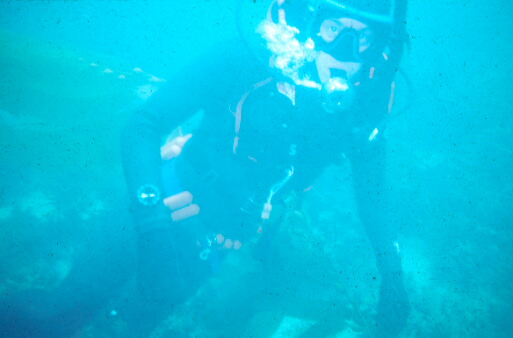
In consummate awe I dropped through the kelp on my way to the bottom during my first dive. As I descended, I brushed against the kelp leaves, causing a shower of pea-size crabs, moon snails, nudibranchs and other creatures that before my descent had been in-residence on the various levels of the Macrocystis. I would later teach my own students that at as much as a foot a day, giant kelp is one of the fastest growing plants on Earth, and that its flotation bladders are filled with enough carbon monoxide to kill a chicken in three minutes.

As I approached the sandy bottom on that first dive, I realized I had a problem. I was falling too quickly. I was a new diver, and buoyancy was not yet something I controlled subconsciously. Looking down as I approached the ocean floor, I had the overwhelming realization that no matter where I landed, whether on those rocks in front of me, or that patch of sea lettuce over there to my left, or on those old, eroded pipes from the canneries, or on the flat, sandy bottom over there, in the process of touching down I would crush countless lives. So profuse was the riot of living things that there wasn’t a square centimeter anywhere that didn’t have something living on it. 

Luckily, I was able to arrest my descent before I destroyed the community below me. I managed to go into a hover, where I stayed, unmoving, just taking it all in. My sense of wonder was so great that I lacked the ability to move. But the truth is that I didn’t want to move: I would have had to drain the tank on my back and three more like it before I saw every living thing on the patch of bottom directly beneath me. In fact, I was so motionless in the water column that my instructor came over to make sure I was okay.

As I floated, unmoving, something else crept into my consciousness: the sounds of the underwater domain. The bubbles from my exhalations. The mechanical hiss and click of my regulator. The far-away sound of a propeller frothing the ocean. A deep, unrecognizable rumble, something industrial, far away.

And then there were the clicks, trills, and bloops, the buzzing and scratching and chirping of ocean life. In other words, a cacophony, a joyous symphony, the countless voices of Monterey Bay. 

At night, the score changed. There were fewer human sounds and more natural sounds, mysterious and eerie. This became my favorite time to be in the ocean; night diving is profoundly magical. Once we sank to the bottom, turned off our lights, and allowed our eyes to acclimate to the darkness, we could see remarkably well. Every movement, every fin stroke, every turn of the head created a star-storm as the moving water caused bioluminescent plankton in the water to spark alight. Every passing seal or sea lion or otter drilled a contrail of glowing green through the black water like a living comet. This was nature’s alchemy at its best. 
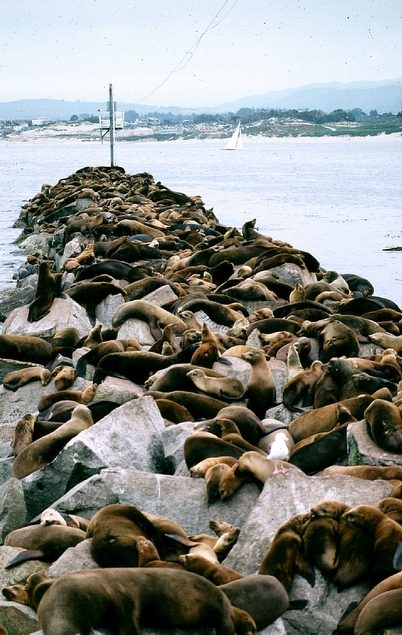
And, there were sounds—so many sounds. I once did a night dive at the far end of the Monterey Coast Guard Pier where a huge colony of seals and sea lions congregates. Divers know that if they turn on their powerful dive lights during a night dive, their vision goes from a dim awareness of everything around them to brilliant awareness of whatever is illuminated by that narrow white beam directly in front of them, drilling a hole into the darkness. Night divers also know that for reasons known only to them, sea lions enjoy barreling down the light beam toward the diver, blowing bubbles and roaring like a freight train—then veering off into the darkness at the last moment before colliding with the now terrified diver. It has happened to me more times than I can remember, and it still scares the hell out of me when it does.

Twice over the years I heard the siren song of whales while night diving in Monterey; once I heard the telltale blast of sonar, presumably from a submarine somewhere outside the Bay. It was mildly terrifying, and it was more than a little painful. One night I found myself on the Cannery Row side of the Coast Guard Pier, not far from the sea lion incident I just described. Sensing movement beside me, I saw that three gigantic ocean sunfish, mola mola, easily eight feet from top to bottom, had unwittingly surrounded me. They meant no harm and were most likely oblivious to me. But with them came a sound, a combination of stomach rumble and the squeak of a hand rubbing a balloon. It was all around me, and it was loud. At first I thought it was air moving around inside their swim bladders, a common marine sound, but giant sunfish don’t have swim bladders. To this day, I have no idea what I was hearing, but I’ve never forgotten it. All I know is that when the sunfish disappeared into the depths of the Bay, the sound disappeared with them.

I have long been an avid photographer, both above the surface and below it. But as time went on, I began to pay more attention to what my ears were telling me than what my eyes were. I don’t know what caused that focal shift; perhaps it was the fundamental nature of the two senses. Not long ago, on a whim, I sat down with a calculator and my photo database and did a back-of-the-envelope calculation. It turns out that from the time I started shooting seriously until today, a period that covers just shy of 50 years, I shot approximately 500,000 images. Big number. Most of them I shot at a 250th of a second, my preferred shutter speed. That means that every 250 images I shot covered one second of Earth time. 500,000 images, then, translates to 2,000 seconds, which is just over 33 minutes. In other words, my nearly 50 years of serious, near-constant shooting captured a half-hour of my life. 

On the other hand, when I go out to record sound, I often sit for an hour or more with the recorder running, capturing a soundscape. During that time, I immerse myself in the environment and become part of it, something that’s impossible to do in a 250th of a second. With my camera I click and go, rarely lingering after the famous ‘moment it clicks’ to savor the entirety of what I just captured a tiny slice of. 

Photography is about capturing a still image, a single, frozen moment in time. But what in the world is a ‘still sound’? The answer of course, is there is no answer. The difference between a photograph and a sound recording, beyond the obvious, is time. A photograph captures a moment in time; a sound recording captures a moment over time. Photography is often described as a “run-and-gun” activity. But when I go out to record, that approach doesn’t work because sound recording by definition is immersive: I have to settle down in the environment, get my gear sorted, and be quiet by being still. If I’m still, I pay attention. And if I pay attention, I notice things. My awareness of my surroundings isn’t limited to what I see through the narrow viewfinder of a camera; it’s as broad as I choose to make it, and the longer I sit, the richer my awareness becomes. 

Maybe it’s age-related. I’m older now than I was when I started photographing seriously; with age comes patience, and patience is a critical element of sound recording. Saint Augustine said, “The reward of patience is patience.” And it isn’t because I have more time now that I’m older; I have the same time now that I had when I was 21, a full 24 hours every single day. It’s a question of how I choose to use those 24 hours. Bernie Krause, writing in The Power of Tranquility in a Very Noisy World, said, “Heed the narratives expressed through the biophony. Our history is writ large within those stories. Be quiet. Listen. Be amazed.” 

Be quiet. Listen. Be amazed. Great advice for all of us.

Of Fens, Mires and Bogs

I Just finished a terrific book called Following the Water by David Carroll. I’ve read all his books; he’s a New Hampshire-based naturalist who specializes in turtle ecology. That makes me smile, because there aren’t many animals that I like as much as turtles. Following the Water is a collection of reflections on his wanderings around the streams, ponds, forests and fields that surround his home. 

I’ve spent most of my career in the technology domain, telecom mostly, so I’m very familiar with the acronyms and unique terminology that every field creates for itself. For example, I don’t play bridge, but I love to read the bridge column in the newspaper, just because I don’t have the foggiest idea what they’re talking about. Here’s an example:

In today’s deal the situation in three no-trump is complicated by South’s desire to keep West off-lead. Declarer will have seven top tricks once he has knocked out the heart ace, so must find two more tricks from somewhere. Fortunately, there are lots of extra chances: the spade finesse, an additional heart trick, and an extra club winner or more. The key, though, is for South to combine his chances in the right order.

Say what? The spade finesse and an additional heart trick? I have no clue what the author’s talking about, but reading the column is like watching a linguistic train wreck. I can’t stop myself.

So, it’s no surprise that Carroll’s book has its own words that address the needs of the aquatic ecologist. As he describes the place where water and land meet to create complex ecosystems that each produce their own unique collection of living things, he draws on a poetic collection of words to describe the hidden world that he’s devoted so much of his life to. What is so interesting to me is that as I read his book, one mysterious word leads to another, causing me to spend way too much time in the dictionary. 

As we follow Carroll through a dense tangle of willows, he describes it as a carr. A carr, it seems, is a bog or a fen, where willow scrub has become well-established. That, of course, sent me back to the dictionary in search of bogs and fens (by the way, this was almost as much fun as actually getting muddy). A fen, it turns out, is one of six recognized types of wetland and one of two types of mire. The other is a bog. Fens tend to have neutral or alkaline waters, whereas bogs are acidic. A mire, by the way, sometimes called a quagmire, is the same as a peatland. Peatlands can be dry, but mires are always wet. Mires, by the way, are the same as a swamp, except that mires tend to be colonized by mosses and grasses, while swamps usually have a forest canopy over them.

Carroll also spends a lot of time describing vernal pools and the creatures that spawn in them. I love that term, vernal; it conjures something mysterious for me, a place of unknown creatures that rise from the depths at night. Think Dr. Seuss’ McElligot’s Pool. Anyway, vernal pools are temporary pools that provide habitat for specific species, although not fish. They tend to be temporary, and are often teeming with things like tadpoles, water striders and whirligig beetles. They’re called ‘vernal’ because they’re at their deepest in the spring (the word comes from the Latin, vernalis, the word for that season), and they’re typically found in low spots or depressions in grassland habitats.

Another word that comes up a lot is riparian. Riparian describes the transition zone that lies between the land and a river or stream that runs through it. Riparian areas are important, because they filter and purify water that runs off the land and enters the waterway. A biome, by the way, is a community of plants, animals or microorganisms that inhabit a particular climatic or geographic zone. So, a riverbank would be a riparian biome.

And what about the wetlands that Carroll refers to throughout the book? Well, a wetland is an area that’s eternally saturated with water, like the Everglades. They’re standalone environments, but they can also include swamps, marshes, bogs, mangroves, carrs, pocosins [puh-CO-sin], and varzea [VAR-zea].

By the way, because you’re dying to know, a pocosin is a palustrine [PAL-e-streen] wetland with deep, acidic peat soils, sometimes called a shrub bog. Palustrine, incidentally, comes from the Latin word palus, which means swamp. Palustrine environments include marshes, swamps, bogs, fens, tundra, and flood plains.

And since we mentioned it, a varzea is a seasonally-flooded woodland specific to Brazil’s Amazon rain forest. A marsh is a wetland dominated by herbaceous rather than woody plants – grasses, rushes and reeds, instead of shrubs and trees. It’s also a transition zone that’s marinated in stagnant, nutrient-rich water. By the way, swamps, like the Everglades, move water across their surfaces, while mires move water below the surface. Marsh plants tend to be submerged; mire plants are not.

Fens, swamps, mires and bogs: who would have thought there was so much diversity at the water’s edge.

Blue Highways Revisited

It was mid-1982. I had been married and working for the phone company in California for just about a year, the first phase of a 40+ year career in the telecom industry. I had left my commercial SCUBA diving business behind, but still wanted to be a professional travel photographer and writer even though I was now going corporate, becoming an Organization Man. It was different, and it was exciting, and I was grateful for the opportunity, not to mention the paycheck, given that I had a young family. But the writer and traveler in me still burned bright, as they do today, more than 40 years later.

One evening, Sabine handed me a book that had come out two weeks before, saying, “Read this. It has you written all over it.” The book was called, “Blue Highways: A Journey into America,” by previously unknown (and quirkily named) author William Least Heat-Moon. If you haven’t read the book, stop whatever you’re doing right now and go buy a copy. I can wait.

Here’s the story, and why even today, 42 years after its release, it’s one of the most important books that has appeared in the American publishing pantheon in the last century. I realize that that statement sounds bombastic, but it isn’t.

The cover of the original book.

Heat-Moon (his name comes from his Osage heritage; he was born William Trogdon) was an English professor at a small college in Columbia, Missouri when a sequence of events left him free of employment and personal attachments. He had a Ford Econoline van into which he tossed a sleeping bag, a camera, a typewriter and writing supplies, and a scattering of camping gear. Leaving Columbia, he drove east on what would become a three-month, 13,000-mile amble around the United States, during which he avoided freeways and interstates, choosing instead to drive only on secondary roads—which are blue on maps, hence the name of the book that grew out of the trip and that would stay on the New York Times bestseller list for more than 40 weeks. 

The Interstate Highway System that was built in the 60s and 70s bypasses the small towns of America, the backbone and soul of the country. Freeways, along with the soulless interchanges around which fast-food chains, hotels, discount stores, and gas stations cluster in a homogeneous nothingness, may create a fast and convenient way to drive across the country, but they don’t allow travelers to drive through the country. Traveling cross-country via interstates gets you there faster; traveling the Blue Highways, as Heat-Moon did, gets you there richer. 

As we enter yet another political election cycle characterized by vicious, puerile attacks between candidates, social media’s slimy degradation of whatever respect and reverence still exist between people of different viewpoints, and the reduction of thinking, caring people into meaningless labels because a label requires far less effort to hate than the complicated person behind it, it’s a very good time to read Blue Highways for either the first, second or in my case, 19th time (and yes, that’s a real number). Here’s why.

Heat-Moon’s journey took him from Missouri to the east coast, where he turned south to follow a slow, wandering route down the eastern seaboard, then westward across the southern tier of the country, up the eastern spine of California, back across the Great Plains states and around the Great Lakes, all the way up to Acadia, then back down and finally west to where the journey began in Missouri.

With William Least Heat-Moon in Vermont.

I had the good fortune to meet the author in the early 1990s, when he taught a week-long creative nonfiction writing workshop at the University of Vermont, and I managed to get accepted into the program after Sabine surreptitiously signed me up for it. In addition to the elements promised in the workshop syllabus, Bill also regaled us with stories about three months on the road in his van, Ghost Dancing, and what he learned during the journey.

Many of you have heard me quote Mark Twain in my own writings and audio programs. One of my favorites Twainisms is, “Travel is fatal to bigotry, prejudice, and narrow-mindedness, and most of our people need it sorely on all three counts.” Heat-Moon is anything BUT bigoted, prejudiced, or narrow-minded, and it shows, as does his adherence to Twain’s words. As he traveled the nation, he went out of his way to stop and talk with people in cafes and diners and bars, when he picked them up as hitchhikers, at their workplaces, occasionally joining in as part of the local labor force. These were not the travelers one meets at freeway exits, stopped only long enough to stretch, use the bathroom, grab a bite and fill the tank. These were the people who live in forgotten Blue Highway towns, the detritus of economies bypassed in pursuit of expediency, at the cost of rural relevance. 

But these were also the people Heat-Moon set out to find. They were, for the most part, genuine, welcoming, and interested. Of course, he met a few unlikeable people along the way, but most were kind and open in the stories they shared with him, and they came from across the spectrum of work and life. Every one of them had something important to say; every one of them had a lesson to share. Blue Highways is the collected teachings of those lessons. 

As it happened, as Heat-Moon listened to the stories of strangers and let them sink in, he realized that he was on a journey of self-discovery as much as he was a journey of national discovery. ‘Self-discovery’: an overused term from the realm of psychobabble, which makes me reluctant to use it here. In this case, though, it was William Least Heat-Moon charting a path to his own future through the stories of others. In the same way the First Nations people of Australia believe that the gods dreamed the world into existence, Bill dreamed his future into existence—who he was and who he wanted to be—by building a fabric from the weft and weave of collective story. In the process, he also painted a national vision, a picture of what could be, although he might deny it.

Blue Highways is not about a driving trip around the country in a van to see the nation’s oddities along the way—the world’s biggest ball of twine or frying pan, the Spam Museum, the biggest truck stop. It’s a vision quest, an attempt to see the future and all its elements in the context of a large, complicated, messy, ultimately good country that has, whether you choose to believe it or not, a very big heart. It’s who we are, and Heat-Moon’s trip in Ghost Dancing is the nation’s collective story writ large. To me, what Heat-Moon discovered as he traveled from place to place and story to story was that who we are as a nation is very different from what we are as a nation. ‘What’ defines a label; ‘who’ is something far deeper and richer and more important—and, very, very difficult to describe or quantify without seeing it firsthand. He proved that hegemony, the attempts of colonialism to overlay a new culture on a place when the existing culture works just fine, thank you very much, fails every time. And if you don’t believe that, then why is there so much discussion going on about ‘the culture wars’? Blue Highways chronicles a journey to discover the things that weave us together, not the things that tear at the fabric of national self. 

As we make our way through this latest election cycle, it’s important to remember who we are, not what we are. It says it all on the Statue of Liberty’s inscription:

Give me your tired, your poor,
Your huddled masses yearning to breathe free,
The wretched refuse of your teeming shore.
Send these, the homeless, tempest-tost to me,
I lift my lamp beside the golden door!

Read the book. And for those of you who already have, it’s worth a second read. Or, in my case, a 19th. For me, it won’t be the last.