March 18, 1937, was a Thursday. It was also the day that the school in New London, Texas, exploded. According to witnesses, the walls bulged, the roof lifted, then dropped back onto what was left of the building, and the structure blew apart. 195 students and teachers died; another 200 suffered serious injuries.
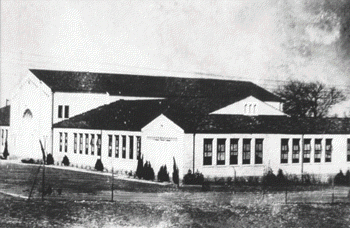
It turned out that the school had recently been plumbed for natural gas, which was used to heat the building. But there was a leak in the pipes under the school, and when a maintenance worker turned on an electric sander in the middle of the afternoon, the spark it created was all it took to ignite it.
In those days, natural gas had no smell at all, and was invisible. In fact, the market in 1937 was all about oil, and natural gas was considered a waste by-product. Refineries and oil wells separated it from the crude, and piped it off to distant towers, where they burned it 100 feet up in the air in a huge yellow flare. As a kid, living in west Texas, I remember seeing those flares at night as we drove by on the highway. Anyway, because it was considered a waste product, some businesses would tap into the gas lines that carried the gas from the wellhead to the flare tower and use it for various things, including heat—which is what the school did. The oil companies didn’t care; they were just burning it to get rid of it. If somebody wanted their garbage, let ‘em have it.
The morning of the explosion, a leak in the connection between the gas pipe and the newly installed heaters filled the crawlspace under the school with gas. The force of the explosion was so great that a 4,000-pound block of concrete was blown through the air, crushing a car 70 yards away. Keep in mind that that’s most of a football field.
Shortly after the disaster, a law was passed that mandated that smelly compounds be added to natural gas, smelly enough that humans would be able to unmistakably detect and recognize a gas leak. The chemical they chose was from a family of compounds called Mercaptans.
Ethyl Mercaptan is considered to be one of the smelliest compounds on the planet. It is so strong that a human can detect it in concentrations as small as one part per billion. For comparison, sugar requires five million parts per billion before it can be tasted.
Methyl Mercaptan, sometimes called methanethiol, is added to natural gas to make it easier to detect. It’s colorless, but it stinks. In fact, it occurs naturally in cabbage, onions, bad breath, asparagus, cheese, the various unsavory things that come out of the north end of a south-facing animal, including people, and rotting carcasses. By the way, just to put the potency of this stuff into perspective, chlorine, which is pretty pungent, requires 143 times as many parts-per-million as Methyl Mercaptan for the human nose to even detect it.
This is one of the reasons why it’s so interesting that when they first started mixing Mercaptans into natural gas, workers at a Texas refinery noticed a weird phenomenon that kept happening. Whenever one of their pipelines sprung a leak, no matter how minor, there would soon be clouds of turkey vultures hovering over the area. This puzzled them until somebody put the facts together, noting that the one thing that rotting carcasses, which is like an all-you-can-eat buffet to vultures, and natural gas and have in common, is Methyl Mercaptan. And you know what’s cool? They still look up for turkey vultures today to find leaking pipelines.
So, smell is pretty important. Before I leave you, let me share a few interesting things about it that I learned while researching this essay. First, there is a disorder called anosmia, which is the inability to smell anything at all. As I record this, Sabine is baking bread upstairs, so at this very moment, I can’t think of a worse disorder to have. But it turns out that there is one, and it’s called cacosmia, which is the ability to ONLY smell disgusting things. In fact, for people with this disorder, even good smelling things, like baking bread, tend to smell disgusting—rotting meat.
OK, moving on. Scientists who specialize in the sense of taste have identified five unique flavors: sweet, salty, sour, bitter, and umami, which is that interesting rich flavor that monosodium glutamate adds to food. Well, they have also identified seven unique smells, from which they believe all smells derive. They are putrid, which is pretty self-explanatory, unless you have anosmia; musky, which is the quality of colognes, perfumes, and after-shaves; pungent, which refers to the taste of things like vinegar; ethereal, which is the smell of things that evaporate quickly, like alcohol, dry cleaning fluid, and such; floral, like roses and geraniums; minty, which again, requires no explanation; and camphoraceous, which is the smell of mothballs. It turns out that our sense of smell accounts for about 95% of our ability to taste. Without it, potatoes, onions and garlic would be indistinguishable.
Let’s see, what else. Bactrian camels—they’re the ones that live in places like the Gobi Desert—can smell water 50 miles away. What they’re smelling is the bacteria that grows in it, not the water, but 50 miles. Zowie.
Finally, babies can detect smells in the womb, and when you’re sleeping, you can’t smell—that particular sense shuts down. And while everybody knows that women smell better than men, did you know that they also smell better than men? That’s right—a woman’s sense of smell is significantly stronger than that of a man. You might also find it interesting that 75% or so of our emotional responses derive directly from our sense of smell.
OK, enough. Another curious topic—hope you enjoyed it.
 Steven Shepard