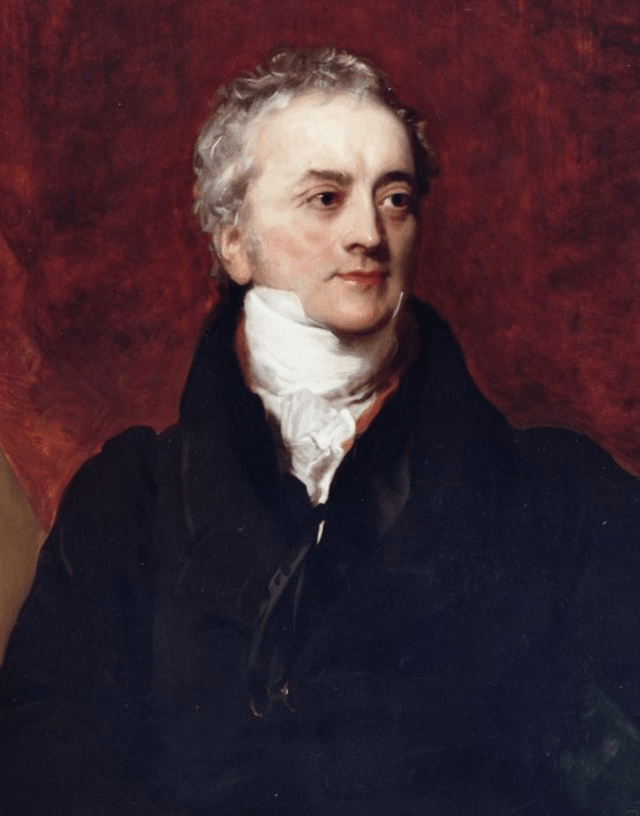
Thomas Young was born in 1773 and lived until 1829. And while living to the ripe old age of 56 may have counted as being in his dotage in the 18th century, he certainly used his time well. The things that Young accomplished are beyond words.
Young was a medical doctor and for a while, a college professor. But he also made huge (as in, change-what-the-world-knows huge) discoveries in physics, energy, optics, vision, physiology, language, music, and Egyptology. He was referenced admiringly by such people as William Herschel, who built the world’s first large telescopes; Hermann von Helmholtz, who was a pioneer in fields as diverse as physiology, psychology, physics, and philosophy; James Clerk Maxwell, who figured out how electromagnetism works; and Albert Einstein, who figured out everything else.
Here’s Young’s story. He studied medicine in London, and later went to Göttingen, Germany, where he received the degree of Doctor of Medicine in 1796. In 1797 he inherited a huge estate that belonged to his grand-uncle, Richard Brocklesby. That inheritance made him financially independent, which is probably why he was able to become a true polymath.
In 1801, Young was appointed professor of natural philosophy (what we’d call physics today) at the Royal Institution. Over the course of two years, he delivered 91 lectures on a staggering plethora of topics.
In 1811, he became a physician at St George’s Hospital, and in 1814 was elected to a committee that was created to study the dangers of installing natural gas lighting throughout London. Five years later, he was elected secretary of a commission charged with determining the exact length of a pendulum whose period is exactly 2 seconds. This was extremely important for time-keeping, but it was also crucial for maritime navigation. No surprise, in 1818, he became secretary to the Board of Longitude, which was convened to come up with an answer to the vexing problem of calculating longitudinal position, which unlike latitude, can’t rely on star and planet positions relative to the horizon to do that.
That’s a pretty healthy academic resume. But why is he called “The Last Man Who Knew Everything?” The answer is, well, he apparently was the last man to know just about everything—at least, for his time.
My brain hurts just reading the list of this guy’s accomplishments. Young believed that his most important contribution to the world’s store of knowledge was his creation of the wave theory of light. This is important on many levels, not the least of which is that it put him at odds with Sir Isaac Newton, who was a science rock star, but believed that light was a particle (today, of course, we know that it behaves like both). He demonstrated his wave theory by crafting what came to be known as the double slit experiment, considered to be one of the most important contributions to physics ever made.
But he didn’t stop there. He went on to publish Young’s Modulus, a mathematical principle that related the pressure on a body to the amount of strain that the body is experiencing, regardless of the shape of the object—all that mattered, he concluded, is the nature of the material itself. This became fundamentally important for engineering problems, like bridge and building construction.
The next thing on Young’s to-do list was to create the science of physiological optics—in other words, to do what no one had yet done—to understand how the eye works. In 1793, he explained how the eye automatically changes the curvature of its lens, based on the distance of the object being viewed.
This, of course (of course), led to his development of the fundamental theories that related vision to color. That theory, called the Young-Helmholtz theory, concludes that color perception is based on the presence of three different kinds of nerves in the retina, each “tuned” to a different range of light frequencies.
Once he checked that off his list, he moved on to the theory of capillary phenomena and its relationship to surface tension. I was just talking about this last night over dinner—yeah, sure I was. This led to the creation of the Young-LaPlace equation, which explains to us why soap bubbles can form, among other things.
At this point, Young apparently got bored with physics, so he moved on to other fields. He came up with a rule of thumb for doctors to determine the correct dosage of a drug for a child, based on their age and weight. He wrote an article for the Encyclopedia Britannica at the beginning of the 18th century, in which he compared the grammar and vocabulary of 400 distinct languages, pointing out the similarities and differences, work that would later lead to the creation of such fields as phonetics, philology and linguistics. He also proposed a universal phonetic alphabet that allowed linguists to write down the correct pronunciation of any word in any language by using the universal symbols that he created. I am very familiar with this language of his, because I used it in my undergraduate studies at Berkeley. For example, the Spanish word for house, ‘casa,’ is pronounced differently in different parts of the Spanish-speaking world. In Latin America, they say ‘casa.’ But in Spain, they say something that sounds like ‘Casha.’ You can actually write the word differently using Young’s phonetic alphabet: ‘casa’ vs. ‘caša.’
And then, there are Young’s contributions to Egyptology (of course). When he was 40 years old, in 1813, he decided to study and decipher Egyptian hieroglyphics. He started with the existing translations of the demotic alphabet, and along the way found numerous errors. By 1814, he translated the Rosetta Stone. I think that was on a Saturday.
Finally, Young developed what came to be known as Young’s temperaments, which were very sophisticated methods for tuning musical instruments.
You know what I like about this guy? First, that curiosity leads to good things; and second, that I shouldn’t get too impressed with myself when I do something that I think might be impressive. Holy cow. This guy DESERVES the title of the Last Man Who Knew Everything.
What a world. And what a guy—Thomas Young. Curiosity, man—it rocks.
 Steven Shepard