Occasionally, I run across something that I just can’t ignore. Sunday morning was one of those times when my curiosity about the natural world just couldn’t be contained.
My wife Sabine and I had gone out for a walk. As we rounded the front of our house, we passed under the canopy of an apple tree grove in our front yard, Sabine pointed at the mulch and said, “OK, that’s just gross. Some dog puked in the yard.” She was right: there was a big pile of yellow goo spread out on the much, about 20 inches cross. It WAS pretty disgusting-looking, so I promised to clean it up when we got back.
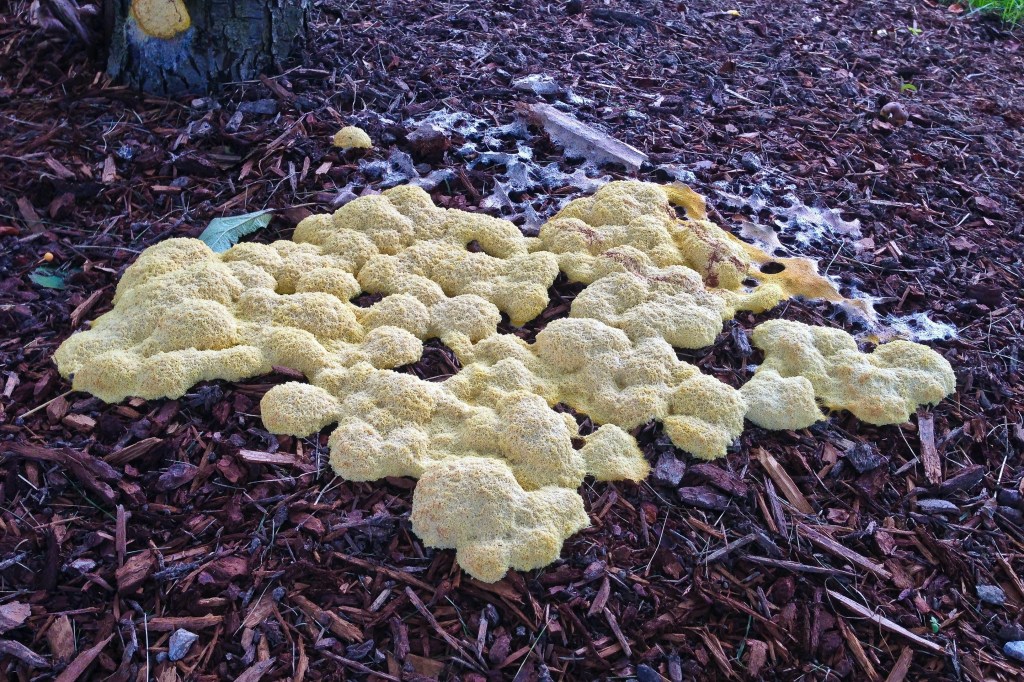
When we did get back a few hours later, I grabbed a shovel to take care of the slime under the apple tree, but when I got out there I stopped dead in my tracks. Why? Because I SWEAR it was bigger, taller, and I kid you not, closer to the apple tree. In fact, there was now a blob of the yellow stuff on the side of one of the trees. Clearly this was not something that came out of a retching dog. But here’s the REALLY weird thing. When I went to pick some of it up with the shovel, a cloud of what looked like smoke erupted from it.
So I decided to leave it where it was. I went inside grabbed my iPad, and searched for “yellow slime on mulch.” Instantly, I was rewarded with a photograph of my slime – Fuligo septica, otherwise known as Dog Vomit Slime Mold. Scientists must have a blast naming things—that has to be a high point when they discover something new. And by the way, it’s also called scrambled egg slime and flowers of tan. In Mexico, they do, in fact, scramble them like eggs and eat them. In Spanish, they’re called caca de luna, which means … well, caca is the Spanish word for what comes out of the north end of a south-bound dog, luna means moon. So this is moon sh—well, you know. I’ve tried them in pueblos south of Mexico City, and they’re not bad—kind of nutty.
Anyway, slime molds are fascinating. They fall into a category called myxomycetes, which comes from two Greek words meaning “mucus fungus.” Yummy combination—that’s not much better than dog vomit. Anyway, the interesting thing about slime molds is that they pass through a development phase called a plasmodium. During the plasmodium phase, the cells that make up the organism rearrange themselves into a single, gigantic cell with millions of nuclei, that can weigh as much 45 pounds. They’re not plants, and they’re not animals—they’re something in between.
By the way, the smoke that came out of the thing when I nudged it with my shovel was a cloud of spores, on their way to propagate the species.
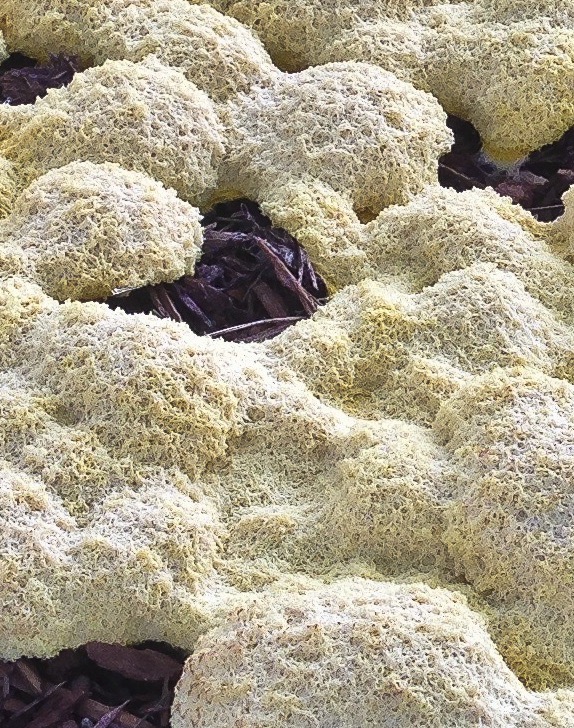
Here’s the other interesting thing about slime molds. They move. As in, they crawl. And how fast, you ask? Well, brace yourself: about an inch a day. That means that … never mind. You don’t want to go to sleep thinking about that. Just be sure to lock the door. In 1973, down in Dallas, people panicked when these things erupted in their gardens. They didn’t know what they were, and they thought it was an alien invasion. Of course, this WAS Dallas, and obviously there were too many people watching Invasion of the Body Snatchers that week.
I know that the vast majority of you couldn’t care less about slime molds, especially those that have ‘vomit’ and ‘mucus’ in their names. But you do have to admit that this is kind of interesting.
I feel like Egon Spengler in the Ghostbusters: “I collect spores, molds and fungus.”
 Steven Shepard