The hardest thing about writing a book isn’t coming up with the story, or inventing the complicated relationships that help define the characters, or making sure the story flows the way it’s supposed to. It isn’t the painstaking process of finding all the typos and misspellings and missing quotes, or fact-checking every tiny detail so that a reader who has it in for you discovers with chagrin that there’s little to criticize. Nope—it’s none of those, although those do require work.
The hardest thing about writing a novel is creating the one-paragraph synopsis that goes on the back cover. Think about it. The publisher says to the author, “Please take your 140,000-word, 468-page novel and describe it in 125 words or less, in a way that will cause a prospective reader to drool uncontrollably all the way to the checkout counter at the bookstore.”
Good luck with that. Like I said: Hard.
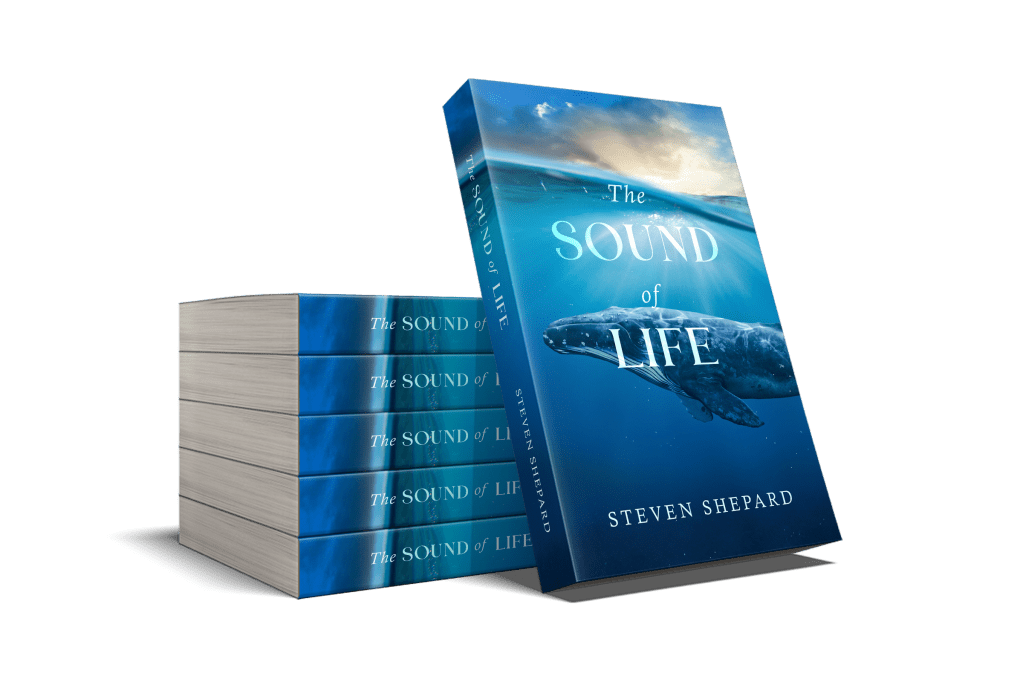
I’m about to publish a new novel, my fifth, called “The Sound of Life.” My editors have gone through it with their editorial microscopes, identifying mistakes, errors and omissions. My cadre of readers have gone through it, uncovering awkward dialogue, technical errors, and flow problems that I inevitably missed. The final manuscript is called ‘The Sound of Life v48F,’ which means that the book went through 48 complete rewrites before I deemed it ready for publication—although there will be at least two more read-throughs before I give it the final go-ahead.
I’m proud of this book. It’s my 106th title (bad habit), and I felt a sense of letdown when I typed the last sentence and knew it was done. That’s never happened to me before. Because of the story that magically emerged from the creative mists before me, the wonderful characters I met along the way, and the journey they allowed me to join them on, when I typed the last word of the final sentence, I felt like I was pulling into the driveway after a long, memorable road trip. I needed a medicine for melancholy, because it was over.
Author Alice Munro wrote, “A good book makes you want to live in the story. A great book gives you no choice.” That’s how I felt with this one. And please understand, this isn’t my ego talking. I experienced something as I wrote this book that rarely happens, like seeing the mysterious and elusive “green flash” over the ocean at sunset. At some point along the creative journey, I realized that I was no longer writing the book: it was writing itself. My job changed from creative director to scribe. It was like it was saying to me, ‘Here’s the keyboard. Try to keep up.’
Author M.L. Farrell said this about books:
A book is not mere paper and words.
It is a door and a key.
It is a road and a journey.
It is a thousand new sights, sensations and sounds.
It holds friendships, experiences, and life lessons.
A book is an entire world.”
There’s so much truth in that. I’m at the point with this one where people are asking me what “The Sound of Life” is about, and now that I know, I’m excited to tell them. But as I describe the 56-foot boat that’s central to the story, the journey from the eastern Caribbean through the Panama Canal then up the coast to Northern California, the rich interactions among the characters, and the happenings in Peru that tie much of the narrative together, I realize somewhat sheepishly that every time I tell someone what the book’s about, I speak in the first person. Not ‘they,’ but ‘we.’ Well, sure—I was there. I was along for the ride. Why wouldn’t I speak in the first person?
Stephen King is a writer whom I admire greatly, for many reasons. “Books are a uniquely portable magic,“ he once said. A uniquely portable magic. I think about the complexity, richness, excitement, laughter, and delicious food that’s captured between the covers of this book. I think about the immensely likable people and their relationships, around whom the story revolves. I think about the sights and sounds and smells and tastes they experience along the way. And I think about what it felt like when my characters, my good friends, got back on the boat and motored away, waving as they left me behind on the dock, en route to their next adventure.
A uniquely portable magic.
“The Sound of Life” will be released in December 2025.
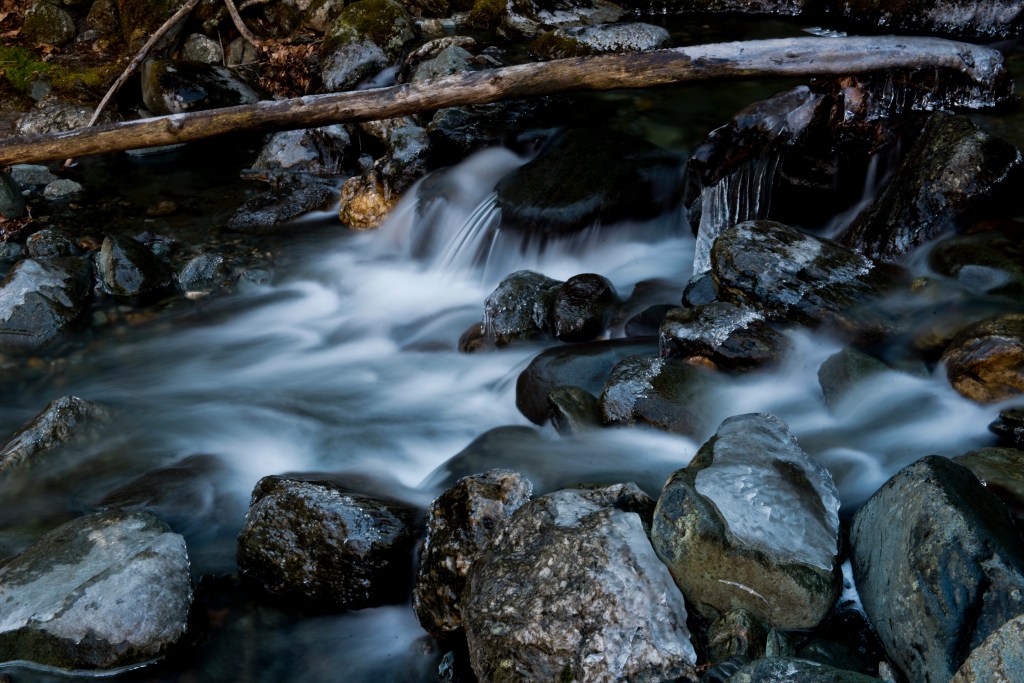
I make occasional trips to a small pond near my home, a place called Mud Pond, which is really a flooded peat bog. I love it, because it’s close—it takes me five minutes to get there—and because it’s a diverse mix of ecological zones. During a 15-minute walk I can wander through deep conifer and deciduous forests, a delicate riparian zone, and I can walk along a chattering, rocky brook as it makes its way to the pond.
The forest there is a gentle, quiet place during the day, and in the summer, it’s a green cathedral—my idea of church. Birds sing; the wind sighs and mumbles through the branches; the stream giggles over the rocks with a voice like a crystalline wind chime. Otherwise, it’s pretty quiet.
Night, on the other hand, is a different story. That’s where I am right now. I’m sitting here, in the dark, deep in the forest. It might be because there’s no moon, and the darkness has wrapped around me like black velvet, but there are sounds, all around me, none of which I hear during the day. Branches crack and fall with a sound like collapsing Tinker-toys, a sound that’s amplified by the darkness. Small things scurry and forage in the leaf litter, and they sound a lot bigger than they are. Somewhere overhead, a screech owl lets loose, and my heart skips beats. Mountain lions come to mind.
I’m wearing a headlamp, and when it’s turned on, it projects a cone of light ahead of me in the darkness. Flying things, insects and bats, flit through the beam, instantaneous and momentary shadow shapes that are unnerving. They remind me of my days as a professional SCUBA diving instructor, when we did night dives in the Pacific Ocean. Until we extinguished our lights—an act of faith of the highest order— and allowed our eyes to grow accustomed to the darkness, we were blind. And even when the lights were on, the only piece of the ocean that we could see was whatever found its way into the cone of light created by our dive lights. All too often, we’d find ourselves in a game of chicken with a harbor seal or a California sea lion. Attracted to our lights and naturally curious, they’d swim down the light beam like a runaway locomotive, veering away at the last possible moment, disappearing into the sea. You never—EVER—forget the first time that happens.
The forest at night is calm, sometimes loud, gentle, often violent, friendly, mysterious, and more than a little terrifying. I’ve stopped to sit on an old fallen tree that’s slowly disappearing into the ground as it returns to the soil. I’ve turned off the light and closed my eyes to take it all in. Eyes open; eyes closed. Nothing changes. The darkness is absolute, but the sounds are all around me. My eyelids make no difference whatsoever, and I have no earlids, so the sounds of the forest are ever-present. A bat whooshes so close to my ear that I feel the wind as it passes. It sounds like a falling envelope.
I slowly grow accustomed to the fact that I’m alone in a dark forest, where my only company is the trees, the mosses, the ferns, the rotting biomass, and whatever unnerving thing is rustling around in the leaves behind me. The smell is deep and rich, slightly foreign, the incense of the forest cathedral. Looking around, I see nothing; I look to the sky, to the treetops, and see the same, although I can just make out the silhouettes of branches against the dark sky.
But when I look down, I see—something. There’s light down there. I can barely see it, but it’s definitely there. Squatting down, then on hands and knees, I move in for a closer look. Clinging to the bottom of the rotting log, in a clump about the size of my fist, is a cluster of small, pixie-capped mushrooms. And they’re glowing in the dark. They aren’t bright; it’s nothing I could read a book by, but they glow.
There’s something intellectually wrong about this glowing mass at my feet. This should not be happening. These are mushrooms, and they’re glowing in the dark. In spite of the fact that I’m struggling to wrap my head around a glowing fungus, I’m no neophyte; this isn’t the first time I’ve experienced bioluminescence. As I said, I used to be a SCUBA instructor. I often taught advanced classes, during which I put the students through their paces to earn a higher-level certification. Over the course of a grueling long weekend, they had to perform a deep dive, a rough water dive, and a salvage dive, during which, if they completed the exercise, they’d successfully bring a large sunken case to the surface, where they would find it to be filled with iced beer, champagne, soft drinks, and snacks. They also had to demonstrate proper underwater navigation skills by swimming a complex compass course, the proper execution of which would take them to a very non-natural formation on the bottom of Monterey Bay called The Bathroom. Years ago, someone dumped a claw foot bathtub, a pedestal sink, and a toilet overboard. Divers gathered the pieces, set them up on the bottom, and, of course, took all of the appropriate photographs of themselves bathing in the tub, brushing their teeth at the sink, and sitting on the toilet. There was no ambiguity about whether a diver succeeded at the navigation dive—they either arrived at the Bathroom, or they didn’t.
The final activity in the program was a night dive. The group would gather in a sloppy, floating circle on the surface, and vainly try to create a sense of collective courage before releasing the air from their vests and descending into the unknown blackness of the dark ocean. Once they arrived at the bottom, they were instructed to turn off their lights, which they reluctantly did. The ocean swallowed them; the darkness was utterly complete.
Initially, they’d see nothing, because their eyes had not yet acclimated to the darkness. After a minute or so, though, as pupils expanded and retinas began to fire in overtime, they’d begin to make out the ghostly, shadowy shapes of rocks and kelp forest and the decaying pipes from the old canneries on shore. And then, in a moment never to be forgotten, magic would strike. One of the divers would collect her courage and push off the bottom, like a fledging bird. The instant she moved, the ocean would catch fire with the sparks of bioluminescent plankton annoyed by the moving water column, a sparkling constellation of biological stars. It was beyond breathtaking. A sweep of a hand through the water left a wash of light like an underwater sparkler; kicking fins left a glowing contrail. It was the most fitting graduation ceremony I could imagine, the earth’s original light show, a microscopic celebration of life.
How appropriate it is that the compounds responsible for this cold light are named for Lucifer, the dark lord, the fallen angel. His name means ‘bringer of light,’ and, just like its namesake, biological light is appropriately otherworldly. And it is indeed cold; 80% of the energy consumed in the generation of bioluminescence creates light; only 20% becomes heat, which is far more efficient than today’s best LED lights, which create 85% heat and 15% light from the energy they consume. Even Shakespeare, in Macbeth, jumped on the Lucifer bandwagon: ‘Angels are bright still, though the brightest fell.’ Into the ocean, apparently.
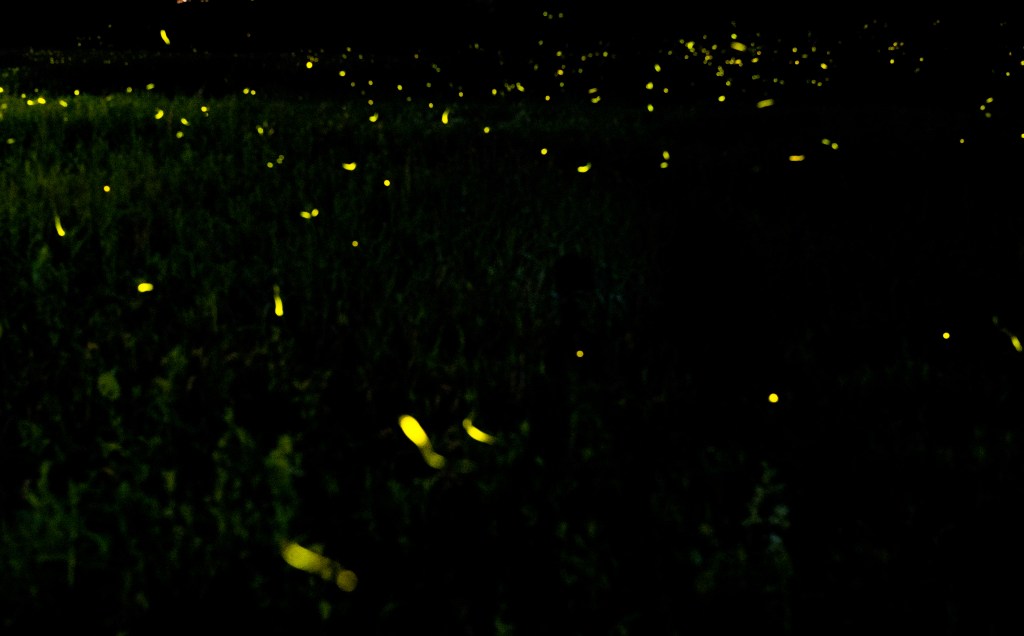
This luminance occurs when two compounds are combined: Luciferin, the substrate that forms the foundation for the reaction; and Luciferase, an enzyme that accelerates the oxidation of Luciferin, a byproduct of which is the light from the mushrooms at my feet—and from the plankton that my divers disturbed during their night dive. It occurs naturally, and all over the world. In New Zealand, bioluminescent glowworms dangle by the tens of thousands from the ceiling of the Waitomo Cave system, like glowing blue spaghetti.
Strangely, the phenomenon results in a host of emotions. I met a man at Mud Pond the other day who will not venture into the woods after dark. He isn’t afraid of animals, which is the fear that most people have; I won’t go there because things glow there, he told me.
I myself am fascinated, and enchanted, and unnerved by the faerie-fire at my feet. I covet this strange light—I want it. A part of me wants to gather the mushrooms and clutch them to my chest like Gollum and his ring, my precious, and run shrieking through the woods. Another part of me wants to put distance between us.
As a biochemistry student at Berkeley years ago, we filled test tubes with light by mixing hydrogen peroxide with dye and a phenyl oxalate ester. Chemically different from Lucifer’s light, it’s equally enchanting (this is the stuff that makes the chemlight sticks that people wave at rock concerts work). Chemical light can be manufactured, but it is a far more elegant undertaking to bioengineer living creatures to glow in the dark. By splicing a specific jellyfish gene into the genetic matrix of the mouse, scientists have created glowing green rodents. And while bioluminescent mice aren’t everyone’s cup of tea, imagine walking through a bioluminescent forest at night, a place out of Avatar’s Pandora. Imagine a city where bioluminescent trees and bushes replace electric streetlights, where glowing, multicolored lichens and mosses and flowers encrust the walls of buildings, and where shimmering grasses carpet everyone’s lawn with flowing waves of light. Imagine if plants could signal their need for water or nutrients by glowing in a particular way, or signal distress by flashing on and off in a specific pattern, a visual, biological SOS, an early warning system against infestation.
So I’m still lying flat on the ground, and I tentatively reach out and touch the glowing fungus at the base of the log. I don’t know what I expect; maybe some kind of a reaction, a subtle shift in colors in response to my approach. Or perhaps I expect warmth; but no, it’s just as cold as any other fungus. This incongruity of cold light is beyond understanding; it defies logic. I can look at the complex diagram of Luciferin’s structure on my phone, its string of intricately interconnected carbon rings, strung with molecular bangles of sulfur and nitrogen and hydroxyls; I can even follow the oxidation process that takes place during its dance with Luciferase that yields light. That doesn’t mean I have to believe it, though. This is faerie fire, plain and simple. There are faeries about in these woods, or perhaps Pandorans; I just haven’t found them yet.
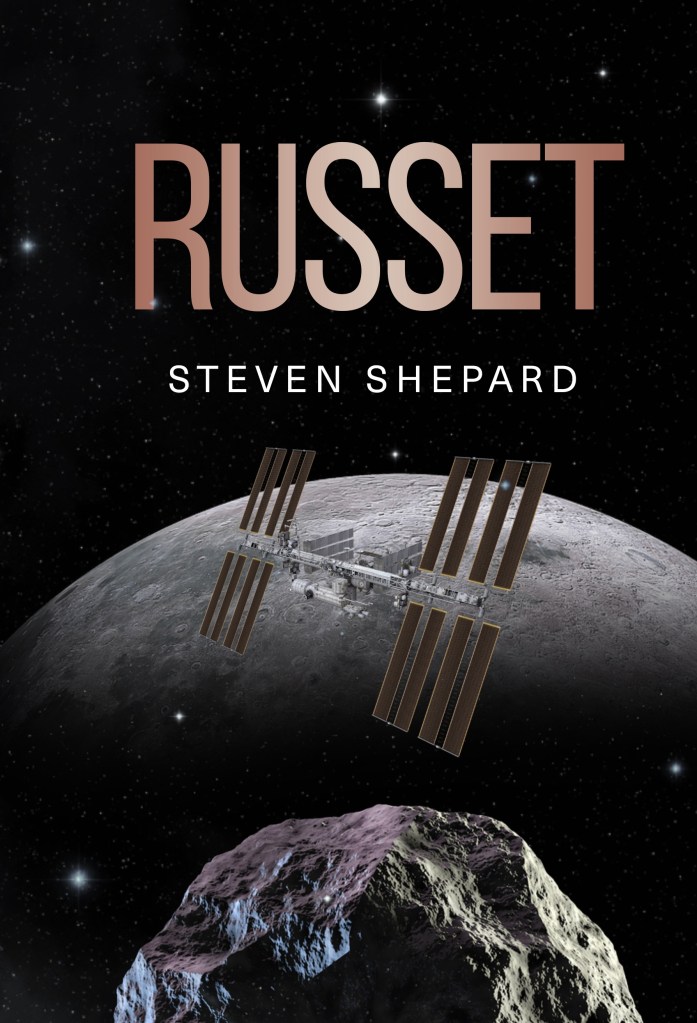
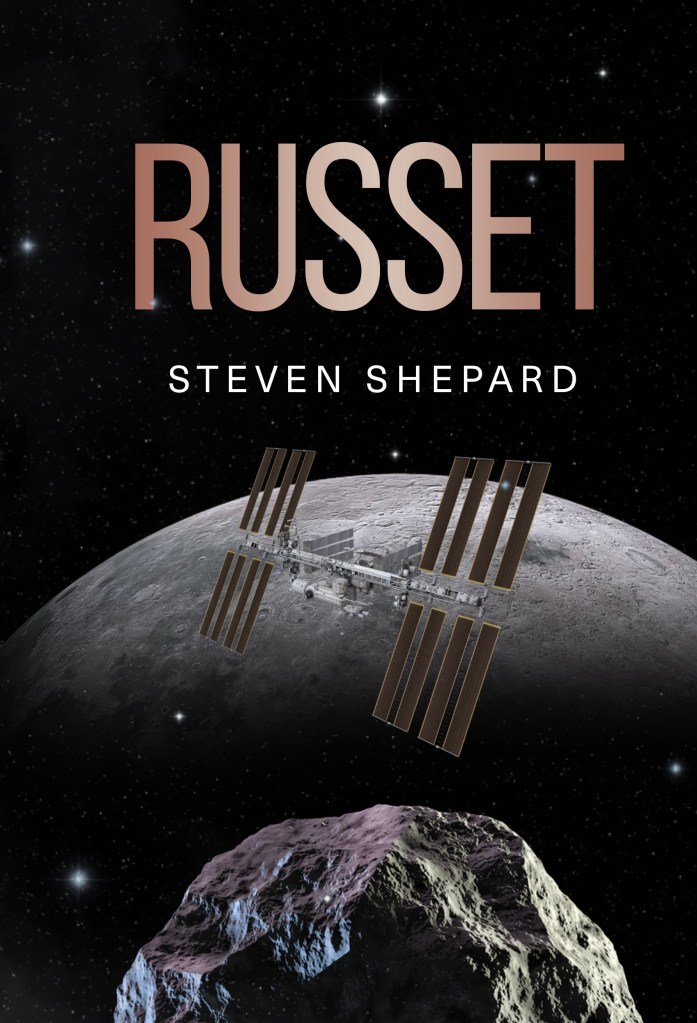
As many of you know, I released a new novel not long ago called Russet. It’s my fourth work of fiction; all my prior titles (all 90+ of them) have been about technology, history, photography, writing, sound recording, storytelling, leadership, biography, and a few other genres. Anyway, Russet’s doing well, especially given the fact that I haven’t done much since its release to market or promote it. It’s my first science fiction book, and I had a blast writing it.
Ever since Russet hit the shelves, I’ve been getting an unusual number of emails and messages from people, asking me about writing books. Actually, they’re asking more than that. Many feel that they have a book inside themselves begging to be written, and want to know how to get it from mind to paper. Or, they have an idea that they think would make a good book, but don’t know how to bridge the gap between their idea and a finished work.
Well, I’ve thought about these questions, because they intrigue me, too. When I started out as a writer, I asked for and was kindly given advice by a handful of established journalists, feature writers, and novelists, and as my skill developed over the years I also learned from the soul-sucking and dehumanizing process of iterative manuscript submission, and the inevitable accumulation of an impressive collection of rejection letters. It’s painful, but it’s a necessary part of the writing and publishing process. It’s also educational.
So, after thinking about these questions, and about my own experiences as a professional writer, I think I have some additional wisdom to impart—at least I hope so. So here goes.
First, to the question of how to write a book. Writers are wired, you see, to believe, to conclude, that the story they want to share should be in the form of a book. And while that MAY be the best way to present a particular story, it’s not the ONLY one. Here’s an example.
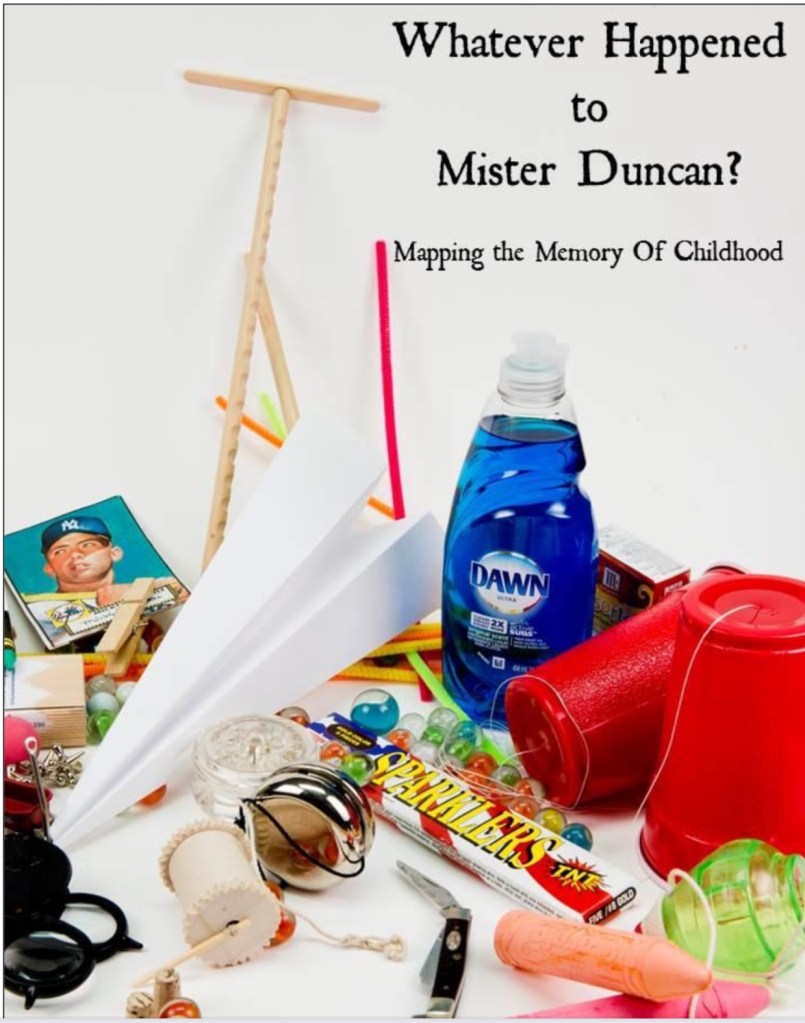
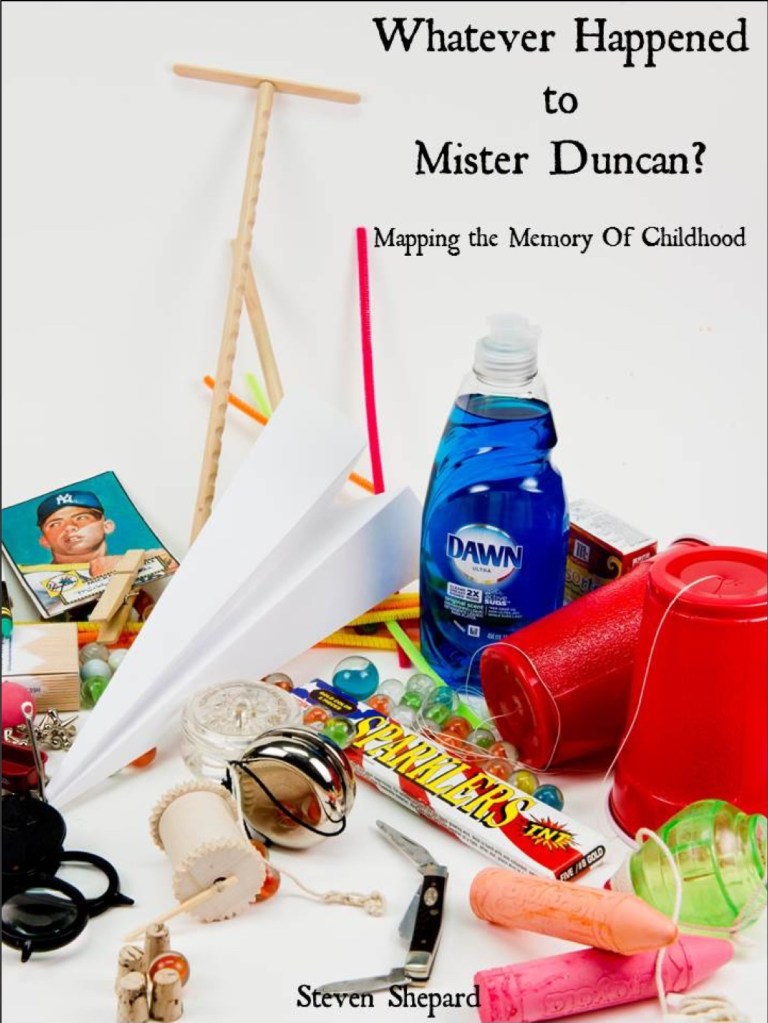
Whatever Happened to Mister Duncan cover.
In 1987 (yep, you read that correctly—almost 38 years ago!) I started writing a book called Whatever Happened to Mister Duncan, a collection of essays about childhood games and activities that were mostly played outside and that didn’t require anything other than our imaginations to play—okay, some of them required a pocket knife or a Popsicle stick, maybe a roll of caps and a rock, but that was pretty much it. No batteries, no screens, no keyboard or joystick. I had a hard time finishing the book; along the way I interviewed hundreds, maybe thousands, of people, asking them about their own childhood memories and what their favorite games and activities were. I then sat down and designed the book, laying out the logical sections which became chapters. But every time I thought I’d finished it, I’d get a call from somebody who wanted to share a long-forgotten memory, or a toy, or an experience that was so rich that it had to be in the book. So, I’d go back and do yet another rewrite. Because they were right—it HAD to be in the book.
The point at which I finally called a halt to the process was the 318th complete rewrite of the book. Yes, that’s a real number. I ended it by adding a paragraph that acknowledges the fact that the book will never actually be finished, but that I’ll include new material in a later edition.
So: 319 versions, by the time I finally had a complete, polished, nine-chapter, fully illustrated, 300-some-odd page book manuscript.
Which I have now decided should not be a book at all—at least, not exclusively.
This is a book about childhood. It’s experiential. I want it to evoke poignant memories of the period in our lives that caused us to become who we all are, before we had to start the odious task of adulting. You see, during those 38 years between the time that I first got the idea to write the book and when it finally emerged from its literary chrysalis, I did, as I said, hundreds of interviews; collected at least that many sound effects; and watched dozens and dozens of adults revert to childhood for the briefest periods during our conversations to show me something, before reverting back to boring, predictable, well-behaved adults. In other words, Duncan (my shorthand title for Whatever Happened to Mister Duncan) is a multiple media experience of sounds and different voices, none of which can adequately be presented between the pages of a book. Sure, I can transcribe the interviews, and I probably will, eventually, but what’s more fun: me writing down a list of all the different kinds of marbles that are out there, or listening to people struggle to remember the names of marbles as they dredge the murky depths of their own childhood memories? (Go ahead—I know you want to. Answer the question: how many marbles can YOU name?)
So: the decision was easy. This has to be an audio book.
NOT TOO LONG AGO, I took stock of the activities that give me pleasure, beyond the obvious ones—family, chasing grandkids, recording the sounds of the natural world. I love to write; I love to interview people so that I can learn about them and then tell their story on my Podcast; I love to teach; I love photography; and I love field recording. When I analyze all of those, I find that they all have one thing in common: they’re all different ways to tell stories. I’m a storyteller—plain and simple. I don’t write to publish a book; I write to tell a story. Here’s a little secret for you: I only publish about 30 percent of what I write. And what I mean by that is that I only TRY to publish about 30 percent. The rest? It’s for me, and the people I share it with.
Stories. Always, stories. It’s what people want to hear; it’s what gets them to focus; and it’s what has to be wrapped around facts if those facts are to be absorbed and retained. No story? No context. No context? No understanding. It’s that simple.
So, Duncan: I’ve decided to give it away, because the material is too good, too precious, too human to sell. It belongs to everybody, which is why it will soon emerge as a nine-chapter audio book as a gift to my listeners on the Natural Curiosity Project. I think you’ll like it—I really do. And check it out: just like that, my creative project is published. Who cares if I published it myself? The joy comes from sharing it, and engaging with those who choose to write or call me about it.
I USED TO RUN LEADERSHIP PROGRAMS at the University of Southern California’s Marshall School of Business. Some of them were multi-week programs, which meant that I’d often be in LA over a weekend. Well, one weekend I had nothing to do, so I walked over to a local science museum because it was only a couple of blocks away and I love museums. I’d never been to this one.
SR-71.
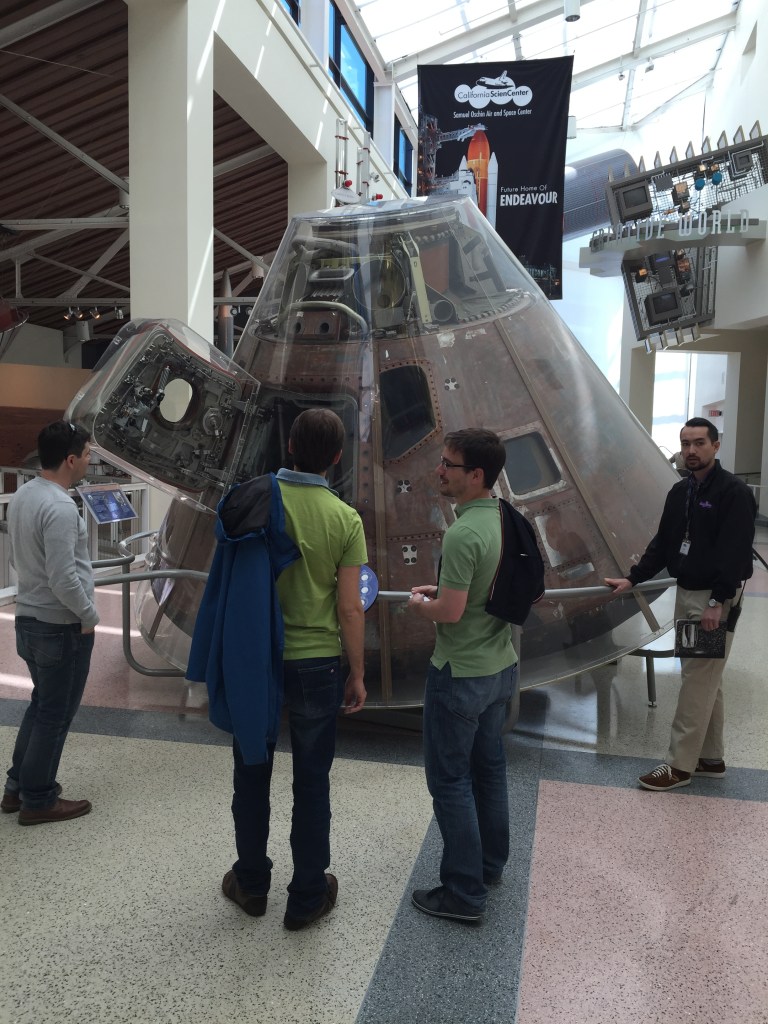
The place was pretty cool: outside, on stands, like gigantic versions of the model airplanes I built when I was a kid, they had an F-104 Starfighter and an SR-71, both amazing aircraft. Inside they had a whole collection of satellites, along with the usual kid-oriented science displays. As I explored the place, I found myself walking down a hall between exhibits, and as I passed a doorway, I looked into a dimly-lit room, and there, lined up in front of me, were a Mercury, a Gemini, and an Apollo capsule. Well, I’m a space geek, so I spent the next hour just walking around these things, peering inside, marveling at how—primitive they were. I kid you not, the seat the Mercury astronauts had to sit in was basically a lawn chair, made out of a metal pipe frame and braided leather straps. And based on the space inside, the astronauts couldn’t have been more than four feet tall. Gemini was no better. I’m exaggerating, but not by much. And Apollo? Bigger, but they also stuffed three people in there for the trip to the Moon. Here are the facts, according to NASA. The average length of a Mercury flight was 15 minutes. Gemini flights ranged from a few hours to one extreme endurance mission that lasted 14 days, But the average was three days. Apollo missions lasted an average of just over eight days.
Apollo capsule.
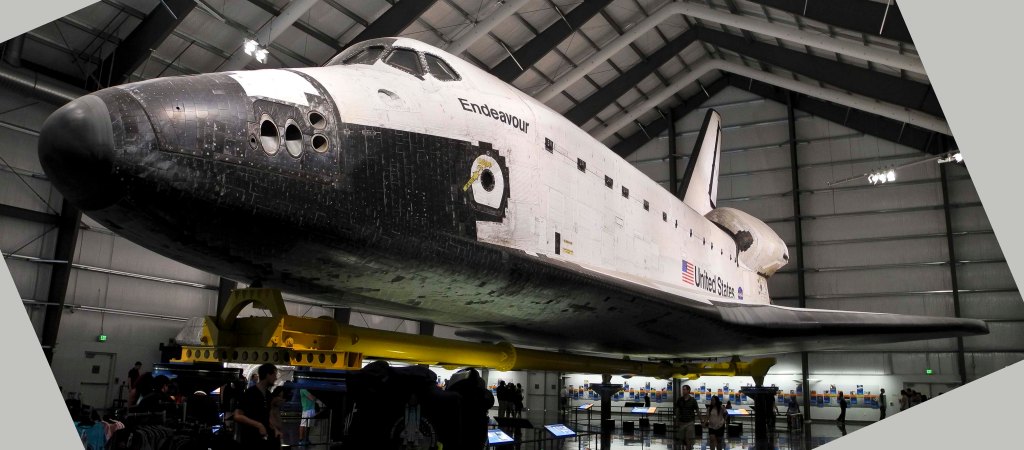
Let me interrupt myself with another story before finishing this one. As I was standing there, admiring these early space capsules, I realized how dark it was in the room. So, I looked up at the ceiling to see the lights. Except I couldn’t see the lights. Why? Well, because just over my head, between me and the ceiling, was the gigantic delta wing of the Space Shuttle Endeavor. The one that they pulled down the streets of LA to get it there. It was so massive and took up so much space in the room that I didn’t notice it, I was so focused on those little capsules hiding in the shadows underneath it.
Space Shuttle Endeavor. Hard to see, but the Mercury, Gemini and Apollo capsules are in the dark background under the starboard wing.
Yep—tears. Geek tears.
WHICH BRINGS ME TO THE SUBJECT OF ADVERBS. You remember—who, what, when, where, how, why. As a writer, adverbs are the best friend you can have.
My curiosity kicked in. There I was, in awe of the mighty space shuttle looking over me, looking at those capsules, thinking about how brave or crazy a person had to be to be bolted into one of those things, and how crowded it was, and how the Apollo astronauts basically just sat there in a space about the size of a VW Beetle for four days, one way, before turning around and doing it again in reverse. There was no bathroom, no privacy, no way to really get up and move around. Just shoot me now.
And that got me thinking—and here’s where the adverbs kicked in. A trip to Mars is somewhere between four-and-a-half and six months, depending on timing. How in the world could we possibly convince a crew to crawl into a ship for a journey that long? Why would they be willing to do it? How would we physically get them there? And thus was born the germ of an idea, the spark of a story, that led to all 625 pages of Russet. Because I figured it out—at least, I figured out ONE way. And I must be pretty accurate, because I got a call from a friend who works at our vaunted space agency, asking me after reading my book whether I had hacked their firewall (I didn’t). Gotta love that. Anyway, that’s how Russet got its start. It was all about the power of adverbs, especially how and why. Those two little words define curiosity. And when curiosity and storytelling are combined? Wow.
Acclaimed author Dorothy Parker once wrote that curiosity is the cure for boredom, but that there is no cure for curiosity. Thank goodness. Curiosity is what keeps the world moving forward. Would you like to see the Dark Ages again, the period that Bill Bryson describes in his book, The Mother Tongue: English and How It Got That Way, as “A period when history blends with myth and proof grows scant”? It’s easy: stop being curious. Does Bryson’s description of the Dark Ages sound alarming, given current events? Does it strike a bit close to home? Good. Get out there. Be curious. Share ideas. And don’t just blindly trust what you read or hear. Wield those adverbs. Question everything. It should be the law. Oh wait—it IS the law. It’s why we have a free press. My bad.
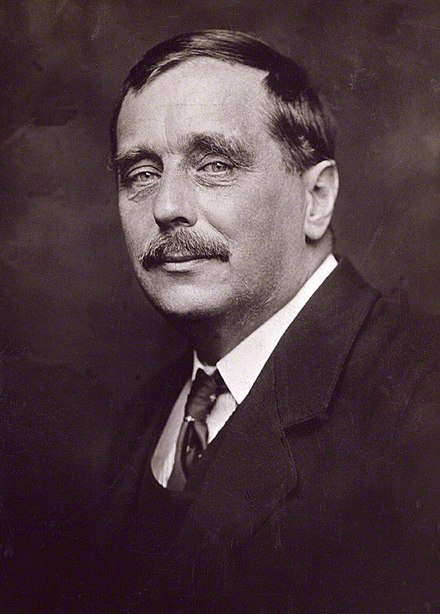
Photo by George Charles Beresford, black and white glossy print, 1920
Not long ago, I started doing something I always said I would do, but honestly never thought I’d actually get around to doing. Remember when you were in high school or college and your English teacher assigned you a book to read? And it wasn’t something fun like Hardy Boys or Tom Swift or Doc Savage (showing my age, here) or Little House on the Prairie. No, it was something BORING by Mark Twain or Charles Dickens or John Steinbeck. If you were like me, you faked it badly, or in college you might have run down to the bookstore to buy the summary of the book to make your fake a bit more believable. Either way, it rarely ended well.
I’m a writer and storyteller by trade—it’s who I am. And, because I’m a writer, I’m also an avid reader—and I mean, avid. I average about 140 books a year. So, a couple of years or so ago, I decided to start mixing the classics into my normal mix of books, starting with Arthur Conan Doyle. At first, I was dreading it. But once I started reading and allowed myself to slow my mind and my reading cadence to match the pace of 19th-century writers, I was hooked with the first book. I blazed through them all, the entire Sherlock Holmes collection, and then moved on to Jules Verne and Mark Twain and H.G. Wells. Reading those books as an adult, with the benefit of a bit more life behind me, gave the stories the context that was missing when I was a kid.
By the way, I have to interrupt myself here to tell you a funny story. I’m a pretty fast reader—not speed-reading fast, but fast. I pretty much keep the same reading cadence in every book I read, unless I’m reading poetry or a book by someone whose work demands a slower pace. Some southern writers, like Rick Bragg, slow me down, but in an enjoyable way. But a typical book of two or three-hundred pages or so, I usually blast through in about three days.
Not long ago, I read David Attenborough’s First Life, a book about the earliest organisms on the planet. That book took me two weeks to read. And it wasn’t because I wasn’t regularly reading it, or because the book was complicated, or poetic. It was because David Attenborough is one of those wonderful writers who writes the way he speaks. Which means that as I was reading, I was hearing his voice, and my reading began to mimic the pace at which he speaks on all the BBC programs: These … extraordinary creatures … equipped … as they are … for life in the shallow, salty seas … of the Pre-Cambrian world … quickly became the hunted … as larger … more complex creatures … emerged … on the scene.
I just couldn’t do it. I tried to read at a normal clip, and I stumbled and tripped over the words. It was pretty funny. It was also a great book.
Anyway, I just finished The Time Machine by H. G. Wells. I saw the movie as a kid, loved it, but the book was, as usual, quite different from the movie. I loved Wells’ writing, and it made me want to read more. So, I decided to read one of his lesser-known works, his Outline of History, a massive work of about 700 pages. And, as so often happens when I read something new, I had an epiphany.
Let me tell you a bit about Herbert George Wells. During the 1930s, he was one of the most famous people in the world. He was a novelist and a Hollywood star, because several of his movies—The Invisible Man, Things to Come, and The Man Who Could Work Miracles were made into movies (the Time Machine didn’t hit the screens until later). In 1938, Orson Wells reportedly caused mass panic when he broadcast a radio show based on Well’s War of the Worlds, which also added to his fame. That story has since been debunked, but it did cause alarm among many.
Wells studied biology under T.H. Huxley at the UK’s Royal College of Science. He was a teacher and science writer before he was a novelist. Huxley, who served as a mentor for Wells, was an English biologist who specialized in comparative anatomy, but he was best known as “Darwin’s Bulldog” because of his loud support for Darwin’s theory of evolution. He also came up with the term, ‘agnosticism.’ “Agnosticism,” he described, “is not a creed, but a method, the essence of which lies in the rigorous application of a single principle… the fundamental axiom of modern science… In matters of the intellect, follow your reason as far as it will take you, without regard to any other consideration… In matters of the intellect, do not pretend that conclusions are certain which are not demonstrated or demonstrable.” Pretty prescient words that need to be broadcast loudly today. Ask questions, and don’t accept a statement as truth until you know it is. That’s precisely why I started this series.
Sorry—I’m all over the place here. The Outline of History tells the story of humankind from the earliest days of civilization to the end of World War I—The Great War, The War to End All Wars. If only.
From there, I went on to read Work, Wealth, and Happiness of Mankind, another of his lesser known works. Both are interesting takes on history and sociology, and somewhere between them, Wells invents the World Wide Web. Really.
Here’s how he begins the concept:
Before the present writer lie half a dozen books, and there are good indexes to three of them. He can pick up any one of these six books, refer quickly to a statement, verify a quotation, and go on writing. … Close at hand are two encyclopedias, a biographical dictionary, and other books of reference.
As a writer, Wells always had reference books on his desk that he used regularly. As he developed the concept that he came to call the World Brain, he wrote about the early scholars who lived during the time of the Library of Alexandria, the greatest center of learning and scholarship in the world at the time. It operated from the third century BC until 30 AD, an incredibly long time. Scholars could visit the Library, but they couldn’t take notes (there was no Paper), and there were no indices or cross-references between documents. So, Wells came up with the idea of taking information to the people instead of the other way around, and figuring out a way to create detailed cross-references—in effect, search capability—to make the vast stores of the world’s knowledge available, on demand, to everybody.
His idea was that the World Brain would be a single source of all of the knowledge contained in the world’s libraries, museums, and universities. He even came up with a system of classification, an information taxonomy, for all that knowledge.
Sometime around 1937, with the War to End All Wars safely in the past, Wells began to realize that the world was once again on the brink of conflict. To his well-read and research-oriented mind, the reason was sheer ignorance: people were really (to steal a word from my daughter) sheeple, and because they were ignorant and chose to do nothing about that, they allowed themselves to be fooled into voting for nationalist, fascist governments. The World Brain, he figured, could solve this problem, by putting all the world’s knowledge into the hands of all its citizens, thus making them aware of what they should do to preserve the peace that they had fought so hard to achieve less than twenty years earlier. What he DIDN’T count on, of course, was that he was dealing with people—and the fact that you can lead a horse to water, but you can’t make him drink from the intelligence well.
Nevertheless, he tried to raise the half million pounds a year that he felt would be needed to run the project. He wrote about it, gave lectures, toured the United States, and had dinner with President Roosevelt, during which he discussed the World Brain idea. He even met with scientists from Kodak who showed him their newest technology—the technology that ultimately became microfiche. But sadly, he couldn’t make it happen, and sure enough, World War II arrived.
Here’s how he summed up the value of the World Brain:
The general public has still to realize how much has been done in this field and how many competent and disinterested men and women are giving themselves to this task. The time is close at hand when any student, in any part of the world, will be able to sit with his projector in his own study at his or her own convenience to examine any book, any document, in an exact replica.
In other words…the World Wide Web. Imagine that.
World War II caused Wells to fall into a deep depression, during which he wrote The Time Machine, which is, I think, the first post-apocalyptic novel ever written—at least as far as I know. He describes the great green structure on the hill, made of beautiful porcelain but now falling down in ruins; I suspect he was thinking about the sacking and burning of the great Library of Alexandria when he wrote that part of the book.
Or, perhaps he was thinking of Percy Bysshe Shelley’s “Ozymandias”:
I met a traveller from an antique land,
Who said—“Two vast and trunkless legs of stone
Stand in the desert. . . . Near them, on the sand,
Half sunk a shattered visage lies, whose frown,
And wrinkled lip, and sneer of cold command,
Tell that its sculptor well those passions read
Which yet survive, stamped on these lifeless things,
The hand that mocked them, and the heart that fed;
And on the pedestal, these words appear:
My name is Ozymandias, King of Kings;
Look on my Works, ye Mighty, and despair!
Nothing beside remains. Round the decay
Of that colossal Wreck, boundless and bare
The lone and level sands stretch far away.”
Never underestimate the power of great literature. And never underestimate the power of curiosity when it’s unleashed on a problem.
I released a new novel a month or so ago, called Russet. It’s my fourth book of fiction; all my prior titles have been about technology, history, photography, writing, sound recording, biography, and a few other genres. Anyway, Russet’s doing well, especially given the fact that I haven’t done much since its release to market or promote it. It’s my first science fiction book, and I had a blast writing it.
For the last six weeks or so, pretty much since Russet hit the shelves, I’ve been getting an unusual number of emails and messages from people, asking me how to write a book. Actually, they’re asking more than that. Many feel like they have a book inside them begging to be written, and want to know how to let it out, how to get it from mind to paper. Or, they have an idea that they think would make a good book, but don’t know how to bridge the gap between their idea and a finished work. And others want to know how I manage to jump between genres in my writing. It’s true—I write about a lot of different things.
First, to the question of how to write a book. When people learn that I’m a writer, their first question is always, “What do you write?” And my response is, always, “Words, mostly.” I know—it’s snarky. But it’s true. As a writer, my job is to assemble letters into words and then string the words into thoughts that become sentences, and then string the sentences into paragraphs that represent vignettes, and then string the paragraphs into chapters that represent movement, and then string the chapters into a book that tells a story. It’s the story that matters. When I hear people say that they have a book inside them wanting to get published, I believe that what they’re actually saying is that they have a story inside them that wants to be told. We’re wired, you see, to naturally conclude that the story we want to share should be in the form of a book. And while that MAY be the best way to present a particular story, it’s not the ONLY one. Here’s an example.
In 1987 (yep, you heard right—almost 38 years ago!) I started writing a book called Whatever Happened to Mister Duncan, a collection of essays about childhood games that were mostly played outside and that didn’t require anything other than our imaginations to play—okay, some of them required a pocket knife or a Popsicle stick, but that was pretty much it. No batteries, no screens, no keyboard or joystick. I had a hard time finishing the book; along the way I interviewed hundreds, maybe thousands, of people, asking them about their own memories of childhood, and what their favorite games and activities were. I then sat down and designed the book, laying out the logical sections and creating chapters. But every time I thought I’d finished it, I’d get a call from somebody who wanted to share a long-forgotten memory, or a toy, or an experience that was so rich that it had to be in the book. So, I’d go back and do yet another rewrite. Because they were right—it HAD to be in the book.
The manuscript at which I finally called a halt to the process was the 318th complete rewrite of the book. I ended it by adding a paragraph that acknowledges the fact that the book will never actually be finished, but that I’ll include new material in later editions.
So: 319 versions, by the time I finally had a complete, polished, nine-chapter, fully illustrated, 300-some-odd page book manuscript.
Which I have now decided should not be a book at all—at least, not exclusively.
This is a book about childhood. It’s experiential. I want it to evoke poignant memories of the period in our lives that created who we all are, before we had to start the odious task of adulting. You see, during those 38 years between the time that I first got the idea to write the book and when it finally emerged from its literary chrysalis, I did, as I said, hundreds of interviews; collected at least that many sound effects; and watched dozens and dozens of adults revert to childhood for the briefest periods during our conversations to show me something, before reverting back to boring, well-behaved adults. In other words, Duncan (my shorthand title for Whatever Happened to Mister Duncan) is a multiple media experience of sounds and different voices, none of which can adequately be presented between the pages of a book. Sure, I can transcribe the interviews, and I probably will, eventually, but what’s more fun: me writing down a list of all the different kinds of marbles that are out there, or listening to people struggle to remember the names of marbles as they dredge the murky depths of their own childhood memories?
So: the decision was easy. This has to be an audio book.
But that brought me to another important point. I’ve already mentioned that most people who say that they have a book inside that needs to get published are actually saying that they have a story that needs telling. Truthfully, most would-be authors I speak with, whether during casual conversation or as participants in my writing workshops, are more interested in getting published than they are in writing a book. One of my favorite authors, Ann Lamott, who wrote the bestselling book about writing called Bird by Bird, says the same thing. People don’t typically buy books because they’re beautifully published. They buy them because they’re creatively written. The creativity is the hard part—and the author’s job. The publishing is the presentation part, a process that’s more mechanical than it is creative.
So: do you want to write a book to tell a story, or to get published? Because here’s the thing: you can’t get published until you’ve written a book, and if you write a book, the goal is to tell the book’s story. Publishing comes after the fact. Without a good story, what is there to publish?
Which brings us back to Duncan. Not too long ago, I took stock of the activities that give me pleasure, beyond the obvious ones—family, chasing grandkids, recording nature. I love to write; I love to interview people so that I can learn about them and then tell their story on my Podcast; I love to teach; I love photography; and I love field recording. When I analyze all of those, I find that they all have one thing in common: they’re all different ways to tell stories. I’m a storyteller—plain and simple. I don’t write to publish a book; I write to tell a story. Here’s a little secret for you: I only publish about 30 percent of what I write. And what I mean by that is that I only TRY to publish about 30 percent.
So, Duncan: I’ve decided to give it away, because the material is too good, too precious, too human to sell. It belongs to everybody, which is why it will soon emerge as a nine-chapter audio book as a gift to my listeners on the Natural Curiosity Project. I think you’ll like it—I really do. And check it out: just like that, my creative project is published. Who cares if I published it myself? The joy comes from sharing it and engaging with those who choose to write or call me about it.
I think that takes care of the first two questions, which leaves the issue of genre-jumping. There, I invented a term.
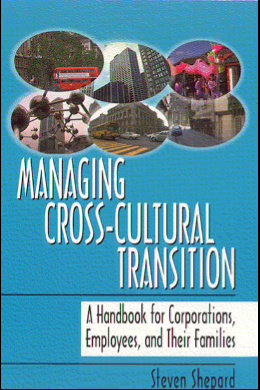
It’s true. My very first book was called Commotion in the Ocean, and it was a professional SCUBA diving manual. I wrote it because there wasn’t a particularly good book on the market, and at the time, that was what I did for a living—I was a SCUBA instructor. I then wrote a book called Managing Cross-Cultural Transition, about my experiences living in different countries and therefore cultures and offering advice to expats about the challenges they would face, not when they moved overseas, but when they moved back to their home country.
Next, I wrote a series of well-received books about various telecom technologies, two of which became bestsellers. Isn’t that insane? But here’s the secret. The reason they were so well-received was because they weren’t boring. Instead of trying to impress my readers with how much I knew about telecom standards and protocols and the inner workings of things, I told stories. What a concept! I talked about being present when the Internet first became available in a small African country, and watching as the kids in a small village connected their little One-Laptop-Per-Child laptops to the Web and started downloading music. I explained optical networking, arguably a very complicated topic, by telling the story of getting the opportunity in Singapore to spend several days aboard a cable-laying ship and watching how they did that. I talked about getting to watch surgeons remove a woman’s gall bladder in a rural African clinic, using a robotic surgery machine—noting that the surgeons were controlling the robot from Maryland, 8,000 miles away. And I wrote about the power of technology and how its complexities were what made education accessible for a large swath of the world’s population.
Stories. Always, stories. It’s what people want to hear; it’s what gets them to focus; and it’s what has to be wrapped around facts if those facts are to be absorbed and retained. No story? No context. No context? No understanding. It’s that simple.
So, by now you’ve probably figured out how I do genre-jumping. I don’t! My genre, you see, is storytelling. The details, the settings, the protagonists, the main characters, are secondary. Sometimes I tell stories about technology, sometimes about history, sometimes I tell stories for children, sometimes I tell stories about childhood games or write political or adventure or science fiction novels. Sometimes my heroes and villains are people, but sometimes they’re devices, or networks, or companies. But it’s always about the story.
And how do the stories come to me? Well, at the risk of sounding self-serving, the answer is curiosity. I seek out people and I have conversations with them, because everybody—and I mean everybody—has a story inside them that will light a spark. I read a lot, and I read a wide variety of genres. If you’ve swapped emails with me, then you know that one of my email signature lines is, “Writing is my craft; reading is my gym.” I really mean that. Reading is what makes me a better writer. That, and writing.
I also spend a lot of time thinking about adverbs. Let me explain.
I used to run leadership programs at the University of Southern California’s Marshall School of Business. Some of them were multi-week programs, which meant that I’d often be in LA over a weekend. Well, one weekend I had nothing to do, so I walked over to a local science museum because it was only a couple of blocks away and I love museums. I’d never been to this one.
The place was pretty cool: outside, on stands, they had an F104 Starfighter and an SR-71, both amazing aircraft. Inside they had a whole collection of satellites, along with the usual kid-oriented science displays. Then I walked down a hall and as I passed a doorway, I looked into a dimly lit room, and there, lined up in front of me, were a Mercury, a Gemini, and an Apollo capsule. Well, I’m a space geek, so I spent the next hour just walking around these things, peering inside, marveling at how—primitive they were. I kid you not, the seat the Mercury astronauts had to sit in was basically a lawn chair, made of braided leather straps. And based on the space inside, the astronaut couldn’t have been more than four feet tall. Gemini was no better. I’m exaggerating, but not by much. And Apollo? Bigger, but they also stuffed three people in there for the trip to the Moon. Here are the facts, according to NASA. The average length of a Mercury flight was 15 minutes. Gemini flights ranged from a few hours to one extreme endurance mission that lasted 14 days, But the average was three days. Apollo missions lasted an average of just over eight days.
Let me interrupt myself with another story before finishing this one. As I was standing there, admiring these early space capsules, I realized how dark it was in the room. So, I looked up at the ceiling to see the lights. Except I couldn’t see the lights. Why? Well, because just over my head, between me and the ceiling, was the gigantic wing of the Space Shuttle Endeavor. The one that they pulled down the streets of LA to get it there. It was so massive and took up so much space in the room that I didn’t notice it, I was so focused on those little capsules hiding in the shadows underneath it.
Yep—tears. Geek tears.
Anyway, adverbs. You remember—who, what, when, where, which, how, why.
My curiosity kicked in. There I was, looking at those capsules, thinking about how brave or crazy a person had to be to be bolted into one of those things, and how crowded it was, and how the Apollo astronauts basically just sat there in a space about the size of a VW Beetle for four days, one way, before turning around and doing it again in reverse. There was no bathroom, no privacy, no way to really get up and move around. Just shoot me now.
And that got me thinking—and here’s where the adverbs came in. A trip to Mars is somewhere between four-and-a-half and six months, depending on timing. How in the world could we possibly convince a crew to crawl into a ship for a journey that long? Well, I figured it out—at least, I figured out ONE way. And I must be pretty accurate, because I got a call from a friend who works at our vaunted space agency, asking me after reading my book whether I had hacked their firewall. Gotta love that. Anyway, that’s how Russet got its start. It was all about asking, ‘hey, what if…?’ The power of adverbs, especially how and why. Those two little words define curiosity. And when curiosity and storytelling are combined? Wow.
It’s why I started The Natural Curiosity Project Podcast. Dorothy Parker once wrote that curiosity is the cure for boredom, but that there is no cure for curiosity. Thank goodness. Curiosity is what keeps the world moving forward. Want to see the Dark Ages again, the period that Bill Bryson describes in his book, “The Mother Tongue: English and How It Got That Way” as “a period when history blends with myth and proof grows scant”? It’s easy: stop being curious. Does Bryson’s description of the Dark Ages sound alarming, given current events? Does it strike a bit close to home? Good. So, get out there. Be curious. Share ideas, and don’t just blindly trust what you read or hear—question everything. It should be the law. Oh wait—it IS the law. My bad.



 Steven Shepard