Tag Archives: Curiosity

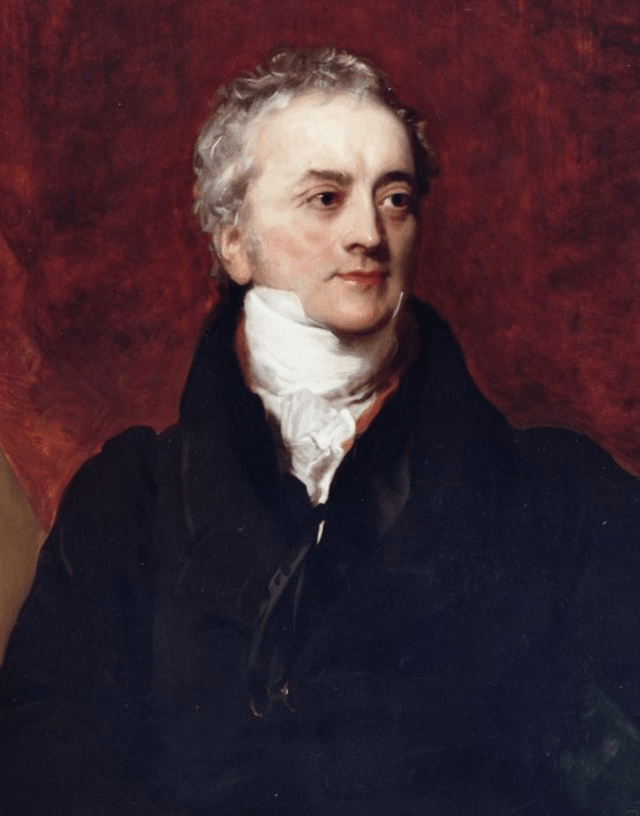
Thomas Young, The Last Man Who Knew Everything

Thomas Young was born in 1773 and lived until 1829. And while living to the ripe old age of 56 may have counted as being in his dotage in the 18th century, he certainly used his time well. The things that Young accomplished are beyond words.

Young was a medical doctor and for a while, a college professor. But he also made huge (as in, change-what-the-world-knows huge) discoveries in physics, energy, optics, vision, physiology, language, music, and Egyptology. He was referenced admiringly by such people as William Herschel, who built the world’s first large telescopes; Hermann von Helmholtz, who was a pioneer in fields as diverse as physiology, psychology, physics, and philosophy; James Clerk Maxwell, who figured out how electromagnetism works; and Albert Einstein, who figured out everything else. 

Here’s Young’s story. He studied medicine in London, and later went to Göttingen, Germany, where he received the degree of Doctor of Medicine in 1796. In 1797 he inherited a huge estate that belonged to his grand-uncle, Richard Brocklesby. That inheritance made him financially independent, which is probably why he was able to become a true polymath.

In 1801, Young was appointed professor of natural philosophy (what we’d call physics today) at the Royal Institution. Over the course of two years, he delivered 91 lectures on a staggering plethora of topics.

In 1811, he became a physician at St George’s Hospital, and in 1814 was elected to a committee that was created to study the dangers of installing natural gas lighting throughout London.  Five years later, he was elected secretary of a commission charged with determining the exact length of a pendulum whose period is exactly 2 seconds. This was extremely important for time-keeping, but it was also crucial for maritime navigation. No surprise, in 1818, he became secretary to the Board of Longitude, which was convened to come up with an answer to the vexing problem of calculating longitudinal position, which unlike latitude, can’t rely on star and planet positions relative to the horizon to do that. 

That’s a pretty healthy academic resume. But why is he called “The Last Man Who Knew Everything?” The answer is, well, he apparently was the last man to know just about everything—at least, for his time. 

My brain hurts just reading the list of this guy’s accomplishments. Young believed that his most important contribution to the world’s store of knowledge was his creation of the wave theory of light. This is important on many levels, not the least of which is that it put him at odds with Sir Isaac Newton, who was a science rock star, but believed that light was a particle (today, of course, we know that it behaves like both). He demonstrated his wave theory by crafting what came to be known as the double slit experiment, considered to be one of the most important contributions to physics ever made.

But he didn’t stop there. He went on to publish Young’s Modulus, a mathematical principle that related the pressure on a body to the amount of strain that the body is experiencing, regardless of the shape of the object—all that mattered, he concluded, is the nature of the material itself. This became fundamentally important for engineering problems, like bridge and building construction.

The next thing on Young’s to-do list was to create the science of physiological optics—in other words, to do what no one had yet done—to understand how the eye works.  In 1793, he explained how the eye automatically changes the curvature of its lens, based on the distance of the object being viewed. 

This, of course (of course), led to his development of the fundamental theories that related vision to color. That theory, called the Young-Helmholtz theory, concludes that color perception is based on the presence of three different kinds of nerves in the retina, each “tuned” to a different range of light frequencies.

Once he checked that off his list, he moved on to the theory of capillary phenomena and its relationship to surface tension. I was just talking about this last night over dinner—yeah, sure I was. This led to the creation of the Young-LaPlace equation, which explains to us why soap bubbles can form, among other things.

At this point, Young apparently got bored with physics, so he moved on to other fields. He came up with a rule of thumb for doctors to determine the correct dosage of a drug for a child, based on their age and weight. He wrote an article for the Encyclopedia Britannica at the beginning of the 18th century, in which he compared the grammar and vocabulary of 400 distinct languages, pointing out the similarities and differences, work that would later lead to the creation of such fields as phonetics, philology and linguistics. He also proposed a universal phonetic alphabet that allowed linguists to write down the correct pronunciation of any word in any language by using the universal symbols that he created. I am very familiar with this language of his, because I used it in my undergraduate studies at Berkeley. For example, the Spanish word for house, ‘casa,’ is pronounced differently in different parts of the Spanish-speaking world. In Latin America, they say ‘casa.’ But in Spain, they say something that sounds like ‘Casha.’ You can actually write the word differently using Young’s phonetic alphabet: ‘casa’ vs. ‘caša.’

And then, there are Young’s contributions to Egyptology (of course). When he was 40 years old, in 1813, he decided to study and decipher Egyptian hieroglyphics. He started with the existing translations of the demotic alphabet, and along the way found numerous errors. By 1814, he translated the Rosetta Stone. I think that was on a Saturday.

Finally, Young developed what came to be known as Young’s temperaments, which were very sophisticated methods for tuning musical instruments.

You know what I like about this guy? First, that curiosity leads to good things; and second, that I shouldn’t get too impressed with myself when I do something that I think might be impressive. Holy cow. This guy DESERVES the title of the Last Man Who Knew Everything.

What a world. And what a guy—Thomas Young. Curiosity, man—it rocks.

Tumblin’ Tumbleweeds

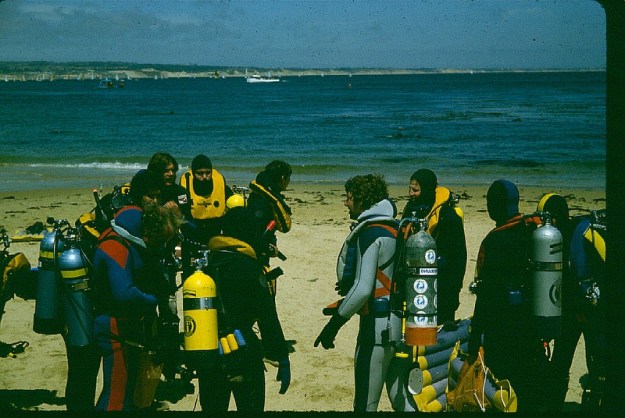
ack in my diving days, my fellow instructors and I used to take groups of divers down to Monterey for their checkout dive. This is the first dive they do in the ocean with full SCUBA gear, during which they have to demonstrate all the skills they’ve learned in class before we certify them as divers. Typically, I’d send the assistant instructors down to the bottom with the students, and they’d run them through all the drills and skill demonstrations to make sure they knew their stuff. I’d stay on the surface, sitting on an inflatable surf mat and nibbling on kelp, ready to deal with any students that came to the surface and needed assistance.

One day, while sitting there watching a pod of sea lions circle the mat (something they did all the time), I spotted something bobbing on the surface a few yards away. I couldn’t tell what it was, so I paddled over and grabbed it. It turned out to be a bottle, sealed with wax, and yes, it had a note inside. I pulled it out, and it was a message from a college student at Cal Poly, who had dropped it into the water nine months before as an experiment to see how far the bottle might go. It included a telephone number (this was before email was common (hell, we barely had electricity), so I called him. He was very grateful and told me that he had dropped it in the water in Morro Bay near San Luis Obispo, which meant that it had traveled almost 150 miles to get to Monterey. I agreed to seal it back up and drop it in the water again so that it could continue its journey, which I did. I never heard back from him, but I assume it continued northward.

Years later, after I had left my professional diving days behind and become a telecom analyst, I was teaching a program in Dallas, where I met an old cowboy who worked part-time in one of the hotels as a greeter. His name was Bud. We chatted every day, sometimes for hours when it was quiet at the hotel, and one day he confided to me that he had a very strange hobby. Not one to ignore that kind of comment, I asked him what it was. He smiled, and, looking around to make sure no one was within earshot, he told me that he drives out into the desert and ties notes to tumbleweeds. He then releases the tumbleweeds, to let ‘em continue rolling across the plains. The notes have the location, date and time that he released them, along with a brief message asking whoever finds the note call him and tell him where and when they found the tumbleweed and the note. He told me that he had released more than 600 tumbleweeds (technically, Russian thistles) and had heard back from over 150 people. He said that he figured that most of them ended up stuck on fence lines or run over by road traffic. One of them, he told me, he released just south of Waco, and it was found in Lampasas. That’s about 90 miles away. He also said that that particular tumbleweed was huge—almost five feet across. Those things really get around.

Everybody thinks of tumbleweeds as having an iconic presence in old westerns. Unless there’s one or two blowing through the streets of that old western town, it just isn’t realistic—although I have to say that I worked on a movie set once where we had a tumbleweed wrangler who used a leaf blower to move them down the street, since the wind wasn’t cooperating. 

Anyway, as I mentioned earlier, tumbleweeds are officially known as Russian thistle, and they originated in Ukraine. Most likely, the seeds got mixed into a shipment of flax seeds that came over from Europe back in the 1800s, took root, and never left. Now, they’re pretty much everywhere, especially in the southwest. And they can be a real problem. Back in 2018, a windstorm came up that was howling at about 60 MPH. For some bizarre reason, the wind funneled hundreds of thousands of tumbleweeds into the California town of Victorville. There were so many that they piled up in huge mounds, in some cases actually burying houses. Go look it up—the pictures are amazing.

But here’s what else is amazing. A typical tumbleweed has 250,000 seeds nestled down inside its dried, thorny leaves. In the summer, the plant, which starts out as a green bushy ball, dries out. A layer of specialized cells right at the base of the plant, called the abscission layer, snaps off, and the wind blows the plant across the prairie, scattering seeds everywhere it goes. It’s a hardy plant, so wherever the seeds fall, they typically, eventually sprout, which is why they’re considered such a nuisance. Not only do they infest crop fields, they also collect along fences, sometimes knocking them down due to their sheer weight. They also have a nasty tendency to blow across roads at the most inopportune times. I’ve had it happen: there’s something pretty unnerving about a six-foot diameter ball suddenly rolling in front of your car from out of nowhere on the highway. They also carry insect pests that hitch a ride and can be widely dispersed across an agricultural area. Not a good thing.

It turns out that plants are a lot smarter than we give them credit for. In fact, they’ve developed a handful of techniques for spreading themselves far and wide. One is by harnessing the wind, which is what tumbleweeds do, as well as maple trees, dandelions, and lots of others. They swim; the reason that coconut trees are on almost every island in the south Pacific is because coconuts fell into the ocean and floated thousands of miles until they landed somewhere. Some explode; there are plants with seed pods that explode with such seed-scattering force that the seeds fly over 300 feet (we’re talking about the length of a football field!) at 160 MPH.

Next, we have the seeds that have to be eaten to be scattered. In fact, some of them actually MUST be eaten to germinate, because the hard shell that protects the embryo inside has to be abraded away by the grinding action of a bird’s gizzard before they’ll sprout.

Then we have those seeds that count on a rodent of some kind collecting them and burying them in the ground, where at least some of them sprout, and seed becomes tree. And then we have the cling-on approach—and no, I’m not making a Star Trek joke. Seed pods from the burdock plant, what we call a cocklebur, are covered with natural Velcro (in fact, it’s what gave the inventor the idea in the first place). When an animal brushes against them, they get tangled in the animal’s fur, and hitch a ride to wherever the animal’s going.

I know this is a pretty geeky topic, but hey, consider the source. I find it remarkable how different species adapt to whatever they’re given to work with. I’ll tell you what—I bet you look at tumbleweeds a little differently from now on. 

By the way, one more thing before I go. Sabine and I watched a pretty good movie a few years ago called “Conagher.’ It’s an adaptation of a Louis L’Amour novel, and it stars Sam Elliott alongside his wife, Katherine Ross. It’s a love story, set in the old west, and it has a great theme. Sam Elliott is this grizzled, lonely cowboy who keeps finding poems tied to tumbleweeds on the prairie. He doesn’t know who’s writing them, but he wants to. I’ll bet you can figure out what happens.

West with Giraffes: Thoughts on the Past and Future

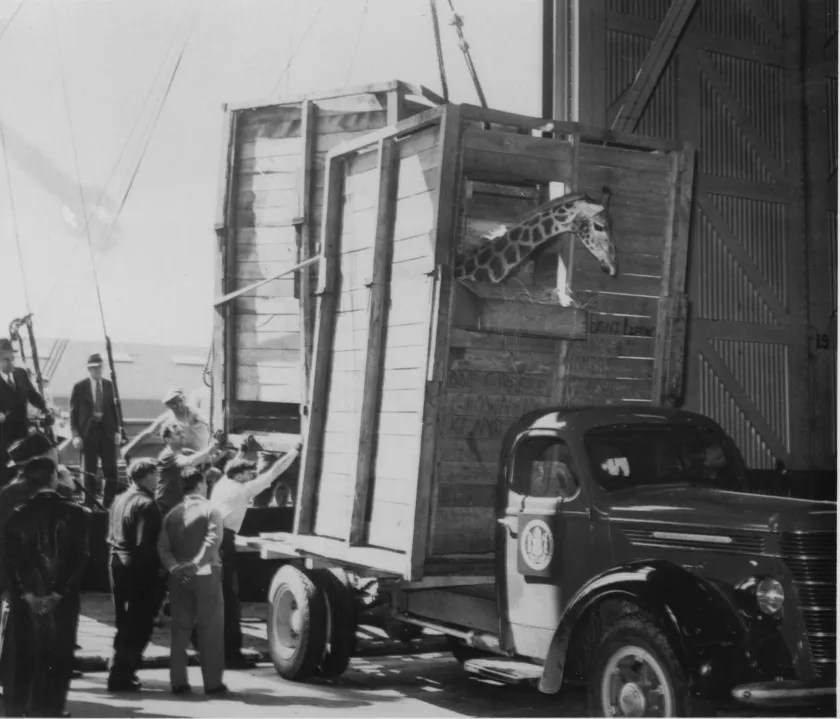
Copyright San Diego Zoo Global. Location: https://library.sandiegozoo.org/sdzg-history-timeline/#1930

I read a lot. It fuels my writing, gives me a better view of the world, and is a great way to travel through time and space. Every once in a while, I run across a book that really hits me as a must-read. The Age of Wonder, by Richard Holmes, is one of those; so is William Least Heat-Moon’s Blue Highways. Lynda Rutledge’s novel, West with Giraffes, is another. Sabine recommended this one to me; as I closed the back cover, I realized that there were tears on my face. This is one great book.

West with Giraffes tells the story of two giraffes, shipped from Uganda to New York City in 1938. There, the animals were loaded onto a truck for a twelve-day drive to San Diego, where they became the first giraffes at the newly created San Diego Zoo, under the care of Belle Benchley, the world’s first female zoo director.

Lynda Rutledge tells a great tale, with well-developed, realistic, likable characters, and a terrific story thread. I LOVED the book. But it wasn’t the story that grabbed me; it was the context it gave me about three things: 1938, the year the book takes place; the current messy turmoil of what passes for politics and all the ridiculous attempts on social media platforms to get us to pay attention to things that deserve no attention whatsoever; and conversations I’ve overheard lately about how HORRIBLE things are right now. “I would NEVER have kids today,” one couple bemoaned. Really? Let’s look at that, because that’s what “West with Giraffes” made me do. It gave me perspective, and context, which is what reading is SUPPOSED to do. It made me laugh without humor about the use of the phrase, “the good old days,” which WERE pretty good—as long as you were white and male. 

Two themes are woven into the book: The Great Depression of 1929, and the Dust Bowl years—the so-called Dirty Thirties—which together, savaged the country and the world. In the U.S., the Depression eliminated work for most of the country, and the drought and winds and locusts of the Dust Bowl made the prairie states impossible places to live, and impossible places to make a living. 

So, people left, many heading west toward “Californy” as the main character in the book calls the Golden State, where they were met with roadblocks and violence and turned away with all their possessions piled high on their Tin Lizzies or their horse or mule-drawn wagons. Many were beaten; some were killed. We don’t want you here, the people at the roadblocks told them, as they brandished rifles and pistols and truncheons. There was no food, little water, and zero opportunity. The highway was littered with the possessions of those who had lost hope, and the bones of livestock—and people—who died along the way. 

Those were very, very bad times in America, so when I walk around today and see storefront after storefront advertising job openings, with big signs that say, ‘Now Hiring,’ and then I see people standing on freeway offramps and street corners begging while talking on their iPhones, my sympathy flags. In 1938, “Hoovervilles” were the norm: great, filthy shanty towns that sprang up alongside bridges, in alleys, wherever an open space could be colonized. They were the homes of the homeless, and breeding grounds for disease, violence and hopelessness. They were routinely torn down by the police, their residents beaten. They had no place to go, and there were no jobs for them. They weren’t living; they were existing.

We talk about the COVID pandemic as an existential global crisis, and yes—it was horrible, with seven million people tragically lost to the disease. But it wasn’t the first time we were hit with epidemics that killed at large scale. In the 18th and 19th centuries, smallpox, yellow fever, tuberculosis, and cholera swept across the United States, killing millions. In 1918, Spanish Flu descended on the world, killing 50 million people. COVID, horrible though it was, was contained because we had access to antibiotics and vaccines, neither of which were available during those earlier times. Before the development of these medical miracles, an infected hangnail could be a death sentence. 

When I was a kid, polio was the boogeyman. I went to school with kids who were disabled by the virus, their withered legs wrapped in steel and leather braces. And I knew people in our neighborhood who lived out their days in iron lungs, a long metal tube that they had to lie in every day of their lives so that the device could mechanically compress their chests, forcing air in and out of their lungs, because the virus had destroyed their ability to do so on their own. Vaccines for polio became available in 1955, 1961, and 1963, and by the early 1990s, polio had been eliminated from North America—because of those vaccines.

And what about casualties from war? More than 40 million died during WWI, 80 million during WWII, a million or so during the Korea Conflict, and four million in Vietnam. We’re talking about numbers that exceed the populations of Germany. Or France. Or Italy. WWI killed numbers that exceed the population of modern-day Canada; WWII killed twice that many.

The author of West with Giraffes describes in horrifying detail the plight of the pejoratively-named “Okies,” the people fleeing the Dust Bowl because they simply wanted to survive—to live. It reminded me of James Agee’s book, “Let Us Now Praise Famous Men,” one of the most moving books I’ve ever read, about the meager lives of sharecroppers during the same period. Many people died of pneumonia during the Dirty Thirties from inhaling the ever-present dust; others died because it was the only thing left for them to do. They were immigrants within their own country, and they were treated as undesirables in the states they fled to to escape the hell of the Great Plains. But they weren’t the only ones. In fact, the evil of discrimination within the country started long before, and its targets were wide-ranging.

On May 24 of 1924, five years before the Great Depression and the Dirty Thirties, President Coolidge signed the Johnson-Reed Act, which imposed immigration restrictions in the U.S. that were beyond punitive. The law banned Asians from becoming naturalized citizens, and established immigration quotas that severely limited entry into the country for Southern and Eastern Europeans. Why? Because they were considered “less white” than other Europeans. No big surprise: the Ku Klux Klan and Adolf Hitler were both inspired by the law. 

The Great Depression brought illness, hunger, hopelessness, and dislocation to farmworkers, but thankfully, Roosevelt’s New Deal was there to help. That is, it was there to help as long as they were white. Many farmworkers were people of color, and southern Democrats were all about preserving Jim Crow. So, unlike workers who lived and worked in urban areas, farmworkers were left out of the National Industrial Recovery Act of 1933, the National Labor Relations Act and Social Security Act of 1935, and the Fair Labor Standards Act of 1938. And because of the convoluted nature of state residency laws, migrant farmworkers, even those who were American citizens, were excluded from federal aid programs. 

Still think this is the worst time be living in the U.S.? See if this sounds familiar. During the Depression, Mexican migrant workers and Mexican-Americans—meaning U.S. citizens— were blamed for taking jobs from ‘real’ U.S. citizens, and at the same time were accused of living off public welfare. That makes ZERO sense. The one contradicts the other. So, immigration agencies kicked off deportation campaigns to get rid of unauthorized migrants. At the same time, legal residents and citizens with Mexican heritage who could not be legally deported were strongly and inexorably pressured to leave “voluntarily.” Somewhere between half-a-million and two million people were loaded onto trains and shipped across the border. More than 60 percent of them were American citizens. A few years later, when WWII started and people went off to war, the government begged the “illegals” to come back, because they were needed on the farms. What blatant, glaring hypocrisy. Oh—and if you happened to be an American citizen of Japanese descent during WWII? Good luck.


Do you still think this is the worst time to be living in this country? In 1962, The Cuban Missile Crisis brought us within hours of a nuclear war with Russia. President Kennedy, who was assassinated in Dallas a year later, faced down Cuba and the Russians and avoided what would have been a no-win outcome. This was the Cold War, during which I and my friends had to file out into the hallway of the school, face the wall, sit on the floor, and cover our heads with our arms, as if that would protect us from being vaporized by a nuclear bomb.

By the time the late 1960s came about, Vietnam was in full swing. At the Democratic National Convention in Chicago in 1968, crowds gathered at the barbed wire-ringed venue to protest the country’s involvement in Vietnam and the expansion of the draft to include 18 year olds, when the voting age was 21. They anticipated the violence that they were about to face from the 12,000 police officers and 6,000 national guard soldiers activated by Mayor Daley, and seeing the news cameras surrounding them, began to chant, “The whole world’s watching. The whole world’s watching. The whole world’s watching.”

Also in 1968, Martin Luther King, Jr. and Robert F. Kennedy were assassinated. In Vietnam a group of renegade soldiers marched into a village called My Lai and massacred the entire place. None of the dead were enemy combatants. They were farmers, men, women, children. None were spared.

In January 1969, a Union Oil rig in Santa Barbara, Calif., blew out, and three million barrels of crude oil covered 35 miles of California’s coastline. 3,500 sea birds and hundreds of thousands of marine animals died. 

Also in 1969, the Black Panther Party, a black political group, had become known for its Free Breakfast for Children Program, which fed tens of thousands of hungry children in cities all over the United States. But because it was so popular, and because it was the work of Black Americans, the FBI and local police forces kicked off a campaign to shut it down. In Baltimore, police raided one of the breakfasts with their guns drawn. In Chicago, they broke into a church after hours that hosted the breakfasts and destroyed the kitchen, then urinated on the food. In Harlem, the police and FBI started a concerted misinformation campaign, telling people that the food was poisoned.  

In 1970, protesters at Kent State University were shot and killed by National Guardsmen for protesting the war in Vietnam. And in 1974, women were finally allowed to have their own credit—and get credit cards—without a co-signature from their husbands. Of course, women weren’t even allowed to vote until 1920. There are plenty of countries out there today that severely limit women’s rights. This should NOT be one of them; this CANNOT be one of them.

During the COVID pandemic, science was attacked for failing to be right all the time. Vaccines are a sham, some said. The science is wrong, so we can’t believe anything the scientists say. But here’s the thing: Never in the history of science has it ever claimed to be one hundred percent right. The only thing it has ever claimed is that it will be more right tomorrow than it is today, and its track record over hundreds of years proves that to be the case. That was Dr. Fauci’s message—but many refused to listen. He was pilloried for it. 

All countries have periods of ugly history, and the U.S. is no exception. We ignore it at our peril, as the prescient quote from George Santayana tells us: Those who cannot remember the past are condemned to repeat it.” But I firmly believe that, as it is with science, we’re better today than we were yesterday, and tomorrow we’ll be better than we are today. But that’s only true if we choose to heed our own historical lessons, and that requires effort. The horrible things in our past will STAY in the past as long as we heed the lessons they teach us—and deliberately choose NOT to repeat them in any form. It behooves us—indeed, it behooves the people of every nation on Earth—to heed the fact that today is history for those who will come after us. What will we do today to create a national history that our descendants will feel proud of?

And yes, some things going on today make us uncomfortable, perhaps even scared, and they make us nostalgically wish for a better time. But looking to the past to find it is a mistake, because it’s not there. It lies in the future. How far in the future is up to us. We’ve come a long way, and just like science, we’ll never be perfect. We can only commit to being more perfect tomorrow than we are today, and even more so the next day. 

So: To all those people who believe that we’re in the darkest place in our history, trust me, that’s simply not true. Ms. Rutledge’s book, her descriptions of what her characters witnessed and went through, and history itself, prove it.

Harry Chapin’s song, “Let Time Go Lightly,” says this: 

“Old friends,

Mean so much more to me than a new friend,

Because they can see where you are,

And they know where you’ve been.”

By reading, by doing a little wide-ranging research, by stepping out of the disinformation sewage that has become so much a part of our lives these days, we can see where we are, and we can know where we’ve been. We can create context, and we can understand. We need to do that more often. We owe it to ourselves, and we owe it to the world.

The book is West with Giraffes, by Lynda Rutledge. Give it a read.