Tag Archives: book-review

Book Magic

Book Magic

If you’d prefer to listen to this as an audio essay, please visit The Natural Curiosity Project or click here.

The hardest thing about writing a book isn’t coming up with the story, or inventing the complicated relationships that help define the characters, or making sure the story flows the way it’s supposed to. It isn’t the painstaking process of finding all the typos and misspellings and missing quotes, or fact-checking every tiny detail so that a reader who has it in for you discovers with chagrin that there’s little to criticize. Nope—it’s none of those, although those do require work.

The hardest thing about writing a novel is creating the one-paragraph synopsis that goes on the back cover. Think about it. The publisher says to the author, “Please take your 140,000-word, 468-page novel and describe it in 125 words or less, in a way that will cause a prospective reader to drool uncontrollably all the way to the checkout counter at the bookstore.”

Good luck with that. Like I said: Hard.  

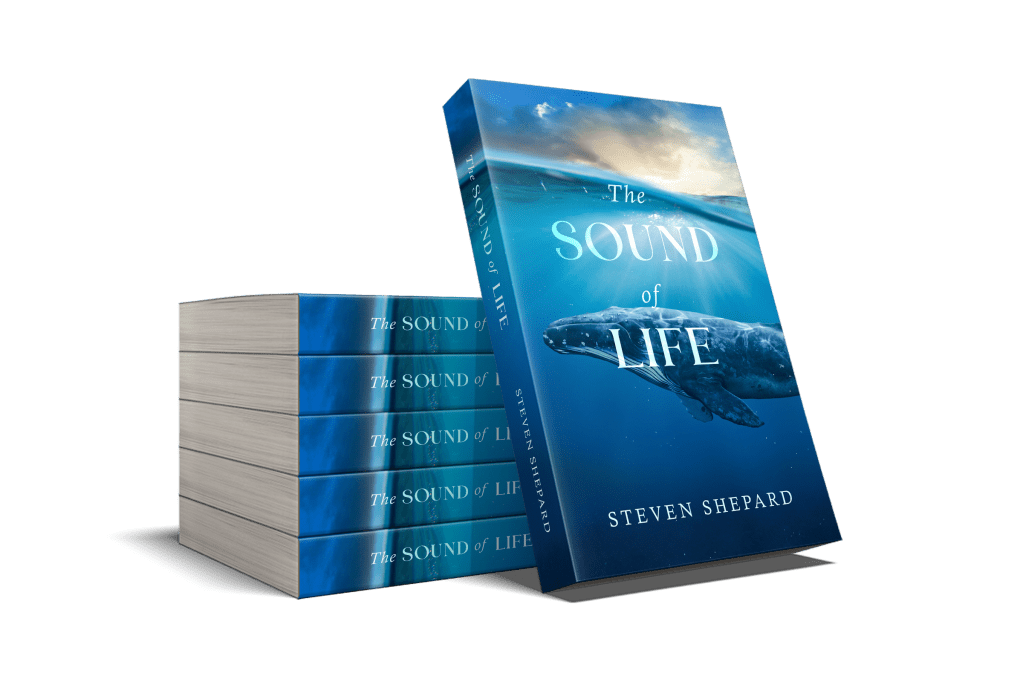
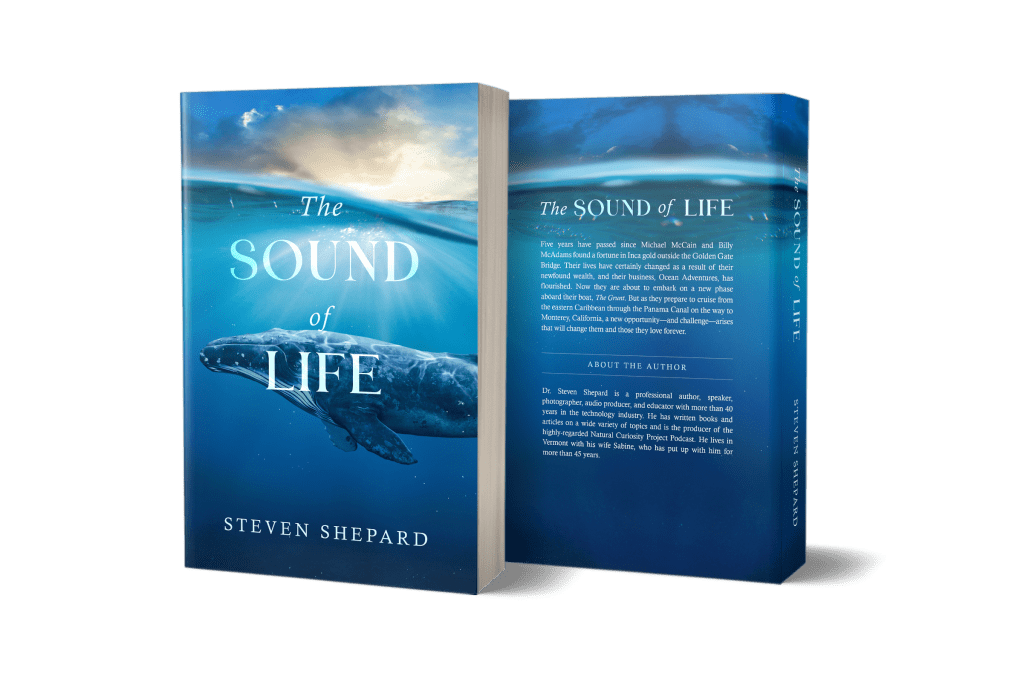
I’m about to publish a new novel, my fifth, called “The Sound of Life.” My editors have gone through it with their editorial microscopes, identifying mistakes, errors and omissions. My cadre of readers have gone through it, uncovering awkward dialogue, technical errors, and flow problems that I inevitably missed. The final manuscript is called ‘The Sound of Life v48F,’ which means that the book went through 48 complete rewrites before I deemed it ready for publication—although there will be at least two more read-throughs before I give it the final go-ahead.

I’m proud of this book. It’s my 106th title (bad habit), and I felt a sense of letdown when I typed the last sentence and knew it was done. That’s never happened to me before. Because of the story that magically emerged from the creative mists before me, the wonderful characters I met along the way, and the journey they allowed me to join them on, when I typed the last word of the final sentence, I felt like I was pulling into the driveway after a long, memorable road trip. I needed a medicine for melancholy, because it was over.

Author Alice Munro wrote, “A good book makes you want to live in the story. A great book gives you no choice.” That’s how I felt with this one. And please understand, this isn’t my ego talking. I experienced something as I wrote this book that rarely happens, like seeing the mysterious and elusive “green flash” over the ocean at sunset. At some point along the creative journey, I realized that I was no longer writing the book: it was writing itself. My job changed from creative director to scribe. It was like it was saying to me, ‘Here’s the keyboard. Try to keep up.’

Author M.L. Farrell said this about books:

A book is not mere paper and words.

It is a door and a key.

It is a road and a journey.

It is a thousand new sights, sensations and sounds.

It holds friendships, experiences, and life lessons.

A book is an entire world.”

There’s so much truth in that. I’m at the point with this one where people are asking me what “The Sound of Life” is about, and now that I know, I’m excited to tell them. But as I describe the 56-foot boat that’s central to the story, the journey from the eastern Caribbean through the Panama Canal then up the coast to Northern California, the rich interactions among the characters, and the happenings in Peru that tie much of the narrative together, I realize somewhat sheepishly that every time I tell someone what the book’s about, I speak in the first person. Not ‘they,’ but ‘we.’ Well, sure—I was there. I was along for the ride. Why wouldn’t I speak in the first person?

Stephen King is a writer whom I admire greatly, for many reasons. “Books are a uniquely portable magic,“ he once said. A uniquely portable magic. I think about the complexity, richness, excitement, laughter, and delicious food that’s captured between the covers of this book. I think about the immensely likable people and their relationships, around whom the story revolves. I think about the sights and sounds and smells and tastes they experience along the way. And I think about what it felt like when my characters, my good friends, got back on the boat and motored away, waving as they left me behind on the dock, en route to their next adventure. 

A uniquely portable magic.

“The Sound of Life” will be released in December 2025.

The Wisdom of Loren Eiseley

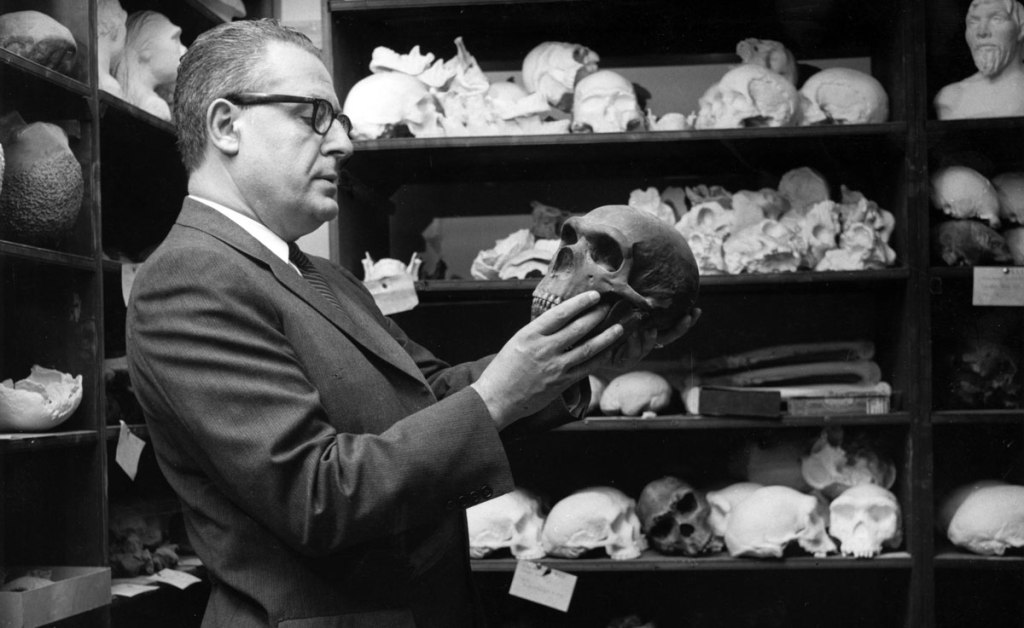
One of my favorite writers is an obscure guy that most people have never heard of. His name is Loren Eiseley, and he was a physical anthropologist and paleontologist at the University of Pennsylvania for over 30 years. As a young man, during the Great Depression, he was a ‘professional hobo,’ riding freight trains all over the United States, looking for work and the occasional adventure; his academic career came later. I’ve met few people who have read his books, yet few writers have affected me as much as he has.  

Loren Eiseley in his office at the University of Pennsylvania Museum, May 12, 1960. Photo by Bernie Cleff, courtesy of the University of Pennsylvania Archives and Records Center.

I discovered Loren Eiseley when I was at Berkeley; a friend loaned me his book, All the Strange Hours: The Excavation of a Life. It’s mostly an autobiography, but it’s powerfully insightful about the world at large. He draws on his early experiences as a vagabond as much as he does as an academic, both of which yield a remarkable way of looking at the ancient and modern worlds.

I have all of his books, in both physical and ebook formats, and they’re among the few I never delete. I keep a list of quotes from Loren’s works in my phone, and I pull them up and read them every once in a while. Here are a few of my favorites. Remember, this guy is a hardcore scientist, although you’d never know it from what you’re about to read.

If there is magic on this planet, it is contained in water.

One does not meet oneself until one catches their reflection from an eye that is other than human.

The journey is difficult, immense. We will travel as far as we can, but we cannot in one lifetime see all that we would like to see or to learn all that we hunger to know.

If it should turn out that we have mishandled our own lives as several civilizations before us have done, it seems a pity that we should involve the violet and the tree frog in our departure.

When man becomes greater than nature, nature, which gave us birth, will respond. This last one strikes me as particularly prescient.

Ray Bradbury, another of my all-time favorite writers, said that ‘Eiseley is every writer’s writer, and every human’s human. He’s one of us, yet most uncommon.’

More than anything else, Loren Eiseley was a gifted observer and storyteller. In All the Strange Hours, he writes about a chance encounter on a train. I’d like to share a bit of it with you.

“In the fall of 1936 I belatedly entered a crowded coach in New York. The train was an early-morning express to Philadelphia and what I had been doing in New York the previous day I no longer remember. The crowded car I do remember because there was only one seat left, and it was clearly evident why everyone who had boarded before me had chosen to sit elsewhere.The vacant seat was beside a huge and powerful man who seemed slumped in a drunken stupor. I was tired, I had once lived amongst rough company, and I had no intention of standing timidly in the aisle. The man did not look quarrelsome, just asleep. I sat down and minded my own business. 

Eventually the conductor made his way down the length of the coach to our seats. I proceeded to yield up my ticket. Just as I was expecting the giant on my right to be nudged awake, he straightened up, whipped out his ticket and took on a sharp alertness, so sharp in fact, that I immediately developed the uncanny feeling that he been holding that particular seat with a show of false drunkenness until the right party had taken it. When the conductor was gone, the big man turned to me with the glimmer of amusement in his eyes. “Stranger,” he appealed before I could return to my book, “tell me a story.” In all the years since, I have never once been addressed by that westernism “stranger” on a New York train. And never again upon the Pennsylvania Railroad has anyone asked me, like a pleading child, for a story. The man’s eyes were a deep fathomless blue with the serenity that only enormous physical power can give. People on trains out of New York tend to hide in their own thoughts. With this man it was impossible. I smiled back at him. ‘You look at me,’ I said, running an eye over his powerful frame, ‘as if you were the one to be telling me a story. I’m just an ordinary guy, but you, you look as if you have been places. Where did you get that double thumb?’

With the eye of a physical anthropologist, I had been drawn to some other characters than just his amazing body. He held up a great fist, looking upon it contemplatively as though for the first time.”

That’s just GREAT writing. Powerfully insightful, visual, and entertaining. And, it demonstrates Eiseley’s skill as a naturally curious storyteller, and the use of storytelling as an engagement technique. His willingness to talk with the odd guy in the next seat over, to ask questions, to give the guy the opportunity to talk, demonstrates one of the most important powers of storytelling.

For most people, storytelling is a way to convey information to another person, or to a group. And while that’s certainly true, that’s not the most important gift of storytelling. The best reason to tell stories is to compel the other person to tell a story BACK. Think about the last time you were sitting with a group of friends, maybe sharing a glass of wine. People relax and get comfortable, and the stories begin. One person tells a story, while everyone else listens. When they finish, someone else responds: ‘Wow. That reminds me of the time that…’ and so it goes, around the group, with everyone sharing. 

When this happens, when the other person starts talking, this is your opportunity to STOP talking and listen—to really listen to the person. They’re sharing something personal with you, something that’s important and meaningful to them—which means that it should be important and meaningful to you, if you want to have any kind of relationship with that person. It’s a gift, so treat it accordingly. 

In west Texas, there’s an old expression that says, ‘Never miss a good chance to shut up.’ This is one of those times. By letting his seat mate talk, Loren Eiseley discovered amazing insights about him, but not just about him. He also learned about his views of society and the world. The conversation goes on for many pages beyond what I quoted earlier, and it’s powerful stuff. So never underestimate the power of the story as an insight gathering mechanism, as much as it is an opportunity to share what YOU have to say.

Here’s one last thing I want to mention. In the tenth episode of my Podcast, The Natural Curiosity Project, I talked about a book I had recently read called ‘The Age of Wonder.’  It’s the story of the scientists of the Romantic Age (1798-1837) who made some of the most important discoveries of the time—people like Charles Babbage, William Herschel, Humphrey Davy, Michael Faraday, and Mungo Park, scientists who had one thing in common: their best friends, partners, and spouses were, without exception, artists—poets and novelists, for the most part. 

These were serious, mainstream, well-respected scientists. For example, Charles Babbage was a mathematician who was the father of modern computing (he invented the Difference Engine, a mechanical calculator that had more than 25,000 brass gears). He was married to Ada Lovelace, the daughter of the poet Lord Byron, and a writer and mathematician herself. William Hershel built the world’s first very large telescopes in England, and his best friend was George Gordon, better known as Lord Byron, the romantic poet. Humphrey Davy was a chemist and anatomist who discovered the medicinal properties of nitrous oxide. His closest friend was the poet and essayist Samuel Taylor Coleridge, who wrote Kubla Khan and The Rime of the Ancient Mariner.

In Xanadu did Kubla Khan, 

A stately pleasure-dome decree: 

Where Alph, the sacred river, ran, 

Through caverns measureless to man, 

Down to a sunless sea.

John Keats, a poet and the author of Ode on a Grecian Urn, was also a medical student whose scientific pursuits shaped his poetry. Mary Shelley is well known as the author of Frankenstein; her last name is Shelley because she was married to Percy Bysshe Shelley, another romantic poet and essayist:

I met a traveller from an antique land, 

Who said—“Two vast and trunkless legs of stone 

Stand in the desert. . . . Near them, on the sand, 

Half sunk a shattered visage lies, whose frown, 

And wrinkled lip, and sneer of cold command, 

Tell that its sculptor well those passions read 

Which yet survive, stamped on these lifeless things, 

The hand that mocked them, and the heart that fed; 

And on the pedestal, these words appear: 

My name is Ozymandias, King of Kings; 

Look on my Works, ye Mighty, and despair!

Shelley’s work was filled with and flavored by the wonders of science. 

So, you may be wondering if there’s a ‘so what’ coming any time soon. The answer is yes: Don’t you find it interesting that these scientists were all supported by and influenced by their artistic friends, and vice-versa? What does that tell us about the importance of the linkage between science and the arts? Well, there’s a huge focus right now in schools on STEM—Science, Technology, Engineering, and Math. Now look: I’ll be the first to tell you that those are all important, but there’s are two letters missing: it should be STREAM. The ‘R’ is for ‘Reading,’ a necessary and critical skill, and the ‘A’ for ‘Arts’ needs to be in there as well, with as much emphasis and priority as the others. Anyone who doubts that should look to the lessons of earlier history.

And Loren Eiseley—remember him? Where does he fit into this? Well, think about it. What made him such a gifted scientist was the fact that he was, in addition to being a respected scientist, a gifted essayist and poet. During his life he wrote nine books, hundreds of essays, and several collections of poetry, all centered on the wonders of the natural world. His philosophy, his approach to his profession, embodied the learnings from the Age of Wonder. 

In one of his essays, ‘How Flowers Changed the World’ (which you’ll find in his book, ‘The Immense Journey’), Loren Eiseley had this to say:

If our whole lives had not been spent in the midst of it, the natural world would astound us. The old, stiff, sky-reaching wooden world (he’s talking about trees here) changed into something that glowed here and there with strange colors, put out queer, unheard of fruits and little intricately carved seed cases, and, most important of all, produced concentrated foods in a way that the land had never seen before, or dreamed of back in the fish-eating, leaf-crunching days of the dinosaurs.” 

Imagining the first human being who pondered the possibility of planting seeds, he writes: “In that moment, the golden towers of man, his swarming millions, his turning wheels, the vast learning of his packed libraries, would glimmer dimly there in the ancestor of wheat, a few seeds held in a muddy hand. Without the gift of flowers and the infinite diversity of their fruits, man and bird, if they had continued to exist at all, would be today unrecognizable. 

Archaeopteryx, the lizard-bird, might still be snapping at beetles on a sequoia limb; man might still be a nocturnal insectivore gnawing a roach in the dark. The weight of a petal has changed the face of the world and made it ours.” 

The poetic power of Loren’s science writing infuses the facts with human wonder. Here he is, writing about the stupefyingly boring topic of angiosperms, seeds that are enclosed in some kind of protective capsule, yet, we’re mesmerized by the imagery his words create.

What a world. And it’s ours.
HG Wells and the World Brain

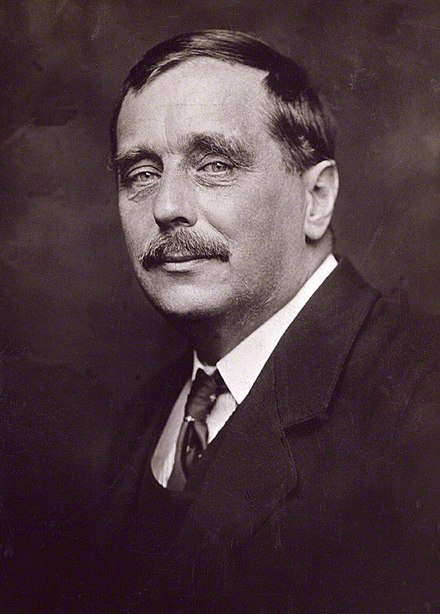
Photo by George Charles Beresford, black and white glossy print, 1920

Not long ago, I started doing something I always said I would do, but honestly never thought I’d actually get around to doing. Remember when you were in high school or college and your English teacher assigned you a book to read? And it wasn’t something fun like Hardy Boys or Tom Swift or Doc Savage (showing my age, here) or Little House on the Prairie. No, it was something BORING by Mark Twain or Charles Dickens or John Steinbeck. If you were like me, you faked it badly, or in college you might have run down to the bookstore to buy the summary of the book to make your fake a bit more believable. Either way, it rarely ended well.

I’m a writer and storyteller by trade—it’s who I am. And, because I’m a writer, I’m also an avid reader—and I mean, avid. I average about 140 books a year. So, a couple of years or so ago, I decided to start mixing the classics into my normal mix of books, starting with Arthur Conan Doyle. At first, I was dreading it. But once I started reading and allowed myself to slow my mind and my reading cadence to match the pace of 19th-century writers, I was hooked with the first book. I blazed through them all, the entire Sherlock Holmes collection, and then moved on to Jules Verne and Mark Twain and H.G. Wells. Reading those books as an adult, with the benefit of a bit more life behind me, gave the stories the context that was missing when I was a kid. 

By the way, I have to interrupt myself here to tell you a funny story. I’m a pretty fast reader—not speed-reading fast, but fast. I pretty much keep the same reading cadence in every book I read, unless I’m reading poetry or a book by someone whose work demands a slower pace. Some southern writers, like Rick Bragg, slow me down, but in an enjoyable way. But a typical book of two or three-hundred pages or so, I usually blast through in about three days.

Not long ago, I read David Attenborough’s First Life, a book about the earliest organisms on the planet. That book took me two weeks to read. And it wasn’t because I wasn’t regularly reading it, or because the book was complicated, or poetic. It was because David Attenborough is one of those wonderful writers who writes the way he speaks. Which means that as I was reading, I was hearing his voice, and my reading began to mimic the pace at which he speaks on all the BBC programs: These … extraordinary creatures … equipped … as they are … for life in the shallow, salty seas … of the Pre-Cambrian world … quickly became the hunted … as larger … more complex creatures … emerged … on the scene. 

I just couldn’t do it. I tried to read at a normal clip, and I stumbled and tripped over the words. It was pretty funny. It was also a great book.

Anyway, I just finished The Time Machine by H. G. Wells. I saw the movie as a kid, loved it, but the book was, as usual, quite different from the movie. I loved Wells’ writing, and it made me want to read more. So, I decided to read one of his lesser-known works, his Outline of History, a massive work of about 700 pages. And, as so often happens when I read something new, I had an epiphany.

Let me tell you a bit about Herbert George Wells. During the 1930s, he was one of the most famous people in the world. He was a novelist and a Hollywood star, because several of his movies—The Invisible Man, Things to Come, and The Man Who Could Work Miracles were made into movies (the Time Machine didn’t hit the screens until later). In 1938, Orson Wells reportedly caused mass panic when he broadcast a radio show based on Well’s War of the Worlds, which also added to his fame. That story has since been debunked, but it did cause alarm among many.

Wells studied biology under T.H. Huxley at the UK’s Royal College of Science. He was a teacher and science writer before he was a novelist. Huxley, who served as a mentor for Wells, was an English biologist who specialized in comparative anatomy, but he was best known as “Darwin’s Bulldog” because of his loud support for Darwin’s theory of  evolution. He also came up with the term, ‘agnosticism.’  “Agnosticism,” he described, “is not a creed, but a method, the essence of which lies in the rigorous application of a single principle… the fundamental axiom of modern science… In matters of the intellect, follow your reason as far as it will take you, without regard to any other consideration… In matters of the intellect, do not pretend that conclusions are certain which are not demonstrated or demonstrable.” Pretty prescient words that need to be broadcast loudly today. Ask questions, and don’t accept a statement as truth until you know it is. That’s precisely why I started this series.

Sorry—I’m all over the place here. The Outline of History tells the story of humankind from the earliest days of civilization to the end of World War I—The Great War, The War to End All Wars. If only. 

From there, I went on to read Work, Wealth, and Happiness of Mankind, another of his lesser known works. Both are interesting takes on history and sociology, and somewhere between them, Wells invents the World Wide Web. Really.

Here’s how he begins the concept: 

Before the present writer lie half a dozen books, and there are good indexes to three of them. He can pick up any one of these six books, refer quickly to a statement, verify a quotation, and go on writing. … Close at hand are two encyclopedias, a biographical dictionary, and other books of reference.

As a writer, Wells always had reference books on his desk that he used regularly. As he developed the concept that he came to call the World Brain, he wrote about the early scholars who lived during the time of the Library of Alexandria, the greatest center of learning and scholarship in the world at the time. It operated from the third century BC until 30 AD, an incredibly long time. Scholars could visit the Library, but they couldn’t take notes (there was no Paper), and there were no indices or cross-references between documents. So, Wells came up with the idea of taking information to the people instead of the other way around, and figuring out a way to create detailed cross-references—in effect, search capability—to make the vast stores of the world’s knowledge available, on demand, to everybody.                

His idea was that the World Brain would be a single source of all of the knowledge contained in the world’s libraries, museums, and universities. He even came up with a system of classification, an information taxonomy, for all that knowledge.             

Sometime around 1937, with the War to End All Wars safely in the past, Wells began to realize that the world was once again on the brink of conflict. To his well-read and research-oriented mind, the reason was sheer ignorance: people were really (to steal a word from my daughter) sheeple, and because they were ignorant and chose to do nothing about that, they allowed themselves to be fooled into voting for nationalist, fascist governments. The World Brain, he figured, could solve this problem, by putting all the world’s knowledge into the hands of all its citizens, thus making them aware of what they should do to preserve the peace that they had fought so hard to achieve less than twenty years earlier. What he DIDN’T count on, of course, was that he was dealing with people—and the fact that you can lead a horse to water, but you can’t make him drink from the intelligence well. 

Nevertheless, he tried to raise the half million pounds a year that he felt would be needed to run the project. He wrote about it, gave lectures, toured the United States, and had dinner with President Roosevelt, during which he discussed the World Brain idea. He even met with scientists from Kodak who showed him their newest technology—the technology that ultimately became microfiche. But sadly, he couldn’t make it happen, and sure enough, World War II arrived.             

Here’s how he summed up the value of the World Brain: 

The general public has still to realize how much has been done in this field and how many competent and disinterested men and women are giving themselves to this task. The time is close at hand when any student, in any part of the world, will be able to sit with his projector in his own study at his or her own convenience to examine any book, any document, in an exact replica. 

In other words…the World Wide Web. Imagine that.

World War II caused Wells to fall into a deep depression, during which he wrote The Time Machine, which is, I think, the first post-apocalyptic novel ever written—at least as far as I know. He describes the great green structure on the hill, made of beautiful porcelain but now falling down in ruins; I suspect he was thinking about the sacking and burning of the great Library of Alexandria when he wrote that part of the book. 

Or, perhaps he was thinking of Percy Bysshe Shelley’s “Ozymandias”:

I met a traveller from an antique land,

Who said—“Two vast and trunkless legs of stone

Stand in the desert. . . . Near them, on the sand,

Half sunk a shattered visage lies, whose frown,

And wrinkled lip, and sneer of cold command,

Tell that its sculptor well those passions read

Which yet survive, stamped on these lifeless things,

The hand that mocked them, and the heart that fed;

And on the pedestal, these words appear:

My name is Ozymandias, King of Kings;

Look on my Works, ye Mighty, and despair!

Nothing beside remains. Round the decay

Of that colossal Wreck, boundless and bare

The lone and level sands stretch far away.”

Never underestimate the power of great literature. And never underestimate the power of curiosity when it’s unleashed on a problem.