The hardest thing about writing a book isn’t coming up with the story, or inventing the complicated relationships that help define the characters, or making sure the story flows the way it’s supposed to. It isn’t the painstaking process of finding all the typos and misspellings and missing quotes, or fact-checking every tiny detail so that a reader who has it in for you discovers with chagrin that there’s little to criticize. Nope—it’s none of those, although those do require work.
The hardest thing about writing a novel is creating the one-paragraph synopsis that goes on the back cover. Think about it. The publisher says to the author, “Please take your 140,000-word, 468-page novel and describe it in 125 words or less, in a way that will cause a prospective reader to drool uncontrollably all the way to the checkout counter at the bookstore.”
Good luck with that. Like I said: Hard.
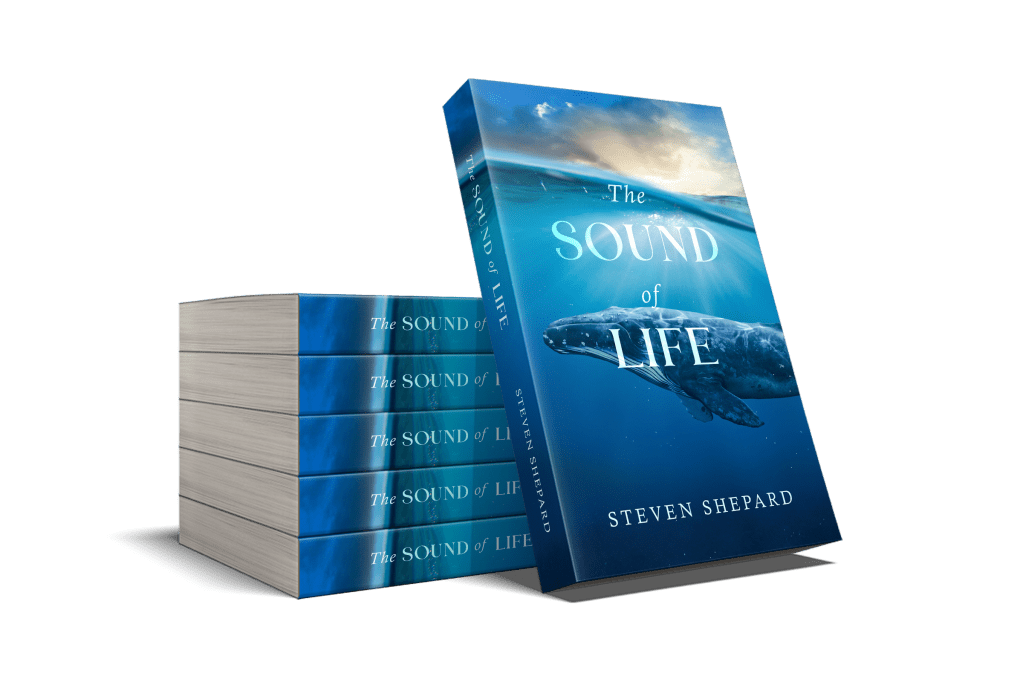
I’m about to publish a new novel, my fifth, called “The Sound of Life.” My editors have gone through it with their editorial microscopes, identifying mistakes, errors and omissions. My cadre of readers have gone through it, uncovering awkward dialogue, technical errors, and flow problems that I inevitably missed. The final manuscript is called ‘The Sound of Life v48F,’ which means that the book went through 48 complete rewrites before I deemed it ready for publication—although there will be at least two more read-throughs before I give it the final go-ahead.
I’m proud of this book. It’s my 106th title (bad habit), and I felt a sense of letdown when I typed the last sentence and knew it was done. That’s never happened to me before. Because of the story that magically emerged from the creative mists before me, the wonderful characters I met along the way, and the journey they allowed me to join them on, when I typed the last word of the final sentence, I felt like I was pulling into the driveway after a long, memorable road trip. I needed a medicine for melancholy, because it was over.
Author Alice Munro wrote, “A good book makes you want to live in the story. A great book gives you no choice.” That’s how I felt with this one. And please understand, this isn’t my ego talking. I experienced something as I wrote this book that rarely happens, like seeing the mysterious and elusive “green flash” over the ocean at sunset. At some point along the creative journey, I realized that I was no longer writing the book: it was writing itself. My job changed from creative director to scribe. It was like it was saying to me, ‘Here’s the keyboard. Try to keep up.’
Author M.L. Farrell said this about books:
A book is not mere paper and words.
It is a door and a key.
It is a road and a journey.
It is a thousand new sights, sensations and sounds.
It holds friendships, experiences, and life lessons.
A book is an entire world.”
There’s so much truth in that. I’m at the point with this one where people are asking me what “The Sound of Life” is about, and now that I know, I’m excited to tell them. But as I describe the 56-foot boat that’s central to the story, the journey from the eastern Caribbean through the Panama Canal then up the coast to Northern California, the rich interactions among the characters, and the happenings in Peru that tie much of the narrative together, I realize somewhat sheepishly that every time I tell someone what the book’s about, I speak in the first person. Not ‘they,’ but ‘we.’ Well, sure—I was there. I was along for the ride. Why wouldn’t I speak in the first person?
Stephen King is a writer whom I admire greatly, for many reasons. “Books are a uniquely portable magic,“ he once said. A uniquely portable magic. I think about the complexity, richness, excitement, laughter, and delicious food that’s captured between the covers of this book. I think about the immensely likable people and their relationships, around whom the story revolves. I think about the sights and sounds and smells and tastes they experience along the way. And I think about what it felt like when my characters, my good friends, got back on the boat and motored away, waving as they left me behind on the dock, en route to their next adventure.
A uniquely portable magic.
“The Sound of Life” will be released in December 2025.
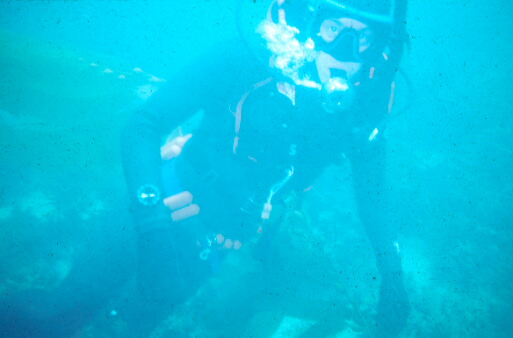
I earned my NAUI Certification card—my C-card, as divers call it—in 1977, and proudly pocketed my Instructor card a year later. As a newly-minted dive shop owner, I taught basic skills in the pool every weeknight, and on weekends I was either somewhere along California’s north coast taking new divers on their first free dive, or in Monterey for final class certification dives. The ocean has always fascinated me; like so many people, I watched, enraptured, as Jacques Cousteau and his team explored the undersea world. When I was a little boy, I pulled a pair of my underwear over my head so that one leg hole served as my face mask and pulled a pair of my dad’s socks onto my feet to serve as fins. I swam down the dark hallway, Jacques at my side. Once I was certified, the ocean became the center of my life, and that has never changed.
My first open water SCUBA dive was at Monterey Bay’s Cannery Row, back when it still had the ruin and wreckage of the old canneries strung along the beach where fancy hotels and restaurants stand today. With the clarity of poignant memory I remember pushing off the surf mat, raising the BC hose over my head, and descending below the calm surface into a world that I would come to love more than just about any other place on the planet. It is a place in which I am so inordinately comfortable that I once fell asleep lying on the bottom of Monterey Bay, my hands under my regulator as I watched life go on, tiny creatures crisscrossing the sandy bottom on their mysterious errands.
In consummate awe I dropped through the kelp on my way to the bottom during my first dive. As I descended, I brushed against the kelp leaves, causing a shower of pea-size crabs, moon snails, nudibranchs and other creatures that before my descent had been in-residence on the various levels of the Macrocystis. I would later teach my own students that at as much as a foot a day, giant kelp is one of the fastest growing plants on Earth, and that its flotation bladders are filled with enough carbon monoxide to kill a chicken in three minutes.
As I approached the sandy bottom on that first dive, I realized I had a problem. I was falling too quickly. I was a new diver, and buoyancy was not yet something I controlled subconsciously. Looking down as I approached the ocean floor, I had the overwhelming realization that no matter where I landed, whether on those rocks in front of me, or that patch of sea lettuce over there to my left, or on those old, eroded pipes from the canneries, or on the flat, sandy bottom over there, in the process of touching down I would crush countless lives. So profuse was the riot of living things that there wasn’t a square centimeter anywhere that didn’t have something living on it.
Luckily, I was able to arrest my descent before I destroyed the community below me. I managed to go into a hover, where I stayed, unmoving, just taking it all in. My sense of wonder was so great that I lacked the ability to move. But the truth is that I didn’t want to move: I would have had to drain the tank on my back and three more like it before I saw every living thing on the patch of bottom directly beneath me. In fact, I was so motionless in the water column that my instructor came over to make sure I was okay.
As I floated, unmoving, something else crept into my consciousness: the sounds of the underwater domain. The bubbles from my exhalations. The mechanical hiss and click of my regulator. The far-away sound of a propeller frothing the ocean. A deep, unrecognizable rumble, something industrial, far away.
And then there were the clicks, trills, and bloops, the buzzing and scratching and chirping of ocean life. In other words, a cacophony, a joyous symphony, the countless voices of Monterey Bay.
At night, the score changed. There were fewer human sounds and more natural sounds, mysterious and eerie. This became my favorite time to be in the ocean; night diving is profoundly magical. Once we sank to the bottom, turned off our lights, and allowed our eyes to acclimate to the darkness, we could see remarkably well. Every movement, every fin stroke, every turn of the head created a star-storm as the moving water caused bioluminescent plankton in the water to spark alight. Every passing seal or sea lion or otter drilled a contrail of glowing green through the black water like a living comet. This was nature’s alchemy at its best.
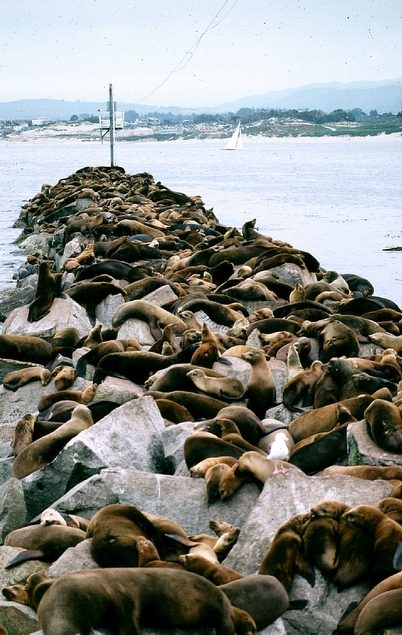
And, there were sounds—so many sounds. I once did a night dive at the far end of the Monterey Coast Guard Pier where a huge colony of seals and sea lions congregates. Divers know that if they turn on their powerful dive lights during a night dive, their vision goes from a dim awareness of everything around them to brilliant awareness of whatever is illuminated by that narrow white beam directly in front of them, drilling a hole into the darkness. Night divers also know that for reasons known only to them, sea lions enjoy barreling down the light beam toward the diver, blowing bubbles and roaring like a freight train—then veering off into the darkness at the last moment before colliding with the now terrified diver. It has happened to me more times than I can remember, and it still scares the hell out of me when it does.
Twice over the years I heard the siren song of whales while night diving in Monterey; once I heard the telltale blast of sonar, presumably from a submarine somewhere outside the Bay. It was mildly terrifying, and it was more than a little painful. One night I found myself on the Cannery Row side of the Coast Guard Pier, not far from the sea lion incident I just described. Sensing movement beside me, I saw that three gigantic ocean sunfish, mola mola, easily eight feet from top to bottom, had unwittingly surrounded me. They meant no harm and were most likely oblivious to me. But with them came a sound, a combination of stomach rumble and the squeak of a hand rubbing a balloon. It was all around me, and it was loud. At first I thought it was air moving around inside their swim bladders, a common marine sound, but giant sunfish don’t have swim bladders. To this day, I have no idea what I was hearing, but I’ve never forgotten it. All I know is that when the sunfish disappeared into the depths of the Bay, the sound disappeared with them.
I have long been an avid photographer, both above the surface and below it. But as time went on, I began to pay more attention to what my ears were telling me than what my eyes were. I don’t know what caused that focal shift; perhaps it was the fundamental nature of the two senses. Not long ago, on a whim, I sat down with a calculator and my photo database and did a back-of-the-envelope calculation. It turns out that from the time I started shooting seriously until today, a period that covers just shy of 50 years, I shot approximately 500,000 images. Big number. Most of them I shot at a 250th of a second, my preferred shutter speed. That means that every 250 images I shot covered one second of Earth time. 500,000 images, then, translates to 2,000 seconds, which is just over 33 minutes. In other words, my nearly 50 years of serious, near-constant shooting captured a half-hour of my life.
On the other hand, when I go out to record sound, I often sit for an hour or more with the recorder running, capturing a soundscape. During that time, I immerse myself in the environment and become part of it, something that’s impossible to do in a 250th of a second. With my camera I click and go, rarely lingering after the famous ‘moment it clicks’ to savor the entirety of what I just captured a tiny slice of.
Photography is about capturing a still image, a single, frozen moment in time. But what in the world is a ‘still sound’? The answer of course, is there is no answer. The difference between a photograph and a sound recording, beyond the obvious, is time. A photograph captures a moment in time; a sound recording captures a moment over time. Photography is often described as a “run-and-gun” activity. But when I go out to record, that approach doesn’t work because sound recording by definition is immersive: I have to settle down in the environment, get my gear sorted, and be quiet by being still. If I’m still, I pay attention. And if I pay attention, I notice things. My awareness of my surroundings isn’t limited to what I see through the narrow viewfinder of a camera; it’s as broad as I choose to make it, and the longer I sit, the richer my awareness becomes.
Maybe it’s age-related. I’m older now than I was when I started photographing seriously; with age comes patience, and patience is a critical element of sound recording. Saint Augustine said, “The reward of patience is patience.” And it isn’t because I have more time now that I’m older; I have the same time now that I had when I was 21, a full 24 hours every single day. It’s a question of how I choose to use those 24 hours. Bernie Krause, writing in The Power of Tranquility in a Very Noisy World, said, “Heed the narratives expressed through the biophony. Our history is writ large within those stories. Be quiet. Listen. Be amazed.”
Be quiet. Listen. Be amazed. Great advice for all of us.
 Steven Shepard