Category Archives: Uncategorized

Monitoring Biodiversity Through Sound

(If you’d prefer to listen to the Podcast version of this essay, with some wonderful embedded natural sounds, please go here).

I begin with a definition of biodiversity. 

Biodiversity measures the variety of life on Earth, including the richness of species, the genetic variation required for hybrid vigor, and the breathtaking variety of unique ecosystems. Biodiversity also includes the interactions between living things to create a self-sustaining, biologically balanced, healthy world. It’s why we have paramecia and pangolins, elephants and echidnas, orchids and owls, wheat and whales.

It doesn’t take much to get a sense of the extent of this biodiversity, especially in the warmer months. It’s literally everywhere. Get up early one morning, the hour before dawn, and go for a walk in the woods, or in the tall grasslands down the road, or across a dewy meadow, or along a stream. Find a place to sit. Be patient, and just listen to the dawn chorus. Or, do the same, but in the late evening. Walk near a marsh, or a lake, or a pond, find a place to sit, and listen to the evening chorus. The experience will feet you deeply, if you allow it to.

Biologists, especially ecologists, monitor biodiversity in various ways. Some monitoring is for academic reasons, the never-ending quest of science to know, to understand. 

Others monitor biodiversity, looking for places where we overstep, human canaries in the coal mine who speak out against chemical dumping, improper disposal of toxins, the hazard of forest clearcutting, greenhouse gas emissions, fertilizer runoff, and a hundred other ecological crimes against the planet and its inhabitants—including ourselves. 

Dr. Barry Commoner

Sometimes, the decision-makers who pay attention to these environmental watchdogs listen and act. DDT and other chemicals were effectively banned after Rachel Carson published Silent Spring in 1962. Barry Commoner, the father of the modern ecology movement, made the world pause when he published his four ecological laws: Everything is connected to everything else; Everything must go somewhere; Nature knows best; and There is no such thing as a free lunch. You know, those are so important that they’re worth repeating. Everything is connected to everything else; Everything must go somewhere; Nature knows best; and There is no such thing as a free lunch. 

Others, like Jacques Cousteau, Sylvia Earle, David Attenborough, EO Wilson, and Loren Eiseley, combine passion and logic, visual storytelling and compelling truths, to motivate us to be more thoughtful and responsible stewards. Even young people can be ecological heroes: Greta Thunberg brought a human and humane face to the impending climate change crisis. And while all of these efforts had impact, and often brought about changes in human behavior, hubris is a powerful motivator.
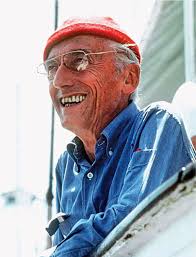
Jacques Cousteau

In the interest of growth-related profit, great swaths of enormously biodiverse landscapes—the Tallgrass Prairie, California’s San Joaquin Valley, the rolling hills of Washington’s Palouse—are cleared to make way for the short-term potential of mono-crops, such as palm oil, soy, wheat, corn, cotton, and sugar cane. The downside of this practice has been known since the early 20th century. When Henry Ford established Fordlandia, for example, his ill-fated American city deep in the Brazilian Amazon, he cleared the tropical forest to make way for the rubber trees he needed to produce latex for rubber tires. He planted the trees in ruler-straight rows, which quickly succumbed to infestations of pests in the now vulnerable, concentrated grid of trees. The hybrid vigor of the forest, the physiological firewall that originally protected everything in the biosphere, was gone, and as I described in an earlier program, not a single drop of rubber from the venture ever made its way onto a Ford automobile. Hubris.

Before the advent of modern farming techniques, there was no need for pesticides, or soil additives, or extensive crop watering infrastructure, or fertilizers, because nature took care of that for herself. But when mono-crop agriculture became the norm, it suddenly became necessary to force the land to produce. Gone was the elegant natural system that took care of itself; it was replaced by a system based on brute force. Man against nature, nature as the enemy, an enemy within which we are an integral part. Oops.

When the natural botanical ecosystem is disrupted or destroyed—forest, jungle, grassland, prairie, chaparral, seashore—the animal life that’s intertwined with the botanical diversity of the environment is equally disrupted. Everything from bacteria that help to keep the soil healthy to the largest mammals at the top of the food chain suddenly find themselves imperiled by the abrupt loss of habitat, their support framework, their life.

If you’re having trouble imagining or believing this scenario, let me offer an analogy of the human sort. Every morning, you wake up in your comfortable bed, in the warmth and safety of your home. You wash up in your well-appointed bathroom, then head down to your well-equipped kitchen where you brew a nice cup of designer coffee and prepare a hearty breakfast to keep you well-nourished until your next meal, which will happen sometime around midday, in a restaurant of your choosing.

But one morning, you wake up and find yourself inexplicably lying on the leeward side of a great sand dune, 120 feet high. Dazed, confused, sweating profusely in the growing heat of the morning, you stand up and trek to the top of the dune, where you see nothing but more dunes, marching off into the haze of distance in all directions. No home, no bedroom, no kitchen, no coffee shop, no grocery store, no pharmacy, no doctor—just sand dunes, sun, and the occasional tuft of silica-rich and entirely inedible desert grass. Welcome to your new home. Suck it up and make it work—or, more likely, don’t.

The naturally biodiverse web of life works because it has evolved over the eons as a balanced system, organically able to change and adapt as required, weaving and dodging to overcome the challenges of the biological lottery. Some individuals win; some lose. But the system survives, and each time it emerges stronger and more resilient, for having run the gauntlet. 

I’m telling you this story because biodiversity matters—not just to the scientific community, but to literally every living thing on this planet. Changes in the biodiversity of an ecosystem, changes that are all-too-often caused by humans, are equally all-too-often invisible to us. On June 22nd, 1969, the Cuyahoga River in Cleveland, Ohio caught fire. You heard that correctly: the river caught fire, shooting flames five stories into the sky. You’d think that a large river flowing through a major American city that was so polluted with industrial chemicals that a flare fired from a passing train ignited it, might have caused somebody to notice. The smell alone, never mind the lack of aquatic life, should have been a glaring clue. Nope. Sometimes we choose not to notice what’s right in front of us; other times we can’t notice, because we’re looking at the problem with the wrong set of senses.

Here’s an example. In the late 1980s, sound ecologist Bernie Krause recorded the rich and varied soundscape of an idyllic place in California called Lincoln Meadow. The air was filled with the joyous cacophony of birdsong. He recorded there for several consecutive years, always in the same place with the same gear.

At one point, a logging company negotiated an agreement to “selectively log” the forest at Lincoln Meadow—meaning, only remove some of the trees. Krause continued to record, during and for several years after the logging.

To the visual observer, nothing changed. The selective removal of some trees made no difference in the look of the forest. But the sound? It went from being sonically raucous and alive to sonically moribund. It went from the joyous voices of a diverse community to what I can only call the singular voice of loneliness. A comparison of the before and after soundscapes is one of the saddest things I’ve ever heard.

One of the saddest things I’ve ever heard. What an important word that is—Heard. After being selectively logged, the forest at Lincoln Meadow looked, smelled and felt the same. The resin-scented old growth air tasted exactly the same as it tasted before being logged. But it sounded different. Something about the biodiversity of the place had changed, something existentially important. But the only way to tell was through sound—or perhaps better said, the lack of it.

It would be easy to brush off Krause’s findings as anecdotal or coincidental. “The birds were having a bad morning when he recorded after the area was logged, so they weren’t singing that day.” Sure—except that he recorded in exactly the same place, using the same setup, year after year, always with the same melancholy result. The logging affected the biosphere, whether the impact was visible or not. Voices had disappeared, because species had disappeared. Bioacoustically, Lincoln Meadows was now a different place.

The use of sound as an indicator of ecosystem health—what we call bioacoustics—is not new, but it’s only in the last decade or so that it has become widely accepted as a scientifically reliable indicator. Dr. Krause’s work is one example, but there are others. During the 1960s, Roger Payne did seminal work on echolocation using bats, moths, and owls as his test subjects. He isn’t known very well for that work, but he IS known for his work with whales—specifically his study of the songs of the humpback whale, which resulted in the release of a massively popular album in 1970 and the beginnings of the global anti-whaling movement.

Jack Greenhalgh, whom I interviewed earlier on The Natural Curiosity Project, has done extensive work on the health and restoration of freshwater ponds, using non-invasive sound monitoring to create successful ecological recovery strategies.

My friend Dick Todd, based in rural Illinois, records the seasonal changes in the sounds of freshwater lakes, ponds and rivers to track the health of local insect species.

Sound Ecologist Gordon Hempton, who calls himself The Sound Tracker, has dedicated his career—no, make that his life—to the preservation of naturally quiet places around the world, places that are free of human-generated sound. Gordon defines a quiet place as a location where it’s possible to sit for a minimum of 15 minutes without hearing any human-generated noise. In the middle of the 20th century, there were thousands of these quiet places in the United States; today, there are 12. Noise matters. It pollutes the environment as much as chemical runoff does. When wildlife can’t vocalize or stridulate effectively because they’re drowned out by human-made noise, they can’t call to each other, they can’t find mates, they can’t locate prey, and they can’t hear predators approaching. 

In the southern hemisphere, where reefs are dying because of warming oceans brought about by a changing climate, researchers have come upon a remarkable discovery that they hope will help them save at least some of the planet’s reef ecosystems.

When the coral polyps and other reef-based species reproduce, they eject clouds of eggs and sperm, which combine to create vast numbers of tiny larvae. The larvae drift randomly in the water column, eventually settling down and establishing themselves as new colonies on or near the living reef.

But, there’s a problem. As the oceans warm, the mature reef polyps die. But they are important links in the food chain, because as they filter nourishment out of the water column with their feather-like gills, they also provide food for organisms like parrotfish, sea snails, and sea stars. So when the polyps die, the reef-dwelling animals that depend on them for food die off as well—or they leave. That includes parrotfish and snapping shrimp, animals that create the voice of a healthy coral reef. And when they depart, the reef … goes … silent.

But researchers wanted to test a wild hypothesis: what if those free-swimming, embryonic coral polyps don’t just wander randomly in the current? What if there is something invisible that guides them, in the same way that the electromagnetic lines of force that girdle the planet help birds and monarch butterflies and countless other species complete their semi-annual migratory journeys of thousands of miles?

For years, researchers have believed that sound plays a key role in maintaining reef health, but they had no way to prove it. But the dying reefs gave them the perfect opportunity to test their theory. They installed waterproof speakers on silent, dying reefs. Then, they played the sounds of a healthy reef through the speakers: the crunching of parrotfish jaws against coral, the frying bacon sound of thousands of snapping shrimp, the low-frequency crunching and scraping of sea stars, the distant sounds of whales. And here’s what they saw: those free-floating little larvae took notice, and deliberately followed the sound back to the reef and began to establish themselves as permanent residents in large numbers. Life returned, because of sound.

Now, before you say anything, yes, the warming waters may yet kill off the reef polyps, especially those that establish themselves in the shallower, warmer water near the top of the reef. But the polyps that settle in the cooler, deeper water may well survive. Time will tell.

The point is that sound, as an indicator and catalyst of biodiversity, is as valid a measure as any other, and may well prove to be more important than some. It’s a passive, non-invasive technique that can be carried on for long periods, providing researchers with trend data that can be used in concert with other insights to provide a richer, more meaningful, more nuanced understanding of the cause and effect criteria that affect biodiverse environments. 

So, here’s my request to you, the listener. Consider this your homework assignment. Go outside and listen, and be deliberate about it. Go for a walk, and don’t just passively hear—really, really listen. You’ll soon become aware of how diverse the sounds are, when they happen, why they happen, who’s making them, and where. You’ll begin to understand the interactions among the animals making the sounds, and what those interactions mean. You’ll start to become a true practitioner of fieldcraft. When you see an entire flotilla of water birds suddenly lift off the lake as one, calling loudly and chaotically, you’ll automatically look straight up, because there will undoubtedly be a raptor—an eagle, an osprey, a peregrine, flying overhead, looking for a meal. You’ll see a flock of chickadees incessantly and aggressively flying in and out of a pine tree, caterwauling as only chickadees can, and you’ll know that there is almost certainly a northern saw-whet owl, the sworn enemy of the chickadee, sitting quietly on a branch of that tree. 
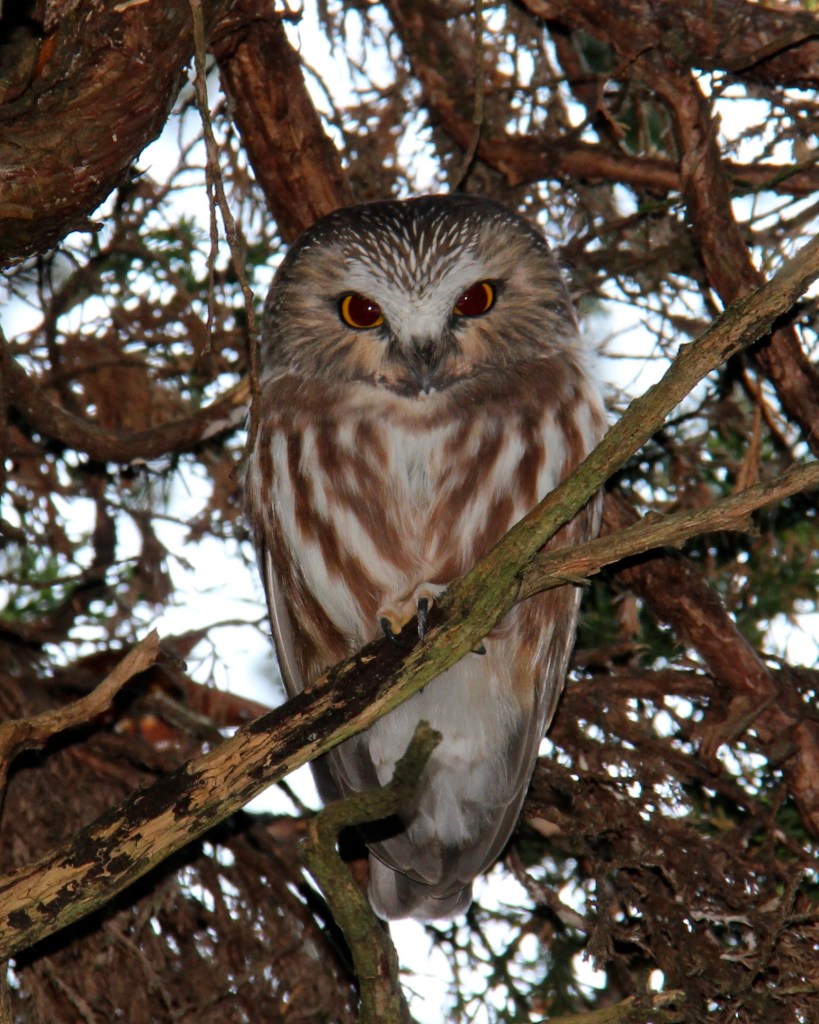
 But more than anything, you’ll find yourself filled with a growing sense of awe, wonder, and appreciation for this amazing thing that we call biodiversity—and, if you’re like most of us who take the time to listen to nature’s voice, you’ll become a sworn protector of it. 

Welcome to membership in the most important club on Earth.
The Wisdom of Loren Eiseley

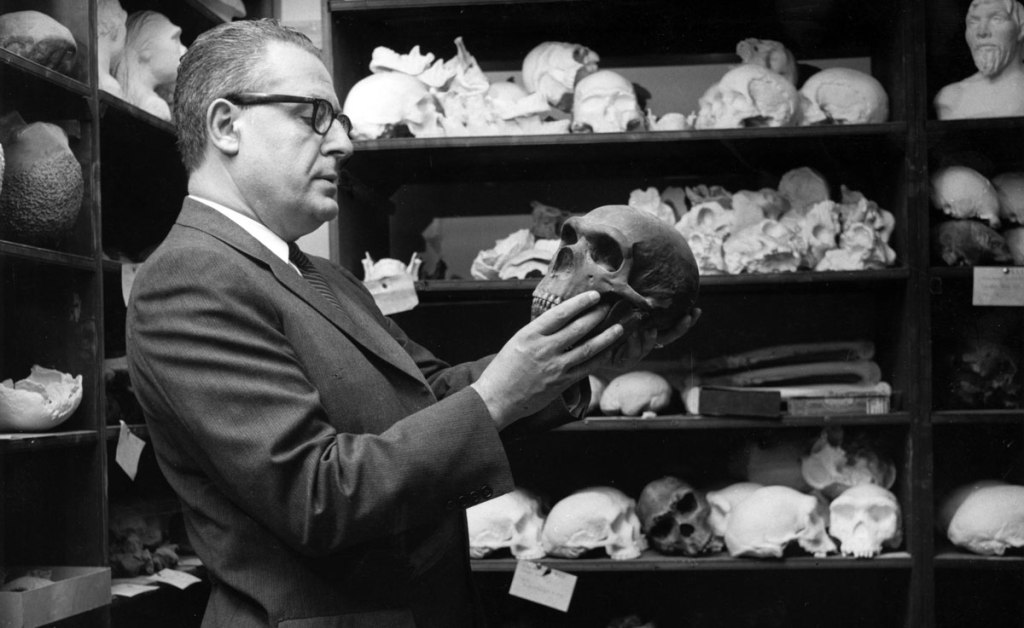
One of my favorite writers is an obscure guy that most people have never heard of. His name is Loren Eiseley, and he was a physical anthropologist and paleontologist at the University of Pennsylvania for over 30 years. As a young man, during the Great Depression, he was a ‘professional hobo,’ riding freight trains all over the United States, looking for work and the occasional adventure; his academic career came later. I’ve met few people who have read his books, yet few writers have affected me as much as he has.  

Loren Eiseley in his office at the University of Pennsylvania Museum, May 12, 1960. Photo by Bernie Cleff, courtesy of the University of Pennsylvania Archives and Records Center.

I discovered Loren Eiseley when I was at Berkeley; a friend loaned me his book, All the Strange Hours: The Excavation of a Life. It’s mostly an autobiography, but it’s powerfully insightful about the world at large. He draws on his early experiences as a vagabond as much as he does as an academic, both of which yield a remarkable way of looking at the ancient and modern worlds.

I have all of his books, in both physical and ebook formats, and they’re among the few I never delete. I keep a list of quotes from Loren’s works in my phone, and I pull them up and read them every once in a while. Here are a few of my favorites. Remember, this guy is a hardcore scientist, although you’d never know it from what you’re about to read.

If there is magic on this planet, it is contained in water.

One does not meet oneself until one catches their reflection from an eye that is other than human.

The journey is difficult, immense. We will travel as far as we can, but we cannot in one lifetime see all that we would like to see or to learn all that we hunger to know.

If it should turn out that we have mishandled our own lives as several civilizations before us have done, it seems a pity that we should involve the violet and the tree frog in our departure.

When man becomes greater than nature, nature, which gave us birth, will respond. This last one strikes me as particularly prescient.

Ray Bradbury, another of my all-time favorite writers, said that ‘Eiseley is every writer’s writer, and every human’s human. He’s one of us, yet most uncommon.’

More than anything else, Loren Eiseley was a gifted observer and storyteller. In All the Strange Hours, he writes about a chance encounter on a train. I’d like to share a bit of it with you.

“In the fall of 1936 I belatedly entered a crowded coach in New York. The train was an early-morning express to Philadelphia and what I had been doing in New York the previous day I no longer remember. The crowded car I do remember because there was only one seat left, and it was clearly evident why everyone who had boarded before me had chosen to sit elsewhere.The vacant seat was beside a huge and powerful man who seemed slumped in a drunken stupor. I was tired, I had once lived amongst rough company, and I had no intention of standing timidly in the aisle. The man did not look quarrelsome, just asleep. I sat down and minded my own business. 

Eventually the conductor made his way down the length of the coach to our seats. I proceeded to yield up my ticket. Just as I was expecting the giant on my right to be nudged awake, he straightened up, whipped out his ticket and took on a sharp alertness, so sharp in fact, that I immediately developed the uncanny feeling that he been holding that particular seat with a show of false drunkenness until the right party had taken it. When the conductor was gone, the big man turned to me with the glimmer of amusement in his eyes. “Stranger,” he appealed before I could return to my book, “tell me a story.” In all the years since, I have never once been addressed by that westernism “stranger” on a New York train. And never again upon the Pennsylvania Railroad has anyone asked me, like a pleading child, for a story. The man’s eyes were a deep fathomless blue with the serenity that only enormous physical power can give. People on trains out of New York tend to hide in their own thoughts. With this man it was impossible. I smiled back at him. ‘You look at me,’ I said, running an eye over his powerful frame, ‘as if you were the one to be telling me a story. I’m just an ordinary guy, but you, you look as if you have been places. Where did you get that double thumb?’

With the eye of a physical anthropologist, I had been drawn to some other characters than just his amazing body. He held up a great fist, looking upon it contemplatively as though for the first time.”

That’s just GREAT writing. Powerfully insightful, visual, and entertaining. And, it demonstrates Eiseley’s skill as a naturally curious storyteller, and the use of storytelling as an engagement technique. His willingness to talk with the odd guy in the next seat over, to ask questions, to give the guy the opportunity to talk, demonstrates one of the most important powers of storytelling.

For most people, storytelling is a way to convey information to another person, or to a group. And while that’s certainly true, that’s not the most important gift of storytelling. The best reason to tell stories is to compel the other person to tell a story BACK. Think about the last time you were sitting with a group of friends, maybe sharing a glass of wine. People relax and get comfortable, and the stories begin. One person tells a story, while everyone else listens. When they finish, someone else responds: ‘Wow. That reminds me of the time that…’ and so it goes, around the group, with everyone sharing. 

When this happens, when the other person starts talking, this is your opportunity to STOP talking and listen—to really listen to the person. They’re sharing something personal with you, something that’s important and meaningful to them—which means that it should be important and meaningful to you, if you want to have any kind of relationship with that person. It’s a gift, so treat it accordingly. 

In west Texas, there’s an old expression that says, ‘Never miss a good chance to shut up.’ This is one of those times. By letting his seat mate talk, Loren Eiseley discovered amazing insights about him, but not just about him. He also learned about his views of society and the world. The conversation goes on for many pages beyond what I quoted earlier, and it’s powerful stuff. So never underestimate the power of the story as an insight gathering mechanism, as much as it is an opportunity to share what YOU have to say.

Here’s one last thing I want to mention. In the tenth episode of my Podcast, The Natural Curiosity Project, I talked about a book I had recently read called ‘The Age of Wonder.’  It’s the story of the scientists of the Romantic Age (1798-1837) who made some of the most important discoveries of the time—people like Charles Babbage, William Herschel, Humphrey Davy, Michael Faraday, and Mungo Park, scientists who had one thing in common: their best friends, partners, and spouses were, without exception, artists—poets and novelists, for the most part. 

These were serious, mainstream, well-respected scientists. For example, Charles Babbage was a mathematician who was the father of modern computing (he invented the Difference Engine, a mechanical calculator that had more than 25,000 brass gears). He was married to Ada Lovelace, the daughter of the poet Lord Byron, and a writer and mathematician herself. William Hershel built the world’s first very large telescopes in England, and his best friend was George Gordon, better known as Lord Byron, the romantic poet. Humphrey Davy was a chemist and anatomist who discovered the medicinal properties of nitrous oxide. His closest friend was the poet and essayist Samuel Taylor Coleridge, who wrote Kubla Khan and The Rime of the Ancient Mariner.

In Xanadu did Kubla Khan, 

A stately pleasure-dome decree: 

Where Alph, the sacred river, ran, 

Through caverns measureless to man, 

Down to a sunless sea.

John Keats, a poet and the author of Ode on a Grecian Urn, was also a medical student whose scientific pursuits shaped his poetry. Mary Shelley is well known as the author of Frankenstein; her last name is Shelley because she was married to Percy Bysshe Shelley, another romantic poet and essayist:

I met a traveller from an antique land, 

Who said—“Two vast and trunkless legs of stone 

Stand in the desert. . . . Near them, on the sand, 

Half sunk a shattered visage lies, whose frown, 

And wrinkled lip, and sneer of cold command, 

Tell that its sculptor well those passions read 

Which yet survive, stamped on these lifeless things, 

The hand that mocked them, and the heart that fed; 

And on the pedestal, these words appear: 

My name is Ozymandias, King of Kings; 

Look on my Works, ye Mighty, and despair!

Shelley’s work was filled with and flavored by the wonders of science. 

So, you may be wondering if there’s a ‘so what’ coming any time soon. The answer is yes: Don’t you find it interesting that these scientists were all supported by and influenced by their artistic friends, and vice-versa? What does that tell us about the importance of the linkage between science and the arts? Well, there’s a huge focus right now in schools on STEM—Science, Technology, Engineering, and Math. Now look: I’ll be the first to tell you that those are all important, but there’s are two letters missing: it should be STREAM. The ‘R’ is for ‘Reading,’ a necessary and critical skill, and the ‘A’ for ‘Arts’ needs to be in there as well, with as much emphasis and priority as the others. Anyone who doubts that should look to the lessons of earlier history.

And Loren Eiseley—remember him? Where does he fit into this? Well, think about it. What made him such a gifted scientist was the fact that he was, in addition to being a respected scientist, a gifted essayist and poet. During his life he wrote nine books, hundreds of essays, and several collections of poetry, all centered on the wonders of the natural world. His philosophy, his approach to his profession, embodied the learnings from the Age of Wonder. 

In one of his essays, ‘How Flowers Changed the World’ (which you’ll find in his book, ‘The Immense Journey’), Loren Eiseley had this to say:

If our whole lives had not been spent in the midst of it, the natural world would astound us. The old, stiff, sky-reaching wooden world (he’s talking about trees here) changed into something that glowed here and there with strange colors, put out queer, unheard of fruits and little intricately carved seed cases, and, most important of all, produced concentrated foods in a way that the land had never seen before, or dreamed of back in the fish-eating, leaf-crunching days of the dinosaurs.” 

Imagining the first human being who pondered the possibility of planting seeds, he writes: “In that moment, the golden towers of man, his swarming millions, his turning wheels, the vast learning of his packed libraries, would glimmer dimly there in the ancestor of wheat, a few seeds held in a muddy hand. Without the gift of flowers and the infinite diversity of their fruits, man and bird, if they had continued to exist at all, would be today unrecognizable. 

Archaeopteryx, the lizard-bird, might still be snapping at beetles on a sequoia limb; man might still be a nocturnal insectivore gnawing a roach in the dark. The weight of a petal has changed the face of the world and made it ours.” 

The poetic power of Loren’s science writing infuses the facts with human wonder. Here he is, writing about the stupefyingly boring topic of angiosperms, seeds that are enclosed in some kind of protective capsule, yet, we’re mesmerized by the imagery his words create.

What a world. And it’s ours.

The Nine-Million Club

If we can believe the work of the UN Environment Programme—and I do—we are in the middle of the next great extinction on Earth. According to their global research, 200 species go extinct on this planet every 24 hours. But anyone who has studied biology knows that species naturally die out if they can’t stand the heat in the genetic kitchen—that’s what Darwin was talking about when he wrote that ‘it is not the strongest of the species that survives, nor the most intelligent that survives. It is the one that is the most adaptable to change.’ 

So, yeah—species die out—it’s part of the natural selection process. But here’s what bothers me. 200 species every 24 hours is about a thousand times the rate at which species naturally disappear from the planet because they get kicked off of gene pool island. The biologists who study this phenomenon say that this disappearance rate is faster than anything we’ve seen since the dinosaurs disappeared, 65 million years ago. And we, humans, are playing a big role in their loss.

According to the latest estimates, there are around 8.7 million species on Earth. And even though 70% of the planet is covered by water, the majority of species live on land—about three-quarters of them. In fact, 86% of the plants and 91% of the animals on Earth haven’t even been named yet—which is ironic, since it appears that many will disappear before we even get to know them.

So, let’s face it. We’ve all grown weary of the dire reports about some kind of biological Armageddon headed our way. Every day, it seems, it’s something else. Global warming that leads to melting icecaps, which will raise sea levels enough to drown coastal cities. The loss of the planet’s “lungs” as farmers cut down the equatorial rainforest to make room for more palm oil plantations, resulting in more carbon dioxide buildup in the atmosphere, stronger greenhouse gas effects, and even warmer climate. The imminent extinction of alpha species like rhinos, elephants, orangutans, and codfish, because of human ignorance and greed. The potential loss of natural medicines as the planet’s herbal base dies off. The point is, the list goes on and on, and it distresses me. But I have to keep reminding myself to not let the warning fade into the background, just another droning non-message. 

In my heart of hearts, I am, and always will be, a biologist and a naturalist. I share this planet with a boatload of other creatures, and while we humans may occupy the apex position on the Earth’s pyramid of life, the top of that pyramid doesn’t have much room—that tip is pretty narrow, which means it wouldn’t take much to shrug us off. E.O. Wilson, the famous biologist and one of my personal heroes, once remarked that if all the insects on earth were to disappear, all life on the planet would end within 50 years. On the other hand, if all the humans disappeared, within fifty years, all life would flourish, and we wouldn’t even be a footnote in the grand scheme of things. 

There’s nothing special about us. Four billion years ago, the universe did a little experiment. It combined a few elements—nitrogen, sulfur, phosphorus, carbon, hydrogen—and then zapped them with lightning. Those elements shook it off, joined forces with their neighbors, and by pure random accident, grouped themselves into complex molecules that ultimately became what we now know as amino acids. Those amino acids went on to meet new neighbors, and somewhere along the way they found themselves in a complex biochemical dance that yielded even more interesting things, like nucleic acids, the basis of biological life. From that primordial soup came tiny microbial creatures, and over time, those little creatures metamorphosed and evolved in billions of different directions, some of which led down a long and winding road of biological diversity, while others dead-ended—game over, dude. We humans are among the lucky few.

So, there’s nothing special about us, or kangaroo rats, or elephant shrews, or freshwater jellyfish, or that paramecium that enchanted you the first time you saw it moving around in a drop of pond water under a microscope. But what IS special is the Nine Million Club, an organization that has the most stringent, unyielding membership requirements in the known universe.

Let me explain. Every creature that’s alive today ran the evolutionary gauntlet, accepted the biological challenge, agreed to run the great genetic race—and, unlike billions of others, made it to the finish line. Each one is the result of that great experiment that the universe ran four billion years ago, an experiment that yielded some really interesting results. Consider this: The organisms living on Earth today have one thing in common: they are all, without exception, the best problem-solvers that have ever existed. Faced with the greatest test imaginable, their very survival, they accepted the challenge, and they beat it. For that, they were allowed to live, like Katniss in the Hunger Games. Five billion applied to the club; nine million were granted membership.

Every time a species goes dark, we lose hundreds of thousands, if not millions, of years of experimentation and problem-solving. I think that should count for something, and I think we should do everything in our power to keep the lights on for the other species that made it this far. The interspecies dependencies on this planet are extraordinary, and we humans are one of not quite nine million card-carrying members of the Club. I can accept the fact that species occasionally get booted off the planet because they just can’t hack it anymore. I’d just rather not be one of them. A few simple acts on our part, driven by curiosity and education and awareness, might allow us to keep calling the planet home. It is, after all, a pretty cool club to belong to. But keep this in mind: membership is revocable at any time.

More Thoughts on Books and How They’re Born

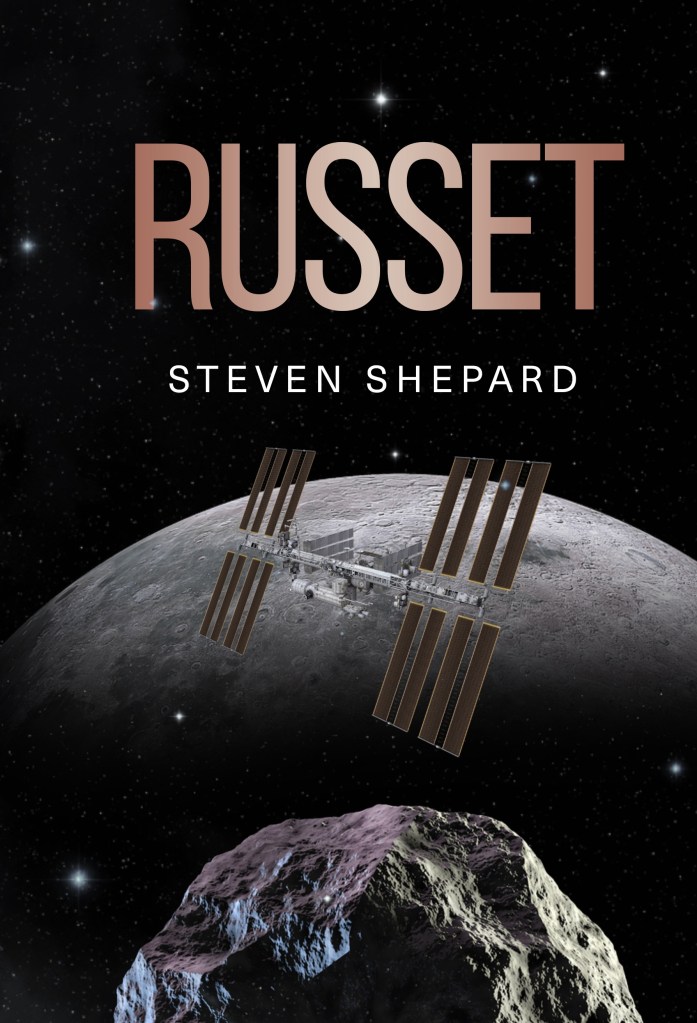
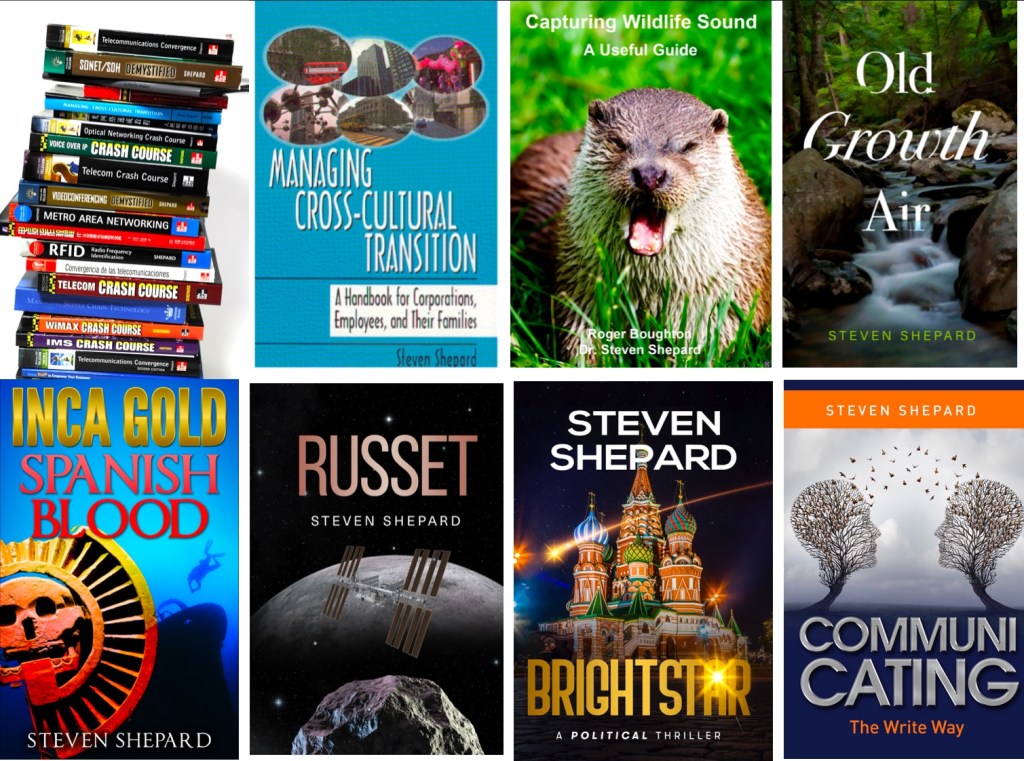
As many of you know, I released a new novel not long ago called Russet. It’s my fourth work of fiction; all my prior titles (all 90+ of them) have been about technology, history, photography, writing, sound recording, storytelling, leadership, biography, and a few other genres. Anyway, Russet’s doing well, especially given the fact that I haven’t done much since its release to market or promote it. It’s my first science fiction book, and I had a blast writing it.

Ever since Russet hit the shelves, I’ve been getting an unusual number of emails and messages from people, asking me about writing books. Actually, they’re asking more than that. Many feel that they have a book inside themselves begging to be written, and want to know how to get it from mind to paper. Or, they have an idea that they think would make a good book, but don’t know how to bridge the gap between their idea and a finished work.

Well, I’ve thought about these questions, because they intrigue me, too. When I started out as a writer, I asked for and was kindly given advice by a handful of established journalists, feature writers, and novelists, and as my skill developed over the years I also learned from the soul-sucking and dehumanizing process of iterative manuscript submission, and the inevitable accumulation of an impressive collection of rejection letters. It’s painful, but it’s a necessary part of the writing and publishing process. It’s also educational.

So, after thinking about these questions, and about my own experiences as a professional writer, I think I have some additional wisdom to impart—at least I hope so. So here goes. 

First, to the question of how to write a book. Writers are wired, you see, to believe, to conclude, that the story they want to share should be in the form of a book. And while that MAY be the best way to present a particular story, it’s not the ONLY one. Here’s an example. 

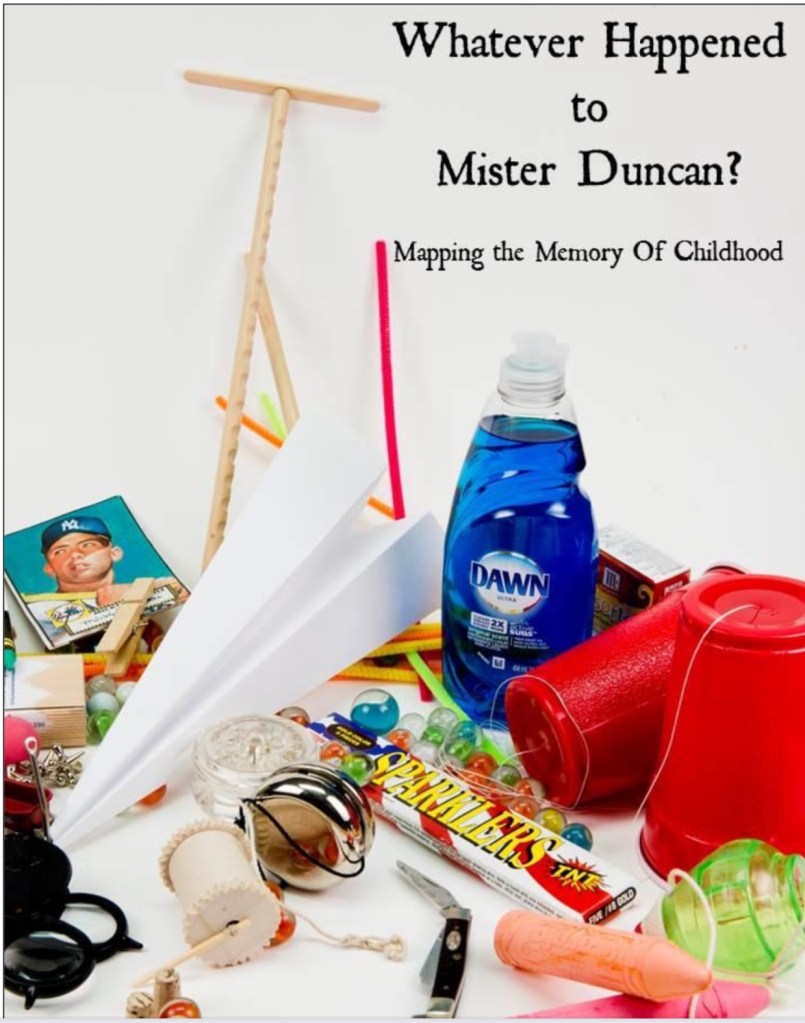
Whatever Happened to Mister Duncan cover.

In 1987 (yep, you read that correctly—almost 38 years ago!) I started writing a book called Whatever Happened to Mister Duncan, a collection of essays about childhood games and activities that were mostly played outside and that didn’t require anything other than our imaginations to play—okay, some of them required a pocket knife or a Popsicle stick, maybe a roll of caps and a rock, but that was pretty much it. No batteries, no screens, no keyboard or joystick. I had a hard time finishing the book; along the way I interviewed hundreds, maybe thousands, of people, asking them about their own childhood memories and what their favorite games and activities were. I then sat down and designed the book, laying out the logical sections which became chapters. But every time I thought I’d finished it, I’d get a call from somebody who wanted to share a long-forgotten memory, or a toy, or an experience that was so rich that it had to be in the book. So, I’d go back and do yet another rewrite. Because they were right—it HAD to be in the book.

The point at which I finally called a halt to the process was the 318th complete rewrite of the book. Yes, that’s a real number. I ended it by adding a paragraph that acknowledges the fact that the book will never actually be finished, but that I’ll include new material in a later edition. 

So: 319 versions, by the time I finally had a complete, polished, nine-chapter, fully illustrated, 300-some-odd page book manuscript.

Which I have now decided should not be a book at all—at least, not exclusively.

This is a book about childhood. It’s experiential. I want it to evoke poignant memories of the period in our lives that caused us to become who we all are, before we had to start the odious task of adulting. You see, during those 38 years between the time that I first got the idea to write the book and when it finally emerged from its literary chrysalis, I did, as I said, hundreds of interviews; collected at least that many sound effects; and watched dozens and dozens of adults revert to childhood for the briefest periods during our conversations to show me something, before reverting back to boring, predictable, well-behaved adults. In other words, Duncan (my shorthand title for Whatever Happened to Mister Duncan) is a multiple media experience of sounds and different voices, none of which can adequately be presented between the pages of a book. Sure, I can transcribe the interviews, and I probably will, eventually, but what’s more fun: me writing down a list of all the different kinds of marbles that are out there, or listening to people struggle to remember the names of marbles as they dredge the murky depths of their own childhood memories? (Go ahead—I know you want to. Answer the question: how many marbles can YOU name?)

So: the decision was easy. This has to be an audio book.

NOT TOO LONG AGO, I took stock of the activities that give me pleasure, beyond the obvious ones—family, chasing grandkids, recording the sounds of the natural world. I love to write; I love to interview people so that I can learn about them and then tell their story on my Podcast; I love to teach; I love photography; and I love field recording. When I analyze all of those, I find that they all have one thing in common: they’re all different ways to tell stories. I’m a storyteller—plain and simple. I don’t write to publish a book; I write to tell a story. Here’s a little secret for you: I only publish about 30 percent of what I write. And what I mean by that is that I only TRY to publish about 30 percent. The rest? It’s for me, and the people I share it with.

Stories. Always, stories. It’s what people want to hear; it’s what gets them to focus; and it’s what has to be wrapped around facts if those facts are to be absorbed and retained. No story? No context. No context? No understanding. It’s that simple.

So, Duncan: I’ve decided to give it away, because the material is too good, too precious, too human to sell. It belongs to everybody, which is why it will soon emerge as a nine-chapter audio book as a gift to my listeners on the Natural Curiosity Project. I think you’ll like it—I really do. And check it out: just like that, my creative project is published. Who cares if I published it myself? The joy comes from sharing it, and engaging with those who choose to write or call me about it.

I USED TO RUN LEADERSHIP PROGRAMS at the University of Southern California’s Marshall School of Business. Some of them were multi-week programs, which meant that I’d often be in LA over a weekend. Well, one weekend I had nothing to do, so I walked over to a local science museum because it was only a couple of blocks away and I love museums. I’d never been to this one.

SR-71.

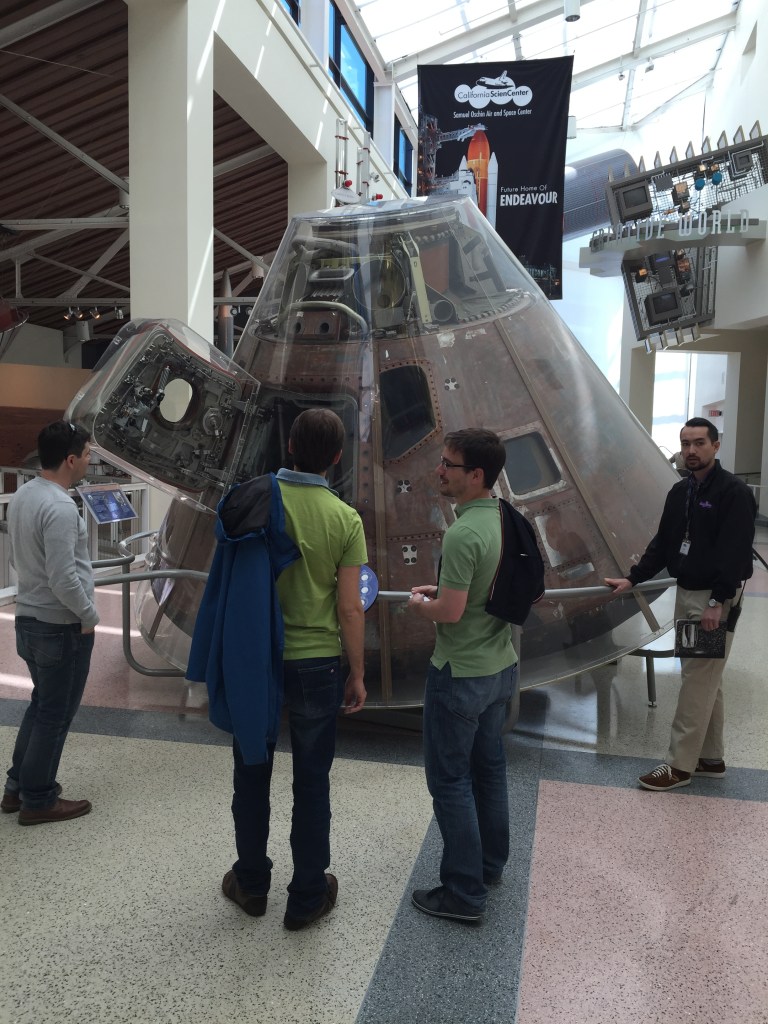
The place was pretty cool: outside, on stands, like gigantic versions of the model airplanes I built when I was a kid, they had an F-104 Starfighter and an SR-71, both amazing aircraft. Inside they had a whole collection of satellites, along with the usual kid-oriented science displays. As I explored the place, I found myself walking down a hall between exhibits, and as I passed a doorway, I looked into a dimly-lit room, and there, lined up in front of me, were a Mercury, a Gemini, and an Apollo capsule. Well, I’m a space geek, so I spent the next hour just walking around these things, peering inside, marveling at how—primitive they were. I kid you not, the seat the Mercury astronauts had to sit in was basically a lawn chair, made out of a metal pipe frame and braided leather straps. And based on the space inside, the astronauts couldn’t have been more than four feet tall. Gemini was no better. I’m exaggerating, but not by much. And Apollo? Bigger, but they also stuffed three people in there for the trip to the Moon. Here are the facts, according to NASA. The average length of a Mercury flight was 15 minutes. Gemini flights ranged from a few hours to one extreme endurance mission that lasted 14 days, But the average was three days. Apollo missions lasted an average of just over eight days. 

Apollo capsule.

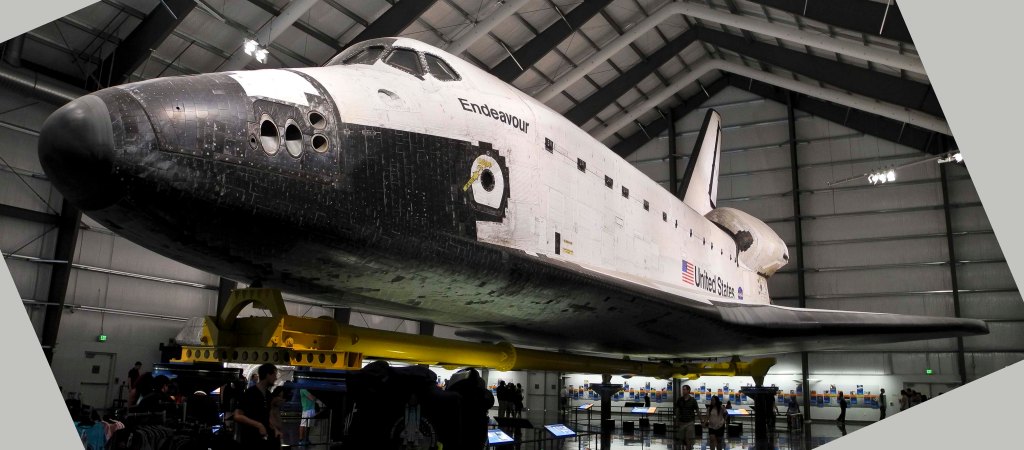
Let me interrupt myself with another story before finishing this one. As I was standing there, admiring these early space capsules, I realized how dark it was in the room. So, I looked up at the ceiling to see the lights. Except I couldn’t see the lights. Why? Well, because just over my head, between me and the ceiling, was the gigantic delta wing of the Space Shuttle Endeavor. The one that they pulled down the streets of LA to get it there. It was so massive and took up so much space in the room that I didn’t notice it, I was so focused on those little capsules hiding in the shadows underneath it. 

Space Shuttle Endeavor. Hard to see, but the Mercury, Gemini and Apollo capsules are in the dark background under the starboard wing.

Yep—tears. Geek tears.

WHICH BRINGS ME TO THE SUBJECT OF ADVERBS. You remember—who, what, when, where, how, why. As a writer, adverbs are the best friend you can have.

My curiosity kicked in. There I was, in awe of the mighty space shuttle looking over me, looking at those capsules, thinking about how brave or crazy a person had to be to be bolted into one of those things, and how crowded it was, and how the Apollo astronauts basically just sat there in a space about the size of a VW Beetle for four days, one way, before turning around and doing it again in reverse. There was no bathroom, no privacy, no way to really get up and move around. Just shoot me now. 

And that got me thinking—and here’s where the adverbs kicked in. A trip to Mars is somewhere between four-and-a-half and six months, depending on timing. How in the world could we possibly convince a crew to crawl into a ship for a journey that long? Why would they be willing to do it? How would we physically get them there? And thus was born the germ of an idea, the spark of a story, that led to all 625 pages of Russet. Because I figured it out—at least, I figured out ONE way. And I must be pretty accurate, because I got a call from a friend who works at our vaunted space agency, asking me after reading my book whether I had hacked their firewall (I didn’t). Gotta love that. Anyway, that’s how Russet got its start. It was all about the power of adverbs, especially how and why. Those two little words define curiosity. And when curiosity and storytelling are combined? Wow. 

Acclaimed author Dorothy Parker once wrote that curiosity is the cure for boredom, but that there is no cure for curiosity. Thank goodness. Curiosity is what keeps the world moving forward. Would you like to see the Dark Ages again, the period that Bill Bryson describes in his book, The Mother Tongue: English and How It Got That Way, as “A period when history blends with myth and proof grows scant”? It’s easy: stop being curious. Does Bryson’s description of the Dark Ages sound alarming, given current events? Does it strike a bit close to home? Good. Get out there. Be curious. Share ideas. And don’t just blindly trust what you read or hear. Wield those adverbs. Question everything. It should be the law. Oh wait—it IS the law. It’s why we have a free press. My bad.

HG Wells and the World Brain

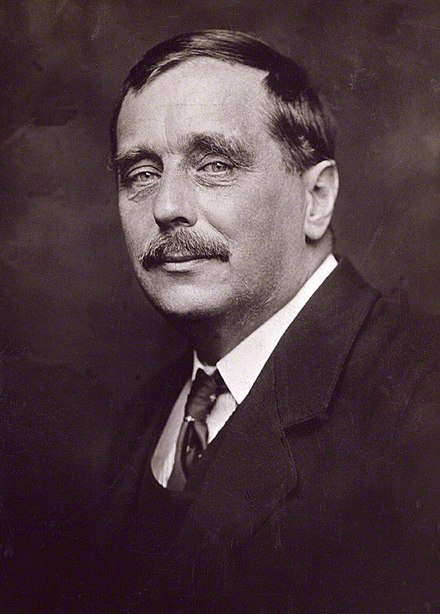
Photo by George Charles Beresford, black and white glossy print, 1920

Not long ago, I started doing something I always said I would do, but honestly never thought I’d actually get around to doing. Remember when you were in high school or college and your English teacher assigned you a book to read? And it wasn’t something fun like Hardy Boys or Tom Swift or Doc Savage (showing my age, here) or Little House on the Prairie. No, it was something BORING by Mark Twain or Charles Dickens or John Steinbeck. If you were like me, you faked it badly, or in college you might have run down to the bookstore to buy the summary of the book to make your fake a bit more believable. Either way, it rarely ended well.

I’m a writer and storyteller by trade—it’s who I am. And, because I’m a writer, I’m also an avid reader—and I mean, avid. I average about 140 books a year. So, a couple of years or so ago, I decided to start mixing the classics into my normal mix of books, starting with Arthur Conan Doyle. At first, I was dreading it. But once I started reading and allowed myself to slow my mind and my reading cadence to match the pace of 19th-century writers, I was hooked with the first book. I blazed through them all, the entire Sherlock Holmes collection, and then moved on to Jules Verne and Mark Twain and H.G. Wells. Reading those books as an adult, with the benefit of a bit more life behind me, gave the stories the context that was missing when I was a kid. 

By the way, I have to interrupt myself here to tell you a funny story. I’m a pretty fast reader—not speed-reading fast, but fast. I pretty much keep the same reading cadence in every book I read, unless I’m reading poetry or a book by someone whose work demands a slower pace. Some southern writers, like Rick Bragg, slow me down, but in an enjoyable way. But a typical book of two or three-hundred pages or so, I usually blast through in about three days.

Not long ago, I read David Attenborough’s First Life, a book about the earliest organisms on the planet. That book took me two weeks to read. And it wasn’t because I wasn’t regularly reading it, or because the book was complicated, or poetic. It was because David Attenborough is one of those wonderful writers who writes the way he speaks. Which means that as I was reading, I was hearing his voice, and my reading began to mimic the pace at which he speaks on all the BBC programs: These … extraordinary creatures … equipped … as they are … for life in the shallow, salty seas … of the Pre-Cambrian world … quickly became the hunted … as larger … more complex creatures … emerged … on the scene. 

I just couldn’t do it. I tried to read at a normal clip, and I stumbled and tripped over the words. It was pretty funny. It was also a great book.

Anyway, I just finished The Time Machine by H. G. Wells. I saw the movie as a kid, loved it, but the book was, as usual, quite different from the movie. I loved Wells’ writing, and it made me want to read more. So, I decided to read one of his lesser-known works, his Outline of History, a massive work of about 700 pages. And, as so often happens when I read something new, I had an epiphany.

Let me tell you a bit about Herbert George Wells. During the 1930s, he was one of the most famous people in the world. He was a novelist and a Hollywood star, because several of his movies—The Invisible Man, Things to Come, and The Man Who Could Work Miracles were made into movies (the Time Machine didn’t hit the screens until later). In 1938, Orson Wells reportedly caused mass panic when he broadcast a radio show based on Well’s War of the Worlds, which also added to his fame. That story has since been debunked, but it did cause alarm among many.

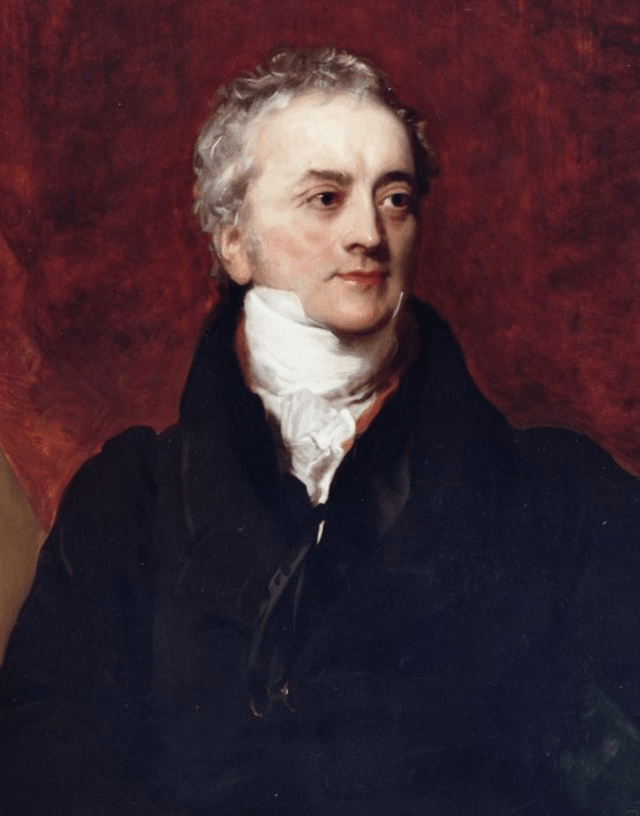
Wells studied biology under T.H. Huxley at the UK’s Royal College of Science. He was a teacher and science writer before he was a novelist. Huxley, who served as a mentor for Wells, was an English biologist who specialized in comparative anatomy, but he was best known as “Darwin’s Bulldog” because of his loud support for Darwin’s theory of  evolution. He also came up with the term, ‘agnosticism.’  “Agnosticism,” he described, “is not a creed, but a method, the essence of which lies in the rigorous application of a single principle… the fundamental axiom of modern science… In matters of the intellect, follow your reason as far as it will take you, without regard to any other consideration… In matters of the intellect, do not pretend that conclusions are certain which are not demonstrated or demonstrable.” Pretty prescient words that need to be broadcast loudly today. Ask questions, and don’t accept a statement as truth until you know it is. That’s precisely why I started this series.

Sorry—I’m all over the place here. The Outline of History tells the story of humankind from the earliest days of civilization to the end of World War I—The Great War, The War to End All Wars. If only. 

From there, I went on to read Work, Wealth, and Happiness of Mankind, another of his lesser known works. Both are interesting takes on history and sociology, and somewhere between them, Wells invents the World Wide Web. Really.

Here’s how he begins the concept: 

Before the present writer lie half a dozen books, and there are good indexes to three of them. He can pick up any one of these six books, refer quickly to a statement, verify a quotation, and go on writing. … Close at hand are two encyclopedias, a biographical dictionary, and other books of reference.

As a writer, Wells always had reference books on his desk that he used regularly. As he developed the concept that he came to call the World Brain, he wrote about the early scholars who lived during the time of the Library of Alexandria, the greatest center of learning and scholarship in the world at the time. It operated from the third century BC until 30 AD, an incredibly long time. Scholars could visit the Library, but they couldn’t take notes (there was no Paper), and there were no indices or cross-references between documents. So, Wells came up with the idea of taking information to the people instead of the other way around, and figuring out a way to create detailed cross-references—in effect, search capability—to make the vast stores of the world’s knowledge available, on demand, to everybody.                

His idea was that the World Brain would be a single source of all of the knowledge contained in the world’s libraries, museums, and universities. He even came up with a system of classification, an information taxonomy, for all that knowledge.             

Sometime around 1937, with the War to End All Wars safely in the past, Wells began to realize that the world was once again on the brink of conflict. To his well-read and research-oriented mind, the reason was sheer ignorance: people were really (to steal a word from my daughter) sheeple, and because they were ignorant and chose to do nothing about that, they allowed themselves to be fooled into voting for nationalist, fascist governments. The World Brain, he figured, could solve this problem, by putting all the world’s knowledge into the hands of all its citizens, thus making them aware of what they should do to preserve the peace that they had fought so hard to achieve less than twenty years earlier. What he DIDN’T count on, of course, was that he was dealing with people—and the fact that you can lead a horse to water, but you can’t make him drink from the intelligence well. 

Nevertheless, he tried to raise the half million pounds a year that he felt would be needed to run the project. He wrote about it, gave lectures, toured the United States, and had dinner with President Roosevelt, during which he discussed the World Brain idea. He even met with scientists from Kodak who showed him their newest technology—the technology that ultimately became microfiche. But sadly, he couldn’t make it happen, and sure enough, World War II arrived.             

Here’s how he summed up the value of the World Brain: 

The general public has still to realize how much has been done in this field and how many competent and disinterested men and women are giving themselves to this task. The time is close at hand when any student, in any part of the world, will be able to sit with his projector in his own study at his or her own convenience to examine any book, any document, in an exact replica. 

In other words…the World Wide Web. Imagine that.

World War II caused Wells to fall into a deep depression, during which he wrote The Time Machine, which is, I think, the first post-apocalyptic novel ever written—at least as far as I know. He describes the great green structure on the hill, made of beautiful porcelain but now falling down in ruins; I suspect he was thinking about the sacking and burning of the great Library of Alexandria when he wrote that part of the book. 

Or, perhaps he was thinking of Percy Bysshe Shelley’s “Ozymandias”:

I met a traveller from an antique land,

Who said—“Two vast and trunkless legs of stone

Stand in the desert. . . . Near them, on the sand,

Half sunk a shattered visage lies, whose frown,

And wrinkled lip, and sneer of cold command,

Tell that its sculptor well those passions read

Which yet survive, stamped on these lifeless things,

The hand that mocked them, and the heart that fed;

And on the pedestal, these words appear:

My name is Ozymandias, King of Kings;

Look on my Works, ye Mighty, and despair!

Nothing beside remains. Round the decay

Of that colossal Wreck, boundless and bare

The lone and level sands stretch far away.”

Never underestimate the power of great literature. And never underestimate the power of curiosity when it’s unleashed on a problem. 

Adventures with Methyl Mercaptan

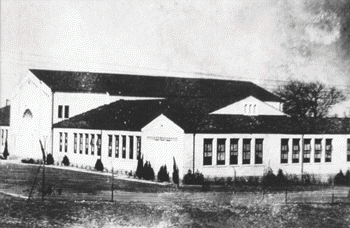
March 18, 1937, was a Thursday. It was also the day that the school in New London, Texas, exploded. According to witnesses, the walls bulged, the roof lifted, then dropped back onto what was left of the building, and the structure blew apart. 195 students and teachers died; another 200 suffered serious injuries.

The school, before the explosion.

It turned out that the school had recently been plumbed for natural gas, which was used to heat the building. But there was a leak in the pipes under the school, and when a maintenance worker turned on an electric sander in the middle of the afternoon, the spark it created was all it took to ignite it.

In those days, natural gas had no smell at all, and was invisible. In fact, the market in 1937 was all about oil, and natural gas was considered a waste by-product. Refineries and oil wells separated it from the crude, and piped it off to distant towers, where they burned it 100 feet up in the air in a huge yellow flare. As a kid, living in west Texas, I remember seeing those flares at night as we drove by on the highway. Anyway, because it was considered a waste product, some businesses would tap into the gas lines that carried the gas from the wellhead to the flare tower and use it for various things, including heat—which is what the school did. The oil companies didn’t care; they were just burning it to get rid of it. If somebody wanted their garbage, let ‘em have it.

The morning of the explosion, a leak in the connection between the gas pipe and the newly installed heaters filled the crawlspace under the school with gas. The force of the explosion was so great that a 4,000-pound block of concrete was blown through the air, crushing a car 70 yards away. Keep in mind that that’s most of a football field.

Shortly after the disaster, a law was passed that mandated that smelly compounds be added to natural gas, smelly enough that humans would be able to unmistakably detect and recognize a gas leak. The chemical they chose was from a family of compounds called Mercaptans.

Ethyl Mercaptan is considered to be one of the smelliest compounds on the planet. It is so strong that a human can detect it in concentrations as small as one part per billion. For comparison, sugar requires five million parts per billion before it can be tasted. 

Methyl Mercaptan, sometimes called methanethiol, is added to natural gas to make it easier to detect. It’s colorless, but it stinks. In fact, it occurs naturally in cabbage, onions, bad breath, asparagus, cheese, the various unsavory things that come out of the north end of a south-facing animal, including people, and rotting carcasses. By the way, just to put the potency of this stuff into perspective, chlorine, which is pretty pungent, requires 143 times as many parts-per-million as Methyl Mercaptan for the human nose to even detect it. 

This is one of the reasons why it’s so interesting that when they first started mixing Mercaptans into natural gas, workers at a Texas refinery noticed a weird phenomenon that kept happening. Whenever one of their pipelines sprung a leak, no matter how minor, there would soon be clouds of turkey vultures hovering over the area. This puzzled them until somebody put the facts together, noting that the one thing that rotting carcasses, which is like an all-you-can-eat buffet to vultures, and natural gas and have in common, is Methyl Mercaptan. And you know what’s cool? They still look up for turkey vultures today to find leaking pipelines.

So, smell is pretty important. Before I leave you, let me share a few interesting things about it that I learned while researching this essay. First, there is a disorder called anosmia, which is the inability to smell anything at all. As I record this, Sabine is baking bread upstairs, so at this very moment, I can’t think of a worse disorder to have. But it turns out that there is one, and it’s called cacosmia, which is the ability to ONLY smell disgusting things. In fact, for people with this disorder, even good smelling things, like baking bread, tend to smell disgusting—rotting meat. 

OK, moving on. Scientists who specialize in the sense of taste have identified five unique flavors: sweet, salty, sour, bitter, and umami, which is that interesting rich flavor that monosodium glutamate adds to food. Well, they have also identified seven unique smells, from which they believe all smells derive. They are putrid, which is pretty self-explanatory, unless you have anosmia; musky, which is the quality of colognes, perfumes, and after-shaves; pungent, which refers to the taste of things like vinegar; ethereal, which is the smell of things that evaporate quickly, like alcohol, dry cleaning fluid, and such; floral, like roses and geraniums; minty, which again, requires no explanation; and camphoraceous, which is the smell of mothballs. It turns out that our sense of smell accounts for about 95% of our ability to taste. Without it, potatoes, onions and garlic would be indistinguishable.

Let’s see, what else. Bactrian camels—they’re the ones that live in places like the Gobi Desert—can smell water 50 miles away. What they’re smelling is the bacteria that grows in it, not the water, but 50 miles. Zowie. 

Finally, babies can detect smells in the womb, and when you’re sleeping, you can’t smell—that particular sense shuts down. And while everybody knows that women smell better than men, did you know that they also smell better than men? That’s right—a woman’s sense of smell is significantly stronger than that of a man. You might also find it interesting that 75% or so of our emotional responses derive directly from our sense of smell.

OK, enough. Another curious topic—hope you enjoyed it.

RIPPED FROM THE HEADLINES!!!

THE BOOK AMAZON REFUSED TO MARKET!

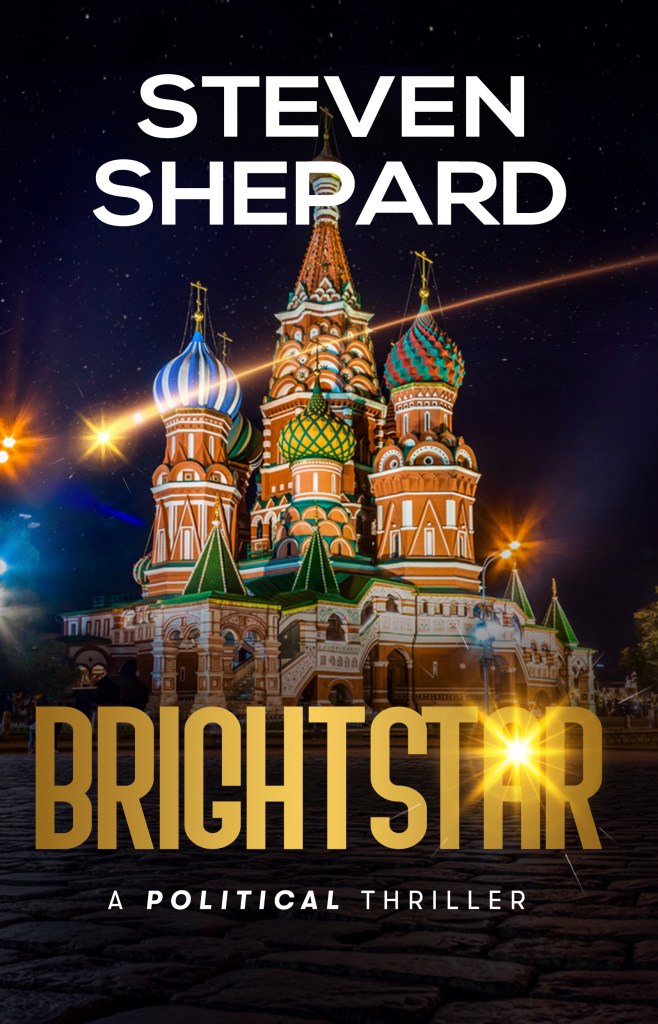
Okay, enough with the histrionics. Although, histrionics or not, it’s true. For almost a year, Amazon refused to let me run a marketing campaign for my novel, Brightstar, because they deemed it too controversial. Why? Apparently, because Russia is the ‘bad guy’ in the novel. That’s not true: Putin is the bad guy in the novel, a title he deserves. The irony is that as Amazon’s army of AI evaluators decided, thanks to their Byzantine algorithms, that my novel was unkind to Putin and therefore ineligible to have its own paid marketing campaign, their biggest advertised product was the latest Jack Ryan series on Amazon Prime, which took place in Russia and did plenty of Russia-bashing. Of course, they had the enormously talented John Krasinski. I … didn’t.

But this is not about sour grapes or Amazon bashing (it isn’t even about Russia bashing). This is about the role that technology increasingly plays in our world, and the fact that while its value is beyond reproach, it does deserve to be questioned before it’s implemented. 

I’ll start with the book. It’s a great story: even without Amazon’s help, it has sold well. And to Amazon’s credit, yesterday, right after I launched the marketing campaign for Russet, I tried again to launch a campaign for Brightstar, and lo and behold, they allowed me to do so. Not sure what changed, but the campaign is now active.

Here’s the point I want to make. I tried for a week to speak to a human at Amazon about their refusal to allow me to advertise the book. But the decision to give Brightstar a thumbs-down for a marketing campaign, a campaign that I have to pay Amazon for, was made (apparently) by one or more AI instances without the benefit of a human in the loop. After a week of trying to get somebody on the phone to explain to me why I was ineligible for Amazon’s marketing services, I gave up and went elsewhere. “Elsewhere” turned out to be a very effective choice, and the book sold very well. It still does.

So, why am I telling you this? To sell books, of course, but there’s another reason, one that’s more important. For 43 years, I worked full-time in the technology, media and telecom industry: more than a decade in the telephone industry, network analysis and IT mostly, then ten years as a senior consultant with an advisory professional services company, then 24 years on my own as a consulting analyst to companies striving to understand the implications of technological change for their businesses. I did this work all over the world, in more than 100 countries. What I discovered in all those years of focusing on the contact point between people and technology is that technology is a game-changer. I have watched in humble awe as it catalyzed education, reinvented healthcare, made government more transparent, forced a shift in power from the few to the many, grew local, regional, and national economies, empowered individuals, and created hope—so much hope. Here are some examples.

I sat on the ground with a group of educators in the shade of acacia trees and watched as the kids from a local rural school unpacked the bright green laptops they had been given by the One Laptop Per Child Project. The adults were largely mystified by the machines, choosing instead to immerse themselves in their mobile phones. Within a half hour, the kids had created social media accounts and were online, chatting with people all over the world. By the end of the day, the machines were old news; they had become experts.

I watched in awe and with no small number of tears as an elderly woman in a different African village was handed a mobile device for the first time and told to push a particular number on the screen. Within seconds, she was videoconferencing with her son, whom she had not seen or communicated with directly in ten years. He left the village to get work in the city; the arrival of mobile connectivity and solar charging stations in her village made it possible for her to routinely speak with distant family members.

In Ghana, in west Africa, an organization I had the opportunity to work with decided to tackle one of the country’s greatest challenges: adult literacy. Without literacy a person can’t take a driver’s test, can’t read road signs, can’t read a map, can’t read medical prescriptions, can’t help their children with their homework, can’t fill out a job application, can’t read loan documents, can’t read a services contract. In Ghana, large swaths of people may not be able to read, and the remote villages may not have running water, or sewer, or electricity, but everyone has a mobile phone—everyone. So, the folks I got to know came up with an idea: let’s send reading lessons as text messages to peoples’ phones. They did. The result? A climb from complete illiteracy to a grade eight reading level in eight weeks.

In one of Southern Africa’s slums, I was invited into a rural clinic by a healthcare organization I was working with. The clinic was a metal shipping container that had been divided into two rooms, one twice the size of the other. The larger room served as the waiting room, exam room, diagnostic center, and prescription dispensary. The smaller room was a full-blown surgical suite. I was invited to sit in while a patient had her gall bladder removed. The procedure took 40 minutes from open to close; they sent her home that afternoon with a bottle of aspirin, four tiny puncture wounds in her belly from the surgical tools, and four band-aids. Nothing magical about this story until I tell you that the procedure was performed by a team of surgeons who were located at a hospital in Maryland, 7,500 miles away, using a robotic surgery machine. The machine was connected on each end to an optical network that provided the bandwidth necessary to perform the procedure remotely.

One of the most poignant photographs I saw during the Arab Spring uprising was of a group of teenagers running past a low brick wall on the perimeter of Tahrir Square in Cairo. The wall was splashed with graffiti, French words that said, “Thank you, Facebook. Thank you, Twitter, for our freedom.” I’m no fan of social media—I believe it has largely become a corrosive and destructive force in modern society—but during Arab Spring, it gave voice to those who for so long had not had one.

Finally, a personal note about the role that technology has played in the lives of so many. The first time I went to South Africa to do work for the small university that became such a big part of my life, I had been there for three days when the founder and chair of the school told me that they had a graduation taking place the next evening and asked if I would please be their commencement speaker.

“Tomorrow? Sure … I think,” I fumbled out a response. Not much notice for a commencement speech.

So, I prepped and got ready, fully prepared to say all the appropriate things. The next evening, we all filed into the auditorium in the standard processional to the familiar tune of Pomp and Circumstance, and sat in the front row. The graduates sat behind us, resplendent in their caps and gowns. One by one they stood when their names were called and climbed to the stage, where they were presented with their rolled certificates.

In the audience, tears flowed on the faces of the gathered family members. What an amazing thing this was: their child was graduating from a university program. 

What I haven’t told you is that these students were not graduating with two-year or four-year degrees, nor were they graduate students. They were employees of various South African companies who had attended and were graduating from a one-week Microsoft Project course. Sounds silly, doesn’t it, to wear caps and gowns and march in a processional? It’s not. It wasn’t all that long ago that these students, all black, were denied access to education in general and would never have had the opportunity to graduate from ANY kind of program, degreed or otherwise, much less from one offered at a highly regarded university.

I won’t bore you with the post-graduation gathering, or the emotional, heartfelt tributes I heard for the next few hours, or the number of hugs I got from graduates, or how humbled and lucky I felt just to be part of the ceremony, but I will say this: technology, whether it’s telecom connectivity, or telemedicine, or the extensive tentacles of the Web, or videoconferencing, or a company’s need to train its employees on the use of a project management application, changes lives. It makes us better people. It gives us the velocity and acceleration we need to move forward, always forward. It can be one of the most powerful eliminators of social and economic inequality ever created. Technology can be, in the truest sense of the word, awesome—as in, awe-inspiring.

But to be fair, tech also has its dark side. Computers and mobile devices tear at the fabric of community, all-too-often forcing us into fearful and paranoid communities of one, obsessed with fear of missing out and not being good enough, smart enough, thin enough, pretty enough, or connected enough. Social media then pits these one-person communities against each other, emphasizing our scant differences while minimizing just how similar we really are. It’s a tragic addition to our reality, it’s destructive, and it’s dangerous.

Artificial Intelligence, the latest innovation to be added to the technological pantheon, is, like all technologies, an amazing thing that has enormous potential. But it also has the potential to make us complacent and lazy, convincing us that its ability to replace human function is up to the task, when in fact it’s not—not even close. It causes us to develop blind spots, makes us believe that good enough is good enough and that the status quo is as good as it gets. Meanwhile, ubiquitous, near-seamless broadband connectivity enrolls us all in a cult of speed, driving us to worship velocity rather than being part of a community of goodness and richness and caring for each other.

As I said at the beginning of this essay, I spent my entire professional career in the technology world, which means that I am no stranger to it. It also means that I appreciate what it does for us in all its many forms, and am sometimes awed by its breathtaking complexity, carefully hidden from view by those who developed it. But I also bear a sense of healthy skepticism about technology because of its potential to do us harm. I can quickly assemble a new piece of furniture with a screwdriver, but I can also stab somebody in the eye with it. Alfred Nobel invented dynamite as a way to cut roadways and tunnel through mountains and accelerate the pace of human infrastructure development; he was deeply saddened when it became a central component of mass warfare. AI can revolutionize healthcare, engineering, and the arts, but as we’re now seeing, when co-opted by ne’er-do-wells, it can be turned into a destructive weapon with great effect.

Two lessons emerge from this essay, one of them admittedly selfish (I’d like people to read Brightstar because it’s a GREAT story with a GREAT ending). The first is to make what I believe is a very, very important observation that we must all keep in mind. Technology in and of itself is always—ALWAYS—a sideshow attraction until it is put to good use by a human. Robots, for example, like AI, cannot begin to replace human capability and capacity, but they can augment it. Remote video is wonderful, but it will never, ever replace a handshake and a conversation over a cup of coffee. I love email, but quite a few of my friends and I exchange hand-written letters several times a year, the receipt of which makes me feel good for days after opening the envelope. Fear not, humans: technology augments us, not the other way around. Never lose sight of that.

My second observation is that I wrote Brightstar to show what happens when an innovative new technology, wielded by people who have their heads screwed on right, wreaks havoc on totalitarian, despotic regimes that would oppress their own people in the name of power-grabbing. The description on the back cover says it all:

Jason and Nicky are much closer than most brothers—they are best friends, growing up in a military household, moving constantly, with an alcoholic, abusive father and a caring mother who tries to shield them from their father’s demons. When Nicky dies in a freak accident, Jason is devastated. He ultimately recovers and joins a company that has developed a remarkable radio-based communication technology called Brightstar that, when deployed, will become one of the most powerful allies to freedom and one of the greatest threats to totalitarianism the world has ever seen.

When a natural disaster gives the company the chance to deploy their new technology to save countless lives, another opportunity unexpectedly arises. Regime change is underway in Russia, and the challenger to Putin sees Brightstar as the lever he needs to bring about hopeful change in the country. It becomes Jason’s job to deploy it—in the face of an incumbent regime that will deny its installation at all costs. 

The book ends with a shattering, unexpected conclusion that will stop readers in their tracks and make them beg for a sequel.

The Brightstar technology does one thing very well: it catalyzes the democratization of information. In other words, the more people know, the better informed they are about the fact and fiction that define an issue. And the more informed they are, the better they can make informed decisions, decisions that have a positive impact on themselves and their community. 

That, you see, is the power of technology. When it’s used to move society toward the future, when it’s used to shine a light on the things that don’t, it serves us as it should. But when it’s used as a bludgeon to disguise the beauty of our attainable future, to move us backward, to create divisiveness by falsely showing us how different we are in our wants and needs and desires, rather than how similar we really are, it does damage. Our job is to prevent that from happening. And that is what Brightstar is about.

By the way, if you’re interested in the Brightstar technology, I wrote a short essay about how it might actually work. I’m happy to share it with you. And if you’d like to read the book, check it out here:

Thoughts on Writing

I’ve been writing for a long time, and I love every second of the process. My first book came out in 1980; my 104th came out two months ago. All but seven of my books were released through traditional publishers; the others I self-published for a variety of good reasons that aren’t important. I also teach writing workshops, which I love.

I’ve gotten a passel of questions about writing over the last few weeks that I’ve decided to answer in this post, because the answers might be helpful to others. So, with your indulgence, I’m going to quickly cover two topics:

  • Why we write: Writing vs. publishing
  • The pleasant schizophrenia of writing across genres (fiction and non-fiction)

WHY WE WRITE

IN RESPONSE TO THE QUESTION, “Why do you write?” a serious writer responds, “Because I can’t NOT write,” or something to that effect. Writing isn’t something we do; it’s something we are, at least, that’s the case for me and most of the committed writers I know. If I miss a day of writing, I feel the same unease as when I miss a day of walking.

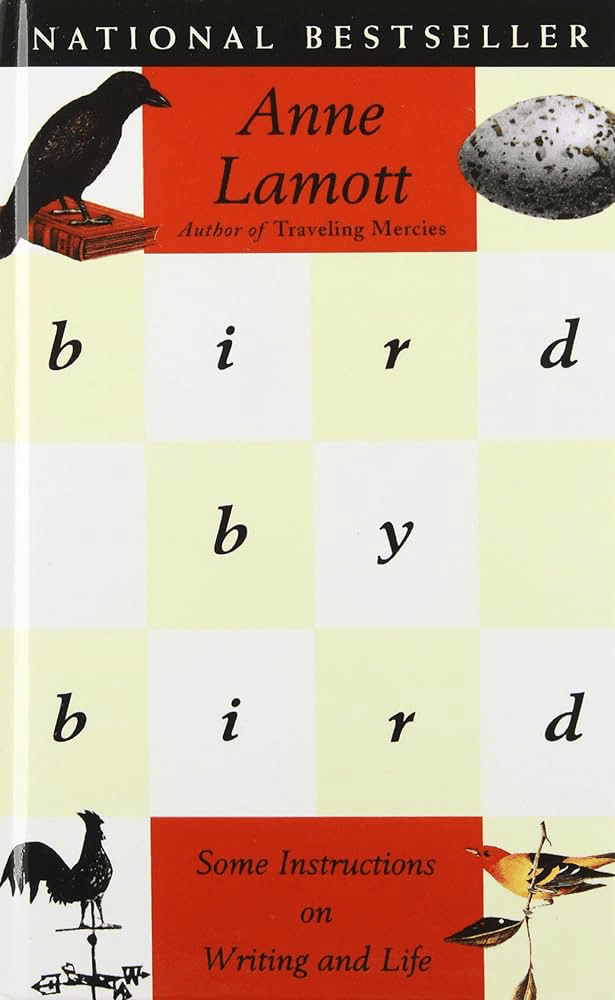
Anne Lamott, the author of Bird by Bird, makes a seminal point in that book. She observes that for many would-be writers, the goal is to get published, not to write a book. I know that sounds off, but it isn’t. Many writers want to have written a book so that they can fondly remember the process as they regale others about the experience and bask in the afterglow. In other words, they want to get published—BE published—more than they want to take the long writing journey. There’s a reason Ernest Hemingway’s description of writing, apocryphal though it may be, is so accurate: Writing a book is easy. All you have to do is sit down at your typewriter and stare at the paper until drops of blood form on your forehead. 

It’s very, very hard and disciplined work to write a book.

Self-evident though it may sound, though, it’s an inviolable rule of the universe that you must write the book (or article, white paper, essay, poem) before you can publish it. The one necessarily begets the other. 

Look: we all want to be published, because we see it as a third-party nod to our skill and prowess as a writer. It’s not enough for us to think our own work is good; we want the confirmation from others that we’re right. There’s absolutely nothing wrong with that. But consider this. The long and storied (yes, that’s deliberate) journey from an idea percolating in your mind to opening the box of author copies when it arrives on the porch, delivered by your new favorite friend, the UPS driver, is one of the greatest experiences you’ll ever have. And why is that? Well, several reasons. First, the only map for the journey ahead is in your mind. In fact, the territory that the map describes and through which you will journey doesn’t even exist yet, and it won’t until you set out to explore it by creating it. Second, you are the only person on the entire planet who knows your story as you bring it to life. And third, writing a book imbues you with the absolute and incalculable power of creation and destruction. You are free to create worlds, civilizations, fantastical beasts, people; and just as easily, with a swipe of the pen (or keyboard), you can make them vanish. In fact, every fiction writer I have ever known has told me that at some point in their writing career, they had a breathtaking moment of indescribable terror. It happened when they realized that the fate of the people who had been living rent-free in their heads for years was entirely, ineluctably in their hands. With great power, as Peter Parker admonishes us, comes great responsibility. 

So, yes, think about getting published. It’s an important part of being a writer. But remember, that book sitting on the shelf is the end of the road, the finish line. When you get there, the journey ends, and trust me, even though there will be miles of rough gravel and strut-busting potholes along the way, more than a few times when you’ll lose control and careen into the ditch, and plenty of moments when you’ll feel that you’re hopelessly lost and will never get to the end of the journey, when all is said and done, two things will happen: you’ll feel a profound sense of letdown; and you’ll feel an enormous sense of accomplishment. Why? Because you did what Bilbo Baggins did in The Hobbit: you went there and back again.

A singular focus on ‘getting published’ denies you the exquisite joy of the journey required to get there.

WRITING ACROSS GENRES

Screenshot

I WRITE BECAUSE I AM A STORYTELLER. I write because it makes me feel good. I write because it pisses me off, forces me to struggle, is an enormously creative pursuit, and because the effort can yield magical things. 

My first book was called Commotion in the Ocean, and it was a SCUBA diving manual. My second book was called Managing Cross-Cultural Transition, and it spoke to the challenges that expatriates face when they return to their home country after an extended stay abroad. 

My next I-have-no-idea-how-many books (25? 30?) were all books about communications technologies, written for non-technologists. That’s the field where I spent my career. Two of those books became bestsellers.

Then, interspersed among the bit-weenie books, I wrote books about storytelling, photography, and history. Under contract, I wrote the biography of a renowned Canadian telecom executive. I wrote a handful of children’s books, and I wrote books about writing, leadership, wildlife sound recording, strategy, cybersecurity, and the natural world. And, I ghost-wrote quite a few books for other writers about topics that I can’t talk about. 

Then, fiction began to call to me, and over the course of ten years or so I wrote four novels, one of which briefly became a global bestseller, holding the number one position in political fiction at Amazon for a couple of weeks. 

All of these books are rectangular and they all have covers, but that’s where the similarity ends. Weird, right? And this is why I am often queried about my writing, because most writers work within a single genre. They write poetry. They write mysteries and thrillers. They write science fiction, or bodice rippers, or historical fiction, or crime procedurals, or children’s books, or any of a thousand thousand non-fiction topics. 

But me? When I’m asked what I write, I sometimes reply, “Well, words, mostly.” That’s snarky, but it’s accurate. I’m not in love with any particular genre, you see; I’m in love with writing. It’s like whittling a stick of wood with a pocket knife. The pleasure doesn’t lie with whatever I end up carving; the pleasure lies in the carving itself. That’s one of the two reasons I can and do write across diverse genres.

THE OTHER REASON, and it’s important, has to do with specific skills. Everybody has them; we all have one or more things that we do really well, as true for writing as it is for carpentry, photography, oil painting, car repair, or surgery.

I am, above all else, a storyteller. That’s my skill. It’s the way my mind works. It’s the technique I rely on to create context for whatever topic I’m writing about, and to create context for whatever I’m trying to understand. One of my technology books that became a bestseller, The Telecom Crash Course, explains how telecom technologies work, but it’s written for an audience of non-technical business decision-makers. The book’s Preface begins with me, standing at a dusty, bustling crossroads in a small African village, watching as life happens there. It ends with me standing amongst a surgical team in that same village who are removing a woman’s gall bladder in an operating room that has been set up inside an old shipping container. Outside, goats and chickens and local kids run around, laughing and playing. Inside, the medical team assists with the procedure—‘assists’ because the surgeons who are actually performing the cholecystectomy are at a hospital in the U.S., seven thousand miles away, operating on the patient using a robotic surgery machine connected to them via a blazingly fast optical cable that winds across the seafloor from North America to Africa. The procedure is done laparoscopically; the surgeons in Maryland precisely control the three arms of the machine, inserting pencil-thin probes and instruments and cameras into three small incisions in the woman’s belly. The procedure takes 40 minutes, open to close; the woman goes home an hour later with six stitches, three band-aids and a bottle of painkillers. 

Look: I could have told my readers that optical networking is important and really fast and deserves their attention and investment. Booooooooring…But, I decided to show them instead, by taking them on a storytelling journey, all true, by the way, and letting them see for themselves. 

A group of kids in Africa surround me, looking at their photo on the back of my camera.

I need to make something clear here. I’ve written dozens of books about extremely technical topics, but I’m not a computer scientist or electrical engineer. My undergraduate degree is in Spanish, to be honest. But as I said, I spent my career in and around the telecom industry, speaking about and teaching technology to people who had a need to understand its implications. I know the subject well, but much more to the point of this essay, I’ve worked hard to develop the ability to explain complex topics, complex themes, through storytelling, by using the story to create context. and that is true, regardless of what I’m writing about.

Storytelling is my specific skill. What’s yours? If you’ve never thought about this, you should. What is the one thing that makes your work stand out above the rest? What do you incorporate in your writing that allows your creative signal to rise above the competitive noise? I spent most of my career working with people who had forgotten more about technology than I would ever know. I’m proud to admit that. But I had something they didn’t: the crucial ability to make complicated, off-putting topics understandable and—dare I say it? Interesting and entertaining. After all, isn’t that what writing is all about in the first place? Creating a bridge between your story and the reader? I think so. Otherwise, what’s the point?

Take a Moment

Let’s talk for a moment about connectivity, about paying attention to the way systems, ecologies, species, habitats and environments engage along the way to some common endpoint, some mutually agreed-to goal. Let’s also include curiosity, awe, wonder, and reverence. 

I’ve been speaking about this theme for years through the nearly 300 episodes of my Podcast, The Natural Curiosity Project. Curiosity matters: I often refer to it as our sixth sense, the power that allows us to make sense of the multifaceted world in which we collectively operate—‘us’ being humans and the other nine million or so species that we share the planet with. 

I hear this all the time, the chanted meme: “We’re all connected.” And while that observation is true for all kinds of reasons, there’s a piece missing, and it’s a big one that no one in the environmental community seems to have really latched onto. So, let me take a swing at it.

I spent my 43-year professional career in the global telecommunications industry, as a consulting analyst. I’ve written dozens of books and hundreds of articles; I’ve taught countless courses on related topics; I’ve given keynotes and workshops all over the world (four million miles on United is the ugly proof); and I’ve consulted with many companies on the best way to get the most return for their technology investment. 

Telecom is complicated stuff, as anyone who has tried to configure their own router knows. But two concepts always float to the top when it comes to understanding how it all works: connectivity and interoperability. They are not the same, but they are equally crucial. And yes, I’ll bring this conversation back to Intertwingled and the environment shortly.

Imagine the following. I pack up my television here in Vermont and take it with me to Spain. I unpack it, set it up, and plug it into a power adapter, which I then plug into the wall.  I attach an external antenna, and turn on the set. It powers on. Perfect! I have connectivity.

However, as soon as the image resolves on the screen, I realize that I have a problem. The picture is distorted, like a funhouse mirror, and it’s black and white. Why? Because I may have connectivity, because I was able to physically plug the set into power and pull a signal down with my antenna. But I don’t have interoperability.

You see, the analog TV standard used in the US, Canada, Mexico, and a handful of other countries was created by an organization called the National Television System Committee, abbreviated NTSC. TV sets that use the NTSC standard “paint” the image on the TV screen using 525 interlaced lines, creating 30 frames every second, using local AC current that runs at 60 Hz. By the way, the NTSC standard is considered by many engineers to be rather sloppy, and they jokingly say that the letters actually stand for ‘Never Twice the Same Color.’ But I digress.

Meanwhile, the standard used in Spain, in Europe, in most of the world, is called PAL, which stands for ‘Phased Alternate Line.’ It assumes 50 Hz current, not 60, and paints 25 frames per second,  Not 30, using a 625-line brush. It doesn’t take an electrical engineer to figure out that NTSC and PAL are incompatible. In other words, we may have connectivity, but we can’t have interoperability.

‘We’re all connected’ is a rallying cry for the environmental movement, and it’s a good one. We all share the same earth, drink the same water, rely on many of the same metabolic processes to maintain life, process the same atmosphere, and take part in the great cycle of life. We have connectivity. Because we’re all connected to the planet.

What we don’t seem to have is interoperability. Or at least, for many of us, it’s a theme that we confidently ignore. Remember the guy holding onto the mattress on top of his car that I discussed in an earlier essay as an example of breathtaking human hubris? 

Think about it. Connectivity is about being physically linked. If I speak Spanish to someone whose only language is Farsi, and they speak back, we have connectivity—our ears receive the signals—but we understand nothing about what the other person is saying. We lack interoperability. Interoperability is about being able to intelligibly exchange information, to understand what the other side is saying. In the world of technology, It’s called protocol conversion. It’s much more complicated than connectivity, and requires significantly more effort, which means that it’s also inconvenient. But if Return on Inconvenience is a valid measure of effectiveness, as I believe it to be, then it’s a worthwhile undertaking.

So, what does that mean? Well, it means paying deliberate attention when you’re out there, engaging all six senses. Being present. It means engaging with the environment the way a four-year-old does. It means asking hundreds of questions every day that start with WHY, listening to the answers, and not being afraid to say, ‘I don’t know.’ It means getting comfortable with not knowing, and looking forward to fixing that. When you go for a walk in the field, or the forest, or the tallgrass, or the beach, engage. Don’t just walk through the environment; strive to be part of it. Walking through the forest with your earbuds in your ears is an exercise in connectivity; your feet do indeed touch the path. But if you return from a walk and you don’t have mud on your knees, or even better, on your chest, then you weren’t behaving interoperably. You may have seen that flash of color on the ground as you walked by, responding to a text on your phone, but you didn’t really get down there to see those amazing fruiting bodies growing out of that lichen, or the snails that were devouring that thumbtack-size mushroom, or the salamander eft hiding under the leaf litter. You weren’t engaged, and you never asked WHY things are the way they are.

Focusing on WHAT instead of WHY is a dangerous, dead-end practice. WHAT leads to blame; WHY leads to understanding and action. As I write this, Southern California burns. That’s the WHAT. Yeah, we know.  But WHY is it happening? Because if we can answer that, really answer that question, then we understand it and can formulate an effective, long-term response. 

Here’s an example. When environmentalists (and I count myself strongly in this camp) rally to point fingers at oil companies for polluting the air with fossil fuel byproducts, I note that they don’t generally arrive at the rally on horseback, in an oxcart, or on a bicycle. That’s a bit hypocritical. And when oil money-backed politicians sneer at environmentalists for wanting to save some tiny, inconsequential species that’s endangered by the warm effluent from a power plant, they’re missing the point. BOTH sides are missing the point. Why? No interoperability. No understanding, and not enough effort to create it.

Consider the timeless lyrics of Stephen Stills’ For What It’s Worth:

There’s battle lines being drawn,

Nobody’s right if everybody’s wrong,

Young people speaking their minds,

Getting so much resistance from behind.

Nobody’s right if everybody’s wrong. Listen up: Pointing out the WHAT does nothing useful, and is divisive. Asking WHY leads to the kinds of effective response that true leaders create. WHAT looks to the past; WHY looks to the future. We can’t change the past; that leaves only one option.

Thomas Young, The Last Man Who Knew Everything

Thomas Young was born in 1773 and lived until 1829. And while living to the ripe old age of 56 may have counted as being in his dotage in the 18th century, he certainly used his time well. The things that Young accomplished are beyond words.

Young was a medical doctor and for a while, a college professor. But he also made huge (as in, change-what-the-world-knows huge) discoveries in physics, energy, optics, vision, physiology, language, music, and Egyptology. He was referenced admiringly by such people as William Herschel, who built the world’s first large telescopes; Hermann von Helmholtz, who was a pioneer in fields as diverse as physiology, psychology, physics, and philosophy; James Clerk Maxwell, who figured out how electromagnetism works; and Albert Einstein, who figured out everything else. 

Here’s Young’s story. He studied medicine in London, and later went to Göttingen, Germany, where he received the degree of Doctor of Medicine in 1796. In 1797 he inherited a huge estate that belonged to his grand-uncle, Richard Brocklesby. That inheritance made him financially independent, which is probably why he was able to become a true polymath.

In 1801, Young was appointed professor of natural philosophy (what we’d call physics today) at the Royal Institution. Over the course of two years, he delivered 91 lectures on a staggering plethora of topics.

In 1811, he became a physician at St George’s Hospital, and in 1814 was elected to a committee that was created to study the dangers of installing natural gas lighting throughout London.  Five years later, he was elected secretary of a commission charged with determining the exact length of a pendulum whose period is exactly 2 seconds. This was extremely important for time-keeping, but it was also crucial for maritime navigation. No surprise, in 1818, he became secretary to the Board of Longitude, which was convened to come up with an answer to the vexing problem of calculating longitudinal position, which unlike latitude, can’t rely on star and planet positions relative to the horizon to do that. 

That’s a pretty healthy academic resume. But why is he called “The Last Man Who Knew Everything?” The answer is, well, he apparently was the last man to know just about everything—at least, for his time. 

My brain hurts just reading the list of this guy’s accomplishments. Young believed that his most important contribution to the world’s store of knowledge was his creation of the wave theory of light. This is important on many levels, not the least of which is that it put him at odds with Sir Isaac Newton, who was a science rock star, but believed that light was a particle (today, of course, we know that it behaves like both). He demonstrated his wave theory by crafting what came to be known as the double slit experiment, considered to be one of the most important contributions to physics ever made.

But he didn’t stop there. He went on to publish Young’s Modulus, a mathematical principle that related the pressure on a body to the amount of strain that the body is experiencing, regardless of the shape of the object—all that mattered, he concluded, is the nature of the material itself. This became fundamentally important for engineering problems, like bridge and building construction.

The next thing on Young’s to-do list was to create the science of physiological optics—in other words, to do what no one had yet done—to understand how the eye works.  In 1793, he explained how the eye automatically changes the curvature of its lens, based on the distance of the object being viewed. 

This, of course (of course), led to his development of the fundamental theories that related vision to color. That theory, called the Young-Helmholtz theory, concludes that color perception is based on the presence of three different kinds of nerves in the retina, each “tuned” to a different range of light frequencies.

Once he checked that off his list, he moved on to the theory of capillary phenomena and its relationship to surface tension. I was just talking about this last night over dinner—yeah, sure I was. This led to the creation of the Young-LaPlace equation, which explains to us why soap bubbles can form, among other things.

At this point, Young apparently got bored with physics, so he moved on to other fields. He came up with a rule of thumb for doctors to determine the correct dosage of a drug for a child, based on their age and weight. He wrote an article for the Encyclopedia Britannica at the beginning of the 18th century, in which he compared the grammar and vocabulary of 400 distinct languages, pointing out the similarities and differences, work that would later lead to the creation of such fields as phonetics, philology and linguistics. He also proposed a universal phonetic alphabet that allowed linguists to write down the correct pronunciation of any word in any language by using the universal symbols that he created. I am very familiar with this language of his, because I used it in my undergraduate studies at Berkeley. For example, the Spanish word for house, ‘casa,’ is pronounced differently in different parts of the Spanish-speaking world. In Latin America, they say ‘casa.’ But in Spain, they say something that sounds like ‘Casha.’ You can actually write the word differently using Young’s phonetic alphabet: ‘casa’ vs. ‘caša.’

And then, there are Young’s contributions to Egyptology (of course). When he was 40 years old, in 1813, he decided to study and decipher Egyptian hieroglyphics. He started with the existing translations of the demotic alphabet, and along the way found numerous errors. By 1814, he translated the Rosetta Stone. I think that was on a Saturday.

Finally, Young developed what came to be known as Young’s temperaments, which were very sophisticated methods for tuning musical instruments.

You know what I like about this guy? First, that curiosity leads to good things; and second, that I shouldn’t get too impressed with myself when I do something that I think might be impressive. Holy cow. This guy DESERVES the title of the Last Man Who Knew Everything.

What a world. And what a guy—Thomas Young. Curiosity, man—it rocks.