Note: If you’d like to listen to the audio version of this essay, you can hear it here on SoundCloud or here on Apple Podcasts.
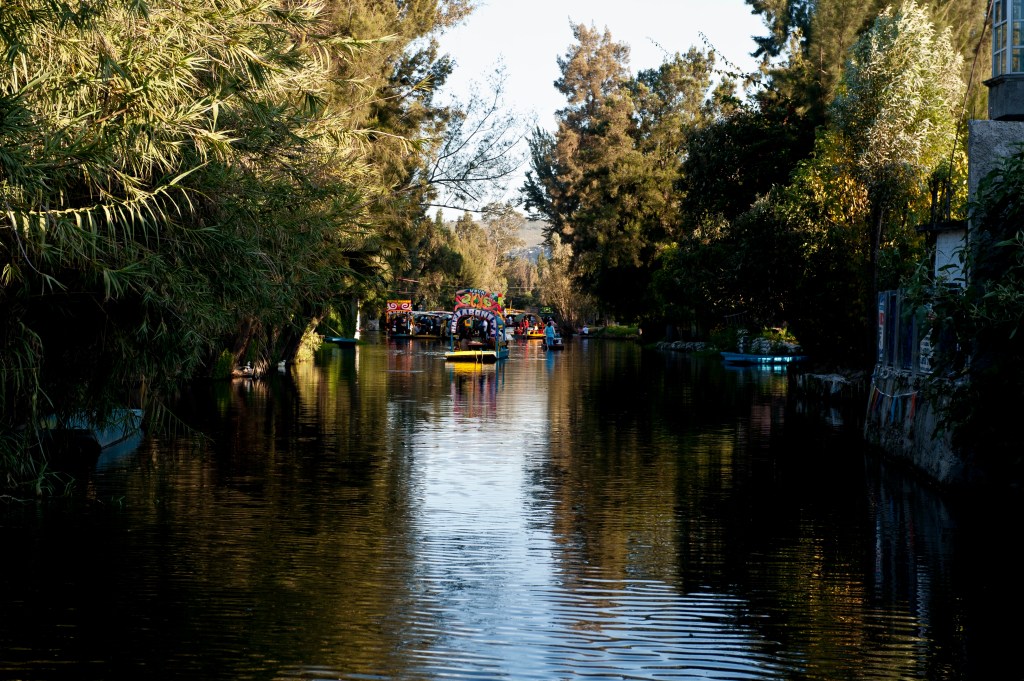
Mexico is rich with mysterious tradition, a culture where magic and mysticism are as present as Catholicism and the lingering Aztec voices that are woven into the wind. Just to the south of Mexico City lies Xochimilco, the Venice of Mexico, a town gridded with more than 100 miles of lushly overgrown canals, heavily trafficked by colorful barges called trajineras that are filled with families celebrating birthdays, quinceañeras, or just the fact that it’s the weekend. Floating food vendors approach the barges to sell tamales, roasted corn, chalupas and barbacoa; music and laughter are everywhere.
The canals in Xochimilco are all that remain of an extensive, pre-Hispanic transportation and agriculture system built by the Aztecs and earlier civilizations to create farmland in the shallows of Lake Xochimilco. Xochimilco was one of five interconnected lakes in the Valley of Mexico, the site of present-day Mexico City and the original Aztec capital, Tenochtitlan. The network of canals that interconnected the lakes allowed the Aztecs to thrive in these wetlands. They contained vast artificial islands called chinampas, on which food was grown for the Tenochtitlan empire.
The Aztecs built the islands by packing mud, silt, and reeds into a dense organic mass, which created a sustainable, water-rich environment for growing an impressive array of crops: corn, beans and squash—the Aztec “three sisters”—along with tomatoes, avocados, greens, a variety of chiles, the ancient grain known as amaranth, and flowers.
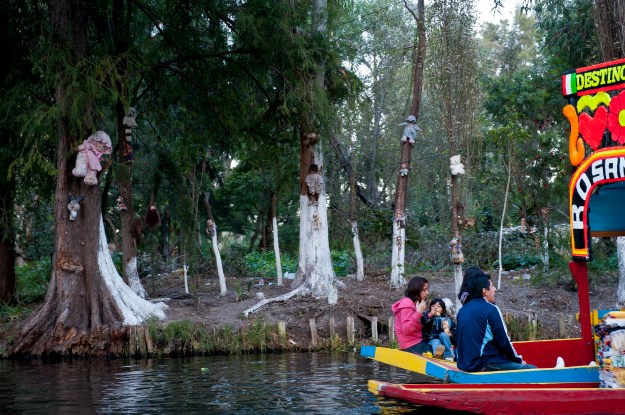
I’m on one of these trajineras, in the middle of a maze of canals, with my friend, Fernando Toledo. The place has a party atmosphere, with competing yet strangely complementary music playing on radios and boom boxes on many of the barges. Laughter and chatter are everywhere, and vendors in small boats approach constantly to sell food and drink and fresh flowers.
As our boat driver slowly propels us down the canal with the long oar he uses to guide us, we pass an aspect of Xochimilco that doesn’t evoke laughter. It’s a small island, one of many that lie between the canals. It’s heavily forested, and it’s called La Isla de las Muñecas: the Island of the Dolls.
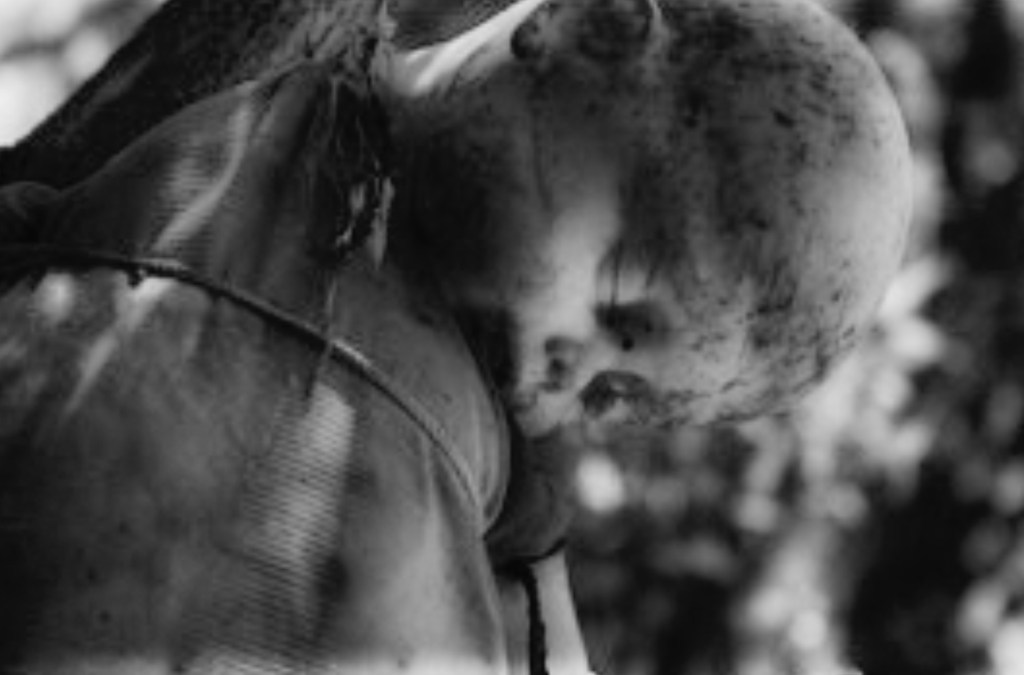
The trunks of the trees that festoon the island are covered with dolls—hundreds and hundreds of them. They’re not all intact; in some cases there are heads or severed limbs nailed to a tree. Most have been there long enough that the elements have varnished them with a patina of age, which has in turn made them look disturbingly real. And if the hair on the back of my neck is any indication, the place is crawling with spirits. Local lore maintains that the eyes of the dolls follow visitors, and that their limbs move. Many claim that the dolls whisper to each other, and that after dark you can hear their voices, mingling with the whispers of long-passed Aztec warriors.
As we approach the island, the voices on the boats fall to whispers; the Mariachi and pop music that had been playing disappears.
No one knows the real story behind the dolls on the island, but they coalesce around a young girl who drowned nearby under mysterious circumstances in the mid-1950s. Don Julian Santana Barrera, the island’s caretaker, found her body, and not long afterward found a doll floating in the canal where her body had been. He assumed that the doll belonged to the little girl, and to honor her memory he recovered it and attached it to a tree.
According to local legend, Santana-Barrera was haunted by the spirit of the little girl, so to appease her, he began to hang other dolls on the trees of his island. He did this for fifty years, until one day he was found drowned in the same place where he had recovered the body of the little girl.
Mysticism and magic deeply permeate Mexican culture, creating a blend of Indigenous spiritual beliefs, descended from the Aztec and Maya, with the relatively new teachings of Catholicism, introduced by Spain during its conquest of the New World.
This weaving together of vastly different beliefs is called Syncretism, the blending of ancient cosmology and nature worship descended from the Maya and Aztecs with the worship of Catholic saints and Christian rituals. Also integrated into the spiritual pattern is a deep respect for native plants and spirits as sources of wisdom and power, both of which were central to Aztec and Mayan heritage.
Another element is the application of spiritual medicine using herbs, prayer, and rituals to heal physical, mental, and spiritual disease, practices that often involve shamans. Equally common is the use of amulets, such as wearing red strings to avoid the evil eye—or God’s eye, as it’s sometimes called.
Then there’s the annual Day of the Dead,where the line between life and death is blurred, a day when the spirits of the dead are welcomed, a practice rooted in ancient Aztec and Mayan beliefs about the afterlife.
Here’s the thing: mysticism and magic don’t lie at the fringes of Mexico’s cultural heritage; they’re foundations of national cultural identity that dominate the nation’s world view, accepted healing practices, and the daily rituals and celebrations that connect people to their ancestral past.
As we drift beyond the Island of the Dolls, the revelry once again picks up; the music and chatter return, and the vendors go back to hawking their wares. As the island receded into the distance, I thought about the inscription that’s engraved into the lintel above the entrance to Mexico City’s famed Archaeological Museum:
When darkness still reigned, when day had not yet been created,
When light did not yet exist, they came together.
The gods came together, in Teotihuacán.
Teotihuacán, the ancient city of pyramids near Mexico City, and Tenochtitlan, the ancient Aztec empire upon which Mexico City was built, are equally important in the nation’s heritage. These beliefs of ancient cultures are deeply embedded in the culture of Mexico—and not just Mexico, but all of Latin America. The magic and mysticism that underlie the national culture is reflected in its literature: whether it’s Laura Esquivel’s “Like Water for Chocolate,” or Amado Nervo’s “The Giver of Souls,” or Silvia Moreno-Garcia’s “Certain Dark Things,” the magic and the mysticism flow and braid together into a rich, unforgettable literature that binds the past to the present. Sometimes, the magic is so breathtaking and so real that it lifts and carries the reader away; sometimes it’s as dark as the story behind the Island of Dolls. I’ve experienced both in my travels in that country.
Many years ago, my friend Gary Kessler and I were in Mexico City to speak at a telecom industry conference. During a down day, we took the bus and headed out to Teotihuacán to see the pyramids. At one point we stopped at an overlook that looked down on the Aztec ‘a tlachtli,’ the ball field where winners and losers were venerated but losers were also sacrificed. We stood there for several minutes, lost in our own thoughts. Then, we both said in unison, “I can feel the ghosts here.” We moved on.

Few places have affected me as much as Mexico: whether it’s the hair-raising feeling of the Island of the Dolls in Xochimilco, or the place where the gods came together, in Teotihuacán.
 Steven Shepard