Over the course of the last three months, I’ve taught a writing workshop at our local library here in Vermont. My audience was people interested in becoming better writers. Interestingly, a significant proportion of them weren’t interested in getting published; they just wanted to be better at the craft of writing. Refreshing!
I’m embarrassed to say that I hadn’t spent much time in our library since our kids were growing up. Being the lover of books that I am, my library became Amazon, as I assembled my own cherished library at home. It’s funny: I recently did a quick survey of our house and was pleased to discover that there are books in every single room of the house—except for the dining room and bathrooms! Go figure.Anyway, the library we had back when the kids were in school and the library we have today are worlds apart. It has expanded, both physically and in terms of what it offers. The Dorothy Alling Memorial Library, situated on the Williston town green in front of the Williston Central School and adjacent to the town gazebo where the town band (the Williston Wheezers) plays on the 4th of July, still has books, but now offers a computer room with available instruction for those looking to develop their digital skills; a massive media collection; Internet access; loads of learning programs; and after-school activities for kids, which are well-attended.But they’re not unique in this, as it turns out. According to information published in The Atlantic, 84% of libraries in the country offer some form of software training, while 90% teach basic Internet skills. In fact, in 2019, 130 million people enrolled in programs offered by their local libraries, including digital literacy. In other words, libraries have gone from being passive repositories of dusty books to active educational institutions. And the value of the investment is returned handsomely: In Ohio, for every dollar spent on public libraries, the state received $5.48 in added economic value. Not a bad return on investment.
These libraries have morphed into learning centers, digital community centers, and career hubs. Some libraries are partnering with local businesses to develop learning programs that will generate a steady flow of high-quality, skilled employees, ready to undertake work in the 21st century.
When was the last time you visited your local library? Check it out—it might surprise you. And if you have kids, make it a regular thing to visit with them. What this demonstrates, once again, is that knowledge really matters. It leads to the development of skills that create differentiation, opportunity, and hope. And where better to have that happen than the local public library?
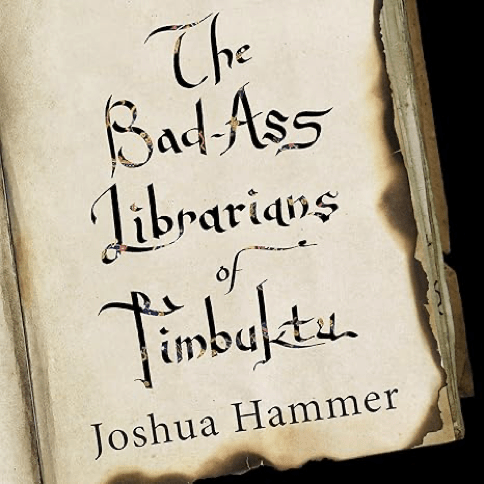
And that’s why I want to tell you about a book I recently read. The name alone should hook you: The Bad-Ass Librarians of Timbuktu, by Joshua Hammer. It’s equal parts thriller, geography, history, and geopolitical intrigue. And, it’s all true. Here’s the story, without giving away the fun parts. Timbuktu (which means ‘Boctou’s well’ in the local dialect) has for centuries been a center of Islamic scholarship, an oasis of culture, knowledge and understanding in the center of Mali, a nation deep in the Sahara.
Abdel Kader Haidara, a minor government functionary in the 1980s, realized something one day: scattered across the Saharan sands of Mali there are tens of thousands of ancient manuscripts, some dating from the 5th century, all hand-illuminated, and all crumbling to paper dust because of heat, dry air, and termites. Stored in rotting chests or buried in the swirling sands of the Sahara, these books include early religious texts, medical treatises, political texts, manuals of early law, political treatises, personal journals of early explorers, accounts of travelers, and much, much more.
Knowing the incalculable value of the knowledge captured in these books, Haidara set out on a quest that would make Don Quixote AND James Bond proud: to collect as many of them as possible, bring them to a world-class, centralized repository for restoration and digitization, thus preserving the wisdom of the ages. But there were some challenges: the restoration facility didn’t exist; and the books were mostly in the hands of families who didn’t trust the government (for good reason) and weren’t about to turn them over to a junior representative of that very same government.
And then, there was the Al Qaeda problem.
Sworn to destroy all vestiges of existing society and its historical foundations, Haidara knew that Al Qaeda would burn the books if they were found. So, he took on the incredibly hazardous task of preventing that from happening by mounting an enormous smuggling operation to move the books, all 350,000 of them, in secret, away from Al Qaeda.
You need to read this book—it’s a FANTASTIC story.
Apparently, reading, and books matter. I have to agree.
 Steven Shepard