This has been a weird summer up here in the northeast, but it finally stopped raining long enough for me to get out this morning for what has become my daily morning routine ever since the zombie apocalypse descended on us back in the beginning of 2020—a five-mile walk down to the local coffee shop and back. It’s a good time to listen to an audio book or catch up on Podcasts. But this morning, I did something different.
It’s fall, or at least starting to feel that way; the goldenrod’s in full bloom, the purple loosestrife is fading, the insects are starting to get whiney and tired in their calls at night, the apple trees are busting at the seams with fruit, and school buses once again prowl the neighborhood. Last night was hot and humid, mid-70s, but this morning it was in the high 40s when I left the house. Low spots in the meadows were filled with fog, and moisture had condensed on everything. As I looked to the west, I was stopped in my tracks by something I had never seen before: a fuzzy, diffuse rainbow, arching over the fog. It was a fogbow, and it was stunning.

The sun was barely above the horizon by the time I reached the elementary school, about halfway to the coffee shop. The bright, flat light hit the tall grasses and wildflowers from the side, creating a silhouette effect that made them glow. But that wasn’t all: the horizontal light also backlit the dozens of orb weaver webs that stretched between the tall plant stems, bejeweled by the droplets of dew that had condensed on them as tiny, transparent, concentric strings of pearls.
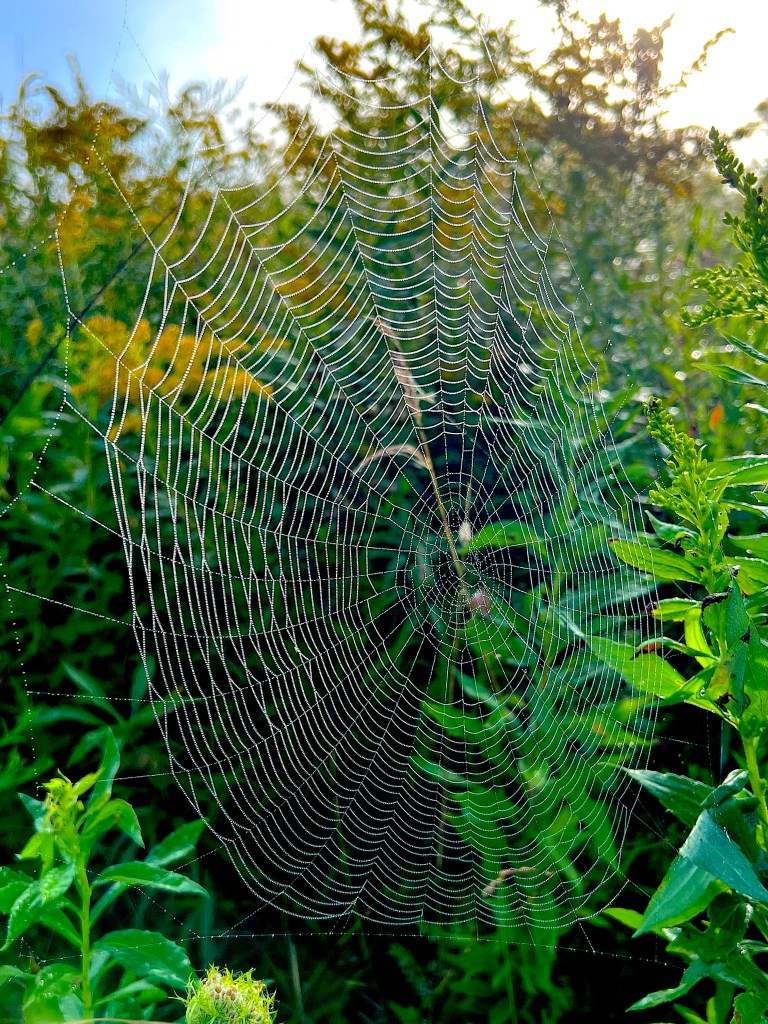
The poet, Emily Dickinson, wrote,
The spider as an artist
Has never been employed
Though his surpassing merit
Is freely certified.
I was entranced by these gorgeous structures. So—rabbit hole time.
Here’s what I wanted to know. How do spiders build those things? How do they know to create THAT shape? Are the webs strictly structural and for capturing prey? Nope—it turns out that they have several functions.
Spider silk is produced by specialized organs on the spider’s abdomen that are called spinnerets. And the silk they produce isn’t just for catching insects. It’s also used for shelter, courtship rituals, structural integrity of whatever they call home, like a burrow, and transportation.
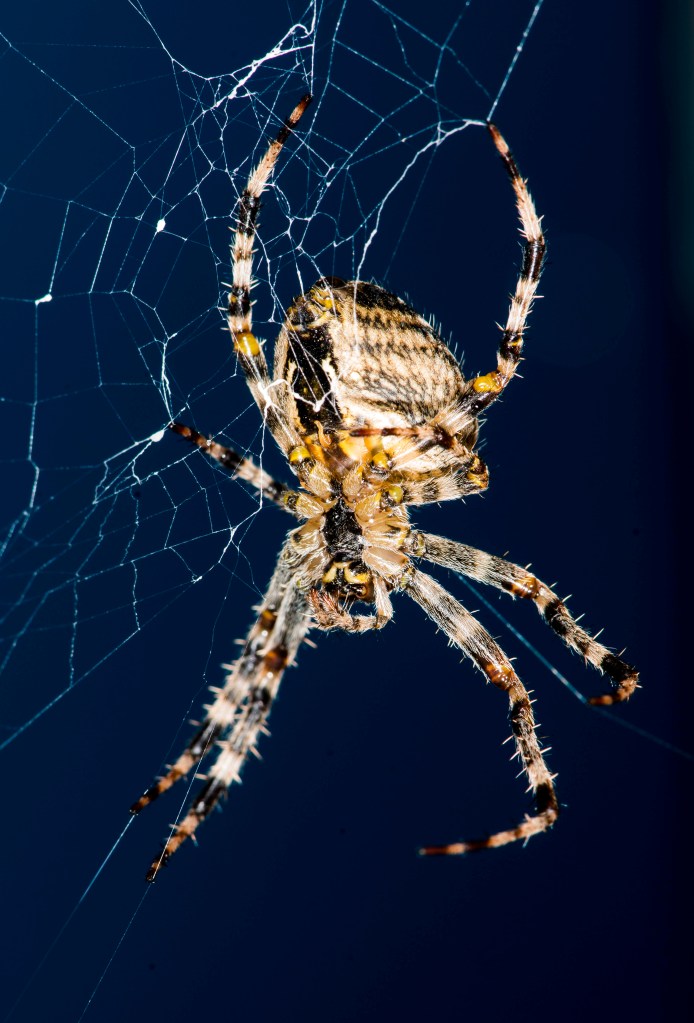
Here’s another fact that blew me away. Spiders produce different kinds of silk, each with a different set of properties. In the spirit of one of my favorite questions—what makes the Teflon stick to the pan—I had to know: how can a spider walk around on its web without getting stuck, like all the other bugs that DO get stuck? Well, that’s what the different kinds of silk are for. Think about an orb weaver, the spider that weaves the web of sticky concentric circles that we all think of when we think of spider webs. It turns out that the silk lines that radiate out from the center like bicycle spokes are called draglines, and they aren’t sticky at all. But the concentric round threads are extremely sticky; they’re what do the bug catching.
So, when a spider weaves a web, it starts by first placing the draglines, the spokes, using silk that isn’t sticky so that it has a surface to walk on. Then, it—I don’t know, changes nozzles, and begins to extrude the sticky silk, traveling around and around to create the concentric circles that capture prey, carefully stepping only on the draglines to avoid getting stuck on the tiny microdots of glue on the concentric rings.
There are about 50,000 known spider species, but interestingly, most of them don’t spin webs. But they ALL produce silk. They just use it for different things. Most commonly, it’s used to create a strong, flexible shelter for the spider, like a wolf spider’s silk-lined burrow. The silk is also extremely clean and often contains antimicrobial chemicals.
But it’s also used for transportation. Spiders use it to create safety lines, with which they can swing across a gap that’s too wide to jump, like Tarzan, or they can use a strand of silk as a parachute to carry them high into the sky, using the wind and the Earth’s magnetic field to move them. Spiders have been found at altitudes as high as 10,000 feet and thousands of miles from land over the ocean.
To the question of whether spider webs are strictly utilitarian? Nope. Web-weaving spiders apparently have an artistic side. Ever since scientists first noticed spiders and their webs, and figured out that they trap insects for food, they’ve assumed that the structure of the webs is purely functional. But it turns out that some of the design elements, which are called stabilimenta, are purely for design, because they’re missing on the webs of nocturnal spiders. If you can’t see, I guess, why decorate?
You may have also noticed that webs are shiny. Turns out there’s a reason for that. Quite a few prey insects that spiders want to attract are more sensitive to ultraviolet light than they are visible light, and the protein that spiderwebs are made from reflects UV light very strongly, making the silk more attractive to food insects. It’s also interesting that spiders are rather fastidious. For example, many spiders replace the entire web every day. Even the tiniest tear in the fabric is enough to cause them to start over. Naturally, larger webs cost the spider more energy to produce, which adds up each time they feel motivated to rebuild, and makes you wonder why they’d go through all that extra trouble to replace the whole structure. But large catches offset the increased energy output because of the protein they provide, so it’s worth it to keep things tidy and well-repaired—and to cast a wide net.
And what about all the hype regarding the strength of spider silk? Turns out it’s not hype at all.
The silk that spiders use to build their webs and trap prey is one of the strongest materials known to science, and it’s fascinating to know that we don’t really know why. But what makes it so unusually resilient is the fact that when it’s pulled or stretched or deformed in any way, like when an insect tries to escape from it, or when somebody tries to poke a hole in a web with their finger, the protein-based silk where the stretching is taking place first softens to become highly flexible, but then, at some point, it suddenly stiffens, a strange property that reduces damage to the web, because the only place the web tears is at the exact point where the deformation is taking place.
Markus Buehler is an associate professor of civil and environmental engineering at MIT who has analyzed the structure of spider silk to determine why it’s stronger than steel. But what’s interesting about Buehler’s research is that he and his team of researchers have gone on to extend their study to the structure of the entire web. And what they’ve found is that some of the things they’ve discovered may help us create more resilient power grids or telecom networks. Think about it: The survivable nature of the “web network” may yield insights into how we build more resilient and survivable telecom and power infrastructure. That, to me, anyway, is fascinating.
It was Buehler’s team’s work that led to the discover of spider silk’s schizophrenic behavior, the way it first softens and then stiffens when it’s placed under stress. They were intrigued by this, so off they went into the field to see the property applied in real webs. They would select a web, and then would apply pressure to a strand somewhere on the web. The strand would stretch, and the entire web would deform—but only to a point. At some critical moment, the strand that was being directly deformed by the researchers would suddenly stiffen, and it would stay that way until it snapped, sacrificing itself to save the overall structure. A single broken strand can easily be repaired or even ignored, if it doesn’t affect the integrity of the web itself. But it was fascinating that the only place the web broke was wherever the force was being directly applied—the rest of the complex web structure remained completely intact.
So, what are the implications of this research that scientists are engaged in with spider silk, other than the potential to build better networks? Well, there are several. For example, imagine if buildings could be designed by structural engineers that would withstand the destructive forces of an earthquake. If buildings could be designed so that they were able to safely fail in small localized areas, then they would perhaps be more survivable. They could flex to some allowable point, after which a sacrificial strength member would fail, allowing the destructive energy to only affect a small part of the building without causing catastrophic, non-survivable damage. The same could be done with ocean-going vessels, aircraft, and other structures that are subject to violent forces.
But other researchers are looking at a different set of properties, this time in the field of medicine. It turns out that spider silk is not only stronger than steel and extremely flexible; it’s also five times tougher than Kevlar, which means that it has potential applications that go way beyond looking at it to strengthen buildings and airplanes and ships. Researchers think it might be used to create artificial skin, to strengthen damaged muscles, and to help bones knit after a break. But there are some challenges.
For example, even though spider silk is orders of magnitude stronger than Kevlar, you wouldn’t want to weave a protective vest from it, because even though the silk would prevent a bullet from penetrating the fabric, it’s also very stretchy—which means that the spider silk-encased bullet would pass right through your body and travel some distance before the silk pulled it back. Not very helpful.
Another problem is that spider silk has to be sourced from—well, spiders, not to put too fine a point on it. Just for context, a golden cape made entirely from spider silk was woven in 2009. But the 11-foot by four-foot cape required a team of 82 people to weave it and required the silk from a million spiders over the course of four years to supply the “thread.” Not exactly practical. But, scientists have figured out how to “re-engineer” silkworm silk, which is much easier to collect in quantity, to make it behave more like spider silk, which means that they might someday be able to supply it in large enough quantities to be useful. But forget about fashion for a minute. They’re also working to give the silk additional properties. For example, bone regeneration requires a naturally occurring calcium compound called hydroxyapatite, so scientists are trying to come up with a way to infuse that compound into spider silk so that it can be used to accelerate healing in broken bones.
Now, silkworms are great—they’ve been the sole source of silk fibers for thousands and thousands of years—but there’s a limit to what they can produce naturally. So, no big surprise, researchers are trying to create synthetic spider silk. This is what a team of scientists at Utah State University is focused on.
Professor Randy Lewis is retired now, but before he left academia, he did groundbreaking research on spider web proteins, going so far as to breed genetically modified goats whose milk contained the protein precursors required to create spider silk (don’t ask—not sure how you get from spiders to goats). His synthetic biomaterials lab is now led by Justin Jones, who has left the goats behind and gone in a different direction.
Because spider silk is so strong and lightweight, it has a lot of potential applications, which means that there’s high demand for the stuff. So, Jones first looked at silkworms, which are more productive than the goats or the spiders. But production is still limited. So instead, Jones and his researchers are now looking at the slime produced by hagfish, which also contain spider silk chemical precursors.
A few words about hagfish, because they’re just weird. They look like eels, and they have a skull, but no spine. They don’t really have eyes, and their skin is barely attached to their bodies, so it just kind of flops around. To protect themselves they squirt out large amounts of slime from mucous glands in their skin, similar, I guess, to why a lot of people won’t eat boiled okra.
The proteins that Jones and company have found in hagfish slime are called intermediate filaments, and when they’ve been deslimed and isolated, they have properties that are very similar to spider silk. Jones and his team have also induced E coli bacteria to produce hagfish proteins at a rate that’s eight times that of silkworms, which puts researchers that much closer to being able to produce commercially viable volumes of material. They freeze dry it, and it can then be dissolved and then extruded to make strong fibers, coatings, gels, and glues, which are significantly stronger than superglue or Gorilla Glue.
But Jones is quick to point out that while the material that he and his colleagues have synthesized is good, it’s still only about half as strong or as flexible as real spider silk. They’re just not there yet. But how cool is it that we have scientists out there who spend their days doing this kind of work? How cool is it that somebody out there made the observation that we can’t possibly get enough spiders to do this, so we’ll use silkworms; but they aren’t really a big production model either, so hey, how about goats? But goats require lots of space and they’re noisy and smelly, so hey, here’s an idea—let’s use hagfish! And maybe E coli?
Back to spiders. I can’t help but be in awe of these tiny little critters that have brains the size of poppy seeds. They create extraordinarily beautiful and functional webs, and somehow know how and when to switch between sticky and non-sticky filaments for maximum effect. How do you explain that?And by the way, to my friends who call themselves web designers, I love the work you do, but sorry—you can’t hold a candle to the eight-legged variety. Just sayin’.
 Steven Shepard