I read a lot. It fuels my writing, gives me a better view of the world, and is a great way to travel through time and space. Every once in a while, I run across a book that really hits me as a must-read. The Age of Wonder, by Richard Holmes, is one of those; so is William Least Heat-Moon’s Blue Highways. Lynda Rutledge’s novel, West with Giraffes, is another. Sabine recommended this one to me; as I closed the back cover, I realized that there were tears on my face. This is one great book.
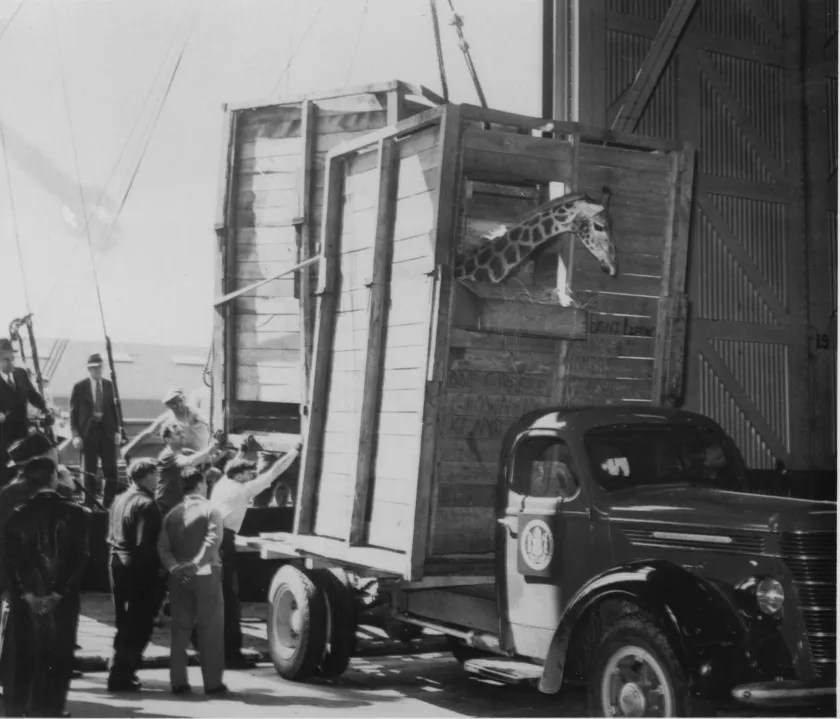
West with Giraffes tells the story of two giraffes, shipped from Uganda to New York City in 1938. There, the animals were loaded onto a truck for a twelve-day drive to San Diego, where they became the first giraffes at the newly created San Diego Zoo, under the care of Belle Benchley, the world’s first female zoo director.
Lynda Rutledge tells a great tale, with well-developed, realistic, likable characters, and a terrific story thread. I LOVED the book. But it wasn’t the story that grabbed me; it was the context it gave me about three things: 1938, the year the book takes place; the current messy turmoil of what passes for politics and all the ridiculous attempts on social media platforms to get us to pay attention to things that deserve no attention whatsoever; and conversations I’ve overheard lately about how HORRIBLE things are right now. “I would NEVER have kids today,” one couple bemoaned. Really? Let’s look at that, because that’s what “West with Giraffes” made me do. It gave me perspective, and context, which is what reading is SUPPOSED to do. It made me laugh without humor about the use of the phrase, “the good old days,” which WERE pretty good—as long as you were white and male.
Two themes are woven into the book: The Great Depression of 1929, and the Dust Bowl years—the so-called Dirty Thirties—which together, savaged the country and the world. In the U.S., the Depression eliminated work for most of the country, and the drought and winds and locusts of the Dust Bowl made the prairie states impossible places to live, and impossible places to make a living.
So, people left, many heading west toward “Californy” as the main character in the book calls the Golden State, where they were met with roadblocks and violence and turned away with all their possessions piled high on their Tin Lizzies or their horse or mule-drawn wagons. Many were beaten; some were killed. We don’t want you here, the people at the roadblocks told them, as they brandished rifles and pistols and truncheons. There was no food, little water, and zero opportunity. The highway was littered with the possessions of those who had lost hope, and the bones of livestock—and people—who died along the way.
Those were very, very bad times in America, so when I walk around today and see storefront after storefront advertising job openings, with big signs that say, ‘Now Hiring,’ and then I see people standing on freeway offramps and street corners begging while talking on their iPhones, my sympathy flags. In 1938, “Hoovervilles” were the norm: great, filthy shanty towns that sprang up alongside bridges, in alleys, wherever an open space could be colonized. They were the homes of the homeless, and breeding grounds for disease, violence and hopelessness. They were routinely torn down by the police, their residents beaten. They had no place to go, and there were no jobs for them. They weren’t living; they were existing.
We talk about the COVID pandemic as an existential global crisis, and yes—it was horrible, with seven million people tragically lost to the disease. But it wasn’t the first time we were hit with epidemics that killed at large scale. In the 18th and 19th centuries, smallpox, yellow fever, tuberculosis, and cholera swept across the United States, killing millions. In 1918, Spanish Flu descended on the world, killing 50 million people. COVID, horrible though it was, was contained because we had access to antibiotics and vaccines, neither of which were available during those earlier times. Before the development of these medical miracles, an infected hangnail could be a death sentence.
When I was a kid, polio was the boogeyman. I went to school with kids who were disabled by the virus, their withered legs wrapped in steel and leather braces. And I knew people in our neighborhood who lived out their days in iron lungs, a long metal tube that they had to lie in every day of their lives so that the device could mechanically compress their chests, forcing air in and out of their lungs, because the virus had destroyed their ability to do so on their own. Vaccines for polio became available in 1955, 1961, and 1963, and by the early 1990s, polio had been eliminated from North America—because of those vaccines.
And what about casualties from war? More than 40 million died during WWI, 80 million during WWII, a million or so during the Korea Conflict, and four million in Vietnam. We’re talking about numbers that exceed the populations of Germany. Or France. Or Italy. WWI killed numbers that exceed the population of modern-day Canada; WWII killed twice that many.
The author of West with Giraffes describes in horrifying detail the plight of the pejoratively-named “Okies,” the people fleeing the Dust Bowl because they simply wanted to survive—to live. It reminded me of James Agee’s book, “Let Us Now Praise Famous Men,” one of the most moving books I’ve ever read, about the meager lives of sharecroppers during the same period. Many people died of pneumonia during the Dirty Thirties from inhaling the ever-present dust; others died because it was the only thing left for them to do. They were immigrants within their own country, and they were treated as undesirables in the states they fled to to escape the hell of the Great Plains. But they weren’t the only ones. In fact, the evil of discrimination within the country started long before, and its targets were wide-ranging.
On May 24 of 1924, five years before the Great Depression and the Dirty Thirties, President Coolidge signed the Johnson-Reed Act, which imposed immigration restrictions in the U.S. that were beyond punitive. The law banned Asians from becoming naturalized citizens, and established immigration quotas that severely limited entry into the country for Southern and Eastern Europeans. Why? Because they were considered “less white” than other Europeans. No big surprise: the Ku Klux Klan and Adolf Hitler were both inspired by the law.
The Great Depression brought illness, hunger, hopelessness, and dislocation to farmworkers, but thankfully, Roosevelt’s New Deal was there to help. That is, it was there to help as long as they were white. Many farmworkers were people of color, and southern Democrats were all about preserving Jim Crow. So, unlike workers who lived and worked in urban areas, farmworkers were left out of the National Industrial Recovery Act of 1933, the National Labor Relations Act and Social Security Act of 1935, and the Fair Labor Standards Act of 1938. And because of the convoluted nature of state residency laws, migrant farmworkers, even those who were American citizens, were excluded from federal aid programs.
Still think this is the worst time be living in the U.S.? See if this sounds familiar. During the Depression, Mexican migrant workers and Mexican-Americans—meaning U.S. citizens— were blamed for taking jobs from ‘real’ U.S. citizens, and at the same time were accused of living off public welfare. That makes ZERO sense. The one contradicts the other. So, immigration agencies kicked off deportation campaigns to get rid of unauthorized migrants. At the same time, legal residents and citizens with Mexican heritage who could not be legally deported were strongly and inexorably pressured to leave “voluntarily.” Somewhere between half-a-million and two million people were loaded onto trains and shipped across the border. More than 60 percent of them were American citizens. A few years later, when WWII started and people went off to war, the government begged the “illegals” to come back, because they were needed on the farms. What blatant, glaring hypocrisy. Oh—and if you happened to be an American citizen of Japanese descent during WWII? Good luck.
Do you still think this is the worst time to be living in this country? In 1962, The Cuban Missile Crisis brought us within hours of a nuclear war with Russia. President Kennedy, who was assassinated in Dallas a year later, faced down Cuba and the Russians and avoided what would have been a no-win outcome. This was the Cold War, during which I and my friends had to file out into the hallway of the school, face the wall, sit on the floor, and cover our heads with our arms, as if that would protect us from being vaporized by a nuclear bomb.
By the time the late 1960s came about, Vietnam was in full swing. At the Democratic National Convention in Chicago in 1968, crowds gathered at the barbed wire-ringed venue to protest the country’s involvement in Vietnam and the expansion of the draft to include 18 year olds, when the voting age was 21. They anticipated the violence that they were about to face from the 12,000 police officers and 6,000 national guard soldiers activated by Mayor Daley, and seeing the news cameras surrounding them, began to chant, “The whole world’s watching. The whole world’s watching. The whole world’s watching.”
Also in 1968, Martin Luther King, Jr. and Robert F. Kennedy were assassinated. In Vietnam a group of renegade soldiers marched into a village called My Lai and massacred the entire place. None of the dead were enemy combatants. They were farmers, men, women, children. None were spared.
In January 1969, a Union Oil rig in Santa Barbara, Calif., blew out, and three million barrels of crude oil covered 35 miles of California’s coastline. 3,500 sea birds and hundreds of thousands of marine animals died.
Also in 1969, the Black Panther Party, a black political group, had become known for its Free Breakfast for Children Program, which fed tens of thousands of hungry children in cities all over the United States. But because it was so popular, and because it was the work of Black Americans, the FBI and local police forces kicked off a campaign to shut it down. In Baltimore, police raided one of the breakfasts with their guns drawn. In Chicago, they broke into a church after hours that hosted the breakfasts and destroyed the kitchen, then urinated on the food. In Harlem, the police and FBI started a concerted misinformation campaign, telling people that the food was poisoned.
In 1970, protesters at Kent State University were shot and killed by National Guardsmen for protesting the war in Vietnam. And in 1974, women were finally allowed to have their own credit—and get credit cards—without a co-signature from their husbands. Of course, women weren’t even allowed to vote until 1920. There are plenty of countries out there today that severely limit women’s rights. This should NOT be one of them; this CANNOT be one of them.
During the COVID pandemic, science was attacked for failing to be right all the time. Vaccines are a sham, some said. The science is wrong, so we can’t believe anything the scientists say. But here’s the thing: Never in the history of science has it ever claimed to be one hundred percent right. The only thing it has ever claimed is that it will be more right tomorrow than it is today, and its track record over hundreds of years proves that to be the case. That was Dr. Fauci’s message—but many refused to listen. He was pilloried for it.
All countries have periods of ugly history, and the U.S. is no exception. We ignore it at our peril, as the prescient quote from George Santayana tells us: Those who cannot remember the past are condemned to repeat it.” But I firmly believe that, as it is with science, we’re better today than we were yesterday, and tomorrow we’ll be better than we are today. But that’s only true if we choose to heed our own historical lessons, and that requires effort. The horrible things in our past will STAY in the past as long as we heed the lessons they teach us—and deliberately choose NOT to repeat them in any form. It behooves us—indeed, it behooves the people of every nation on Earth—to heed the fact that today is history for those who will come after us. What will we do today to create a national history that our descendants will feel proud of?
And yes, some things going on today make us uncomfortable, perhaps even scared, and they make us nostalgically wish for a better time. But looking to the past to find it is a mistake, because it’s not there. It lies in the future. How far in the future is up to us. We’ve come a long way, and just like science, we’ll never be perfect. We can only commit to being more perfect tomorrow than we are today, and even more so the next day.
So: To all those people who believe that we’re in the darkest place in our history, trust me, that’s simply not true. Ms. Rutledge’s book, her descriptions of what her characters witnessed and went through, and history itself, prove it.
Harry Chapin’s song, “Let Time Go Lightly,” says this:
“Old friends,
Mean so much more to me than a new friend,
Because they can see where you are,
And they know where you’ve been.”
By reading, by doing a little wide-ranging research, by stepping out of the disinformation sewage that has become so much a part of our lives these days, we can see where we are, and we can know where we’ve been. We can create context, and we can understand. We need to do that more often. We owe it to ourselves, and we owe it to the world.
The book is West with Giraffes, by Lynda Rutledge. Give it a read.
 Steven Shepard
Excellent book. I read it and will eventually read it again.
LikeLike